



django-request is a statistics module for django. It stores requests in a database for admins to see, it can also be used to get statistics on who is online etc.
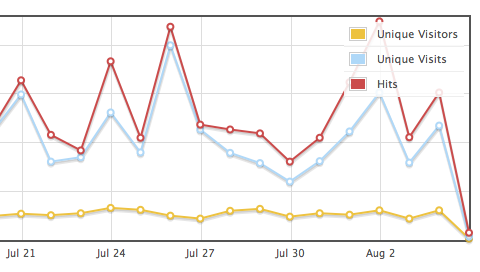
As well as a site statistics module, with the active_users template tag and manager method you can also use django-request to show who is online in a certain time:
Request.objects.active_users(minutes=15)
To find the request overview page, please click on Requests inside the admin, then “Overview” on the top right, next to “add request”.
Requirements
Python: 3.8, 3.9, 3.10, 3.11, 3.12, 3.13, 3.14
Django: 4.2, 5.0, 5.1, 5.2, 6.0
python-dateutil
django-request 1.5.1 is the last version that supports Django 1.4, 1.5, 1.6.
django-request 1.5.4 is the last version that supports Django 1.7, 1.8, 1.9.
django-request 1.5.5 is the last version that supports Django 1.10.
django-request 1.5.6 is the last version that supports Django 1.11, 2.0, 2.1, 3.0, 3.1, and Python 2.7 and 3.4.
django-request 1.6.3 is the last version that supports Django 2.2, 3.2, 4.0, 4.1, and Python 3.6 and 3.7.
Installation
Put 'request' in your INSTALLED_APPS setting.
Run the command manage.py migrate.
Add request.middleware.RequestMiddleware to MIDDLEWARE. If you use django.contrib.auth.middleware.AuthenticationMiddleware, place the RequestMiddleware after it. If you use django.contrib.flatpages.middleware.FlatpageFallbackMiddleware place request.middleware.RequestMiddleware before it else flatpages will be marked as error pages in the admin panel.
Add REQUEST_BASE_URL to your settings with the base URL of your site (e.g. https://www.my.site/). This is used to calculate unique visitors and top referrers. REQUEST_BASE_URL defaults to 'http://%s' % Site.objects.get_current().domain.
Detailed documentation
For a detailed documentation of django-request, or how to install django-request please see: django-request or the docs/ directory.
3 maintainers


Metadata
3 maintainers
Release files for django-request 1.7.1
For a detailed explanation of source distributions (sdists) and built distributions (wheels), please see the package formats documentation.
Source distribution (sdist)
| File | Size | Uploaded | Provenance | |
|---|---|---|---|---|
| django_request-1.7.1.tar.gz | 80.8 kB | Without provenance | Details |
Built distribution (wheel)
| File | Interpreter | ABI | Platform | Reset |
|---|---|---|---|---|
| django_request-1.7.1-py3-none-any.whl | Python 3 | none | any | Details |
Total release size: 165.9 kB
Release files / django_request-1.7.1.tar.gz
| Download URL | django_request-1.7.1.tar.gz |
|---|---|
| Size | 80.8 kB |
| Tags | Source |
|
SHA-256 checksum How to use checksums |
a4c9dcfe5a9c61765f26e98269df2b8de492fa319ed0eacd41c8bcd4d7b181e4
|
|
BLAKE2b-256 checksum How to use checksums |
0e8bd490d2a1f61bc1f33d42765644b46b356ee3056bd892ecf1fee45f94ac28
|
| Upload date | |
|
Uploaded using Trusted Publishing? What is trusted publishing? |
No |
| Uploaded via |
twine/6.1.0 CPython/3.12.3
|
Release files / django_request-1.7.1-py3-none-any.whl
| Download URL | django_request-1.7.1-py3-none-any.whl |
|---|---|
| Size | 85.1 kB |
| Tags | Python 3 |
|
SHA-256 checksum How to use checksums |
5c386fe66c056999cefafb700c7e81c57e011b43574a052689bdf30fb7bfa023
|
|
BLAKE2b-256 checksum How to use checksums |
94cf89ec73c050cb68a73d18c32bc1af3532274cc89041cf5a3b391270767545
|
| Upload date | |
|
Uploaded using Trusted Publishing? What is trusted publishing? |
No |
| Uploaded via |
twine/6.1.0 CPython/3.12.3
|
Security for django-request 1.7.1
Provenance
Provenance describes where a file came from. On PyPI, provenance is shared via attestations, which provide a verifiable record of the build or publishing details. View details, limitations and caveats.
No provenance found
None of the files in this release were uploaded with provenance metadata.
A note on package security
PyPI is a repository for distributing packages, not a service for auditing them. While third-party security researchers and our staff do their best to detect and remove malicious packages, PyPI cannot guarantee the quality, security or suitability of any given package.
To learn more about protecting yourself from malicious actors, visit our package security documentation.














