
django-zxcvbn-password-validator
A translatable password validator for django, based on zxcvbn-python and available with pip.
Unlike rule-based validators (minimum length, must contain a digit...), zxcvbn estimates actual password strength using pattern matching, common password dictionaries, and keyboard layout analysis. It provides meaningful, actionable feedback to help users create stronger passwords.
Professional support for django-zxcvbn-password-validator is available as part of the Tidelift Subscription




How to use
Install the package:
pip install django-zxcvbn-password-validator
Add 'django_zxcvbn_password_validator' in the INSTALLED_APPS:
INSTALLED_APPS = [
    # ...
    "django_zxcvbn_password_validator"
]
Modify AUTH_PASSWORD_VALIDATORS:
AUTH_PASSWORD_VALIDATORS = [
    {
        "NAME": "django.contrib.auth.password_validation.UserAttributeSimilarityValidator",
    },
    {
        "NAME": "django_zxcvbn_password_validator.ZxcvbnPasswordValidator",
    },
    # ...
]
You could choose to use zxcvbn alone, but using it alongside Django's
UserAttributeSimilarityValidator is recommended.
Finally, you can set the PASSWORD_MINIMAL_STRENGTH to your liking (default is 2),
every password scoring lower than this number will be rejected:
# 0 too guessable: risky password. (guesses < 10^3)
# 1 very guessable: protection from throttled online attacks.
# (guesses < 10^6)
# 2 somewhat guessable: protection from unthrottled online attacks.
# (guesses < 10^8)
# 3 safely unguessable: moderate protection from offline slow-hash scenario.
# (guesses < 10^10)
# 4 very unguessable: strong protection from offline slow-hash scenario.
# (guesses >= 10^10)
PASSWORD_MINIMAL_STRENGTH = 0 if DEBUG else 4
You can also provide a project-specific list of terms a password should not resemble
(your company name, product name, etc.) with PASSWORD_EXTRA_DICTIONARY. These are fed
to zxcvbn on every check, in addition to the user's own attributes:
PASSWORD_EXTRA_DICTIONARY = ["AcmeCorp", "RocketWidget"]
If the password is not strong enough, we provide errors explaining what you need to do:

The error messages are translated to your target language (even the strings given by zxcvbn that are in English only):

Checking strength without raising
validate() raises a ValidationError when a password is too weak, which is what
Django's auth machinery expects. If you instead want to inspect a password's strength
— for example to power a live strength meter — use get_strength(), which never raises
for a weak password:
from django_zxcvbn_password_validator import ZxcvbnPasswordValidator

strength = ZxcvbnPasswordValidator().get_strength("p@sswOrd1", user=request.user)
# {
#     "score": 1,                  # zxcvbn score, 0 (worst) to 4 (best)
#     "minimal_strength": 4,       # your PASSWORD_MINIMAL_STRENGTH
#     "acceptable": False,         # score >= minimal_strength
#     "crack_time_seconds": 2.0,   # estimated offline crack time
#     "crack_time_display": "2 seconds",          # the same, translated
#     "warning": "This is similar to a commonly used password",  # translated
#     "suggestions": ["Add another word or two. Uncommon words are better"],  # translated
# }
The warning, suggestions and crack_time_display fields are translated to the
active language, just like the validation errors. get_strength() still raises
ValidationError if the password exceeds zxcvbn's maximal length.
Compatibility
Requires Django 2+ and Python 3.6+. Note that Python 3.6 and 3.7 are not tested in CI anymore (GitHub Actions no longer provides runners for them), so while they should work, there is no guarantee.
Translating the project
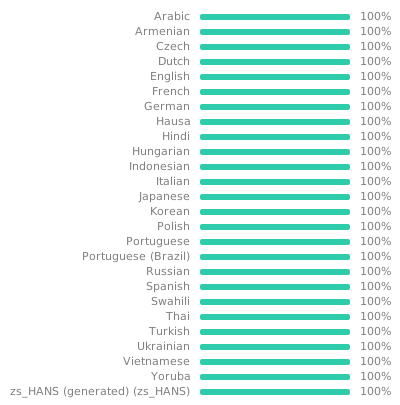
This project is available in 131 languages. Your contribution would be very appreciated if you know a language that is not yet available or if you want to improve an existing translation (especially AI-generated ones). See how to contribute
Translators
- Andrés Martano: Brazilian Portuguese
- eruedin: Lingala
- itsmechinmoy: Assamese
- Lionel Sausin: French
- Michal Čihař: Czech
- Pierre Sassoulas: French
- RViktor: Hungarian
- Thom Wiggers: Dutch
- Unai Loidi: Basque
- Claude AI: Afrikaans, Akan, Albanian, Amharic, Arabic, Armenian, Assamese, Azerbaijani, Belarusian, Bengali, Bosnian, Brazilian Portuguese (corrections), Breton, Bulgarian, Burmese, Cantonese, Catalan, Cebuano, Chichewa, Chinese Simplified, Chinese Traditional, Corsican, Croatian, Danish, Esperanto, Estonian, Ewe, Faroese, Filipino, Finnish, Fulah, Galician, Georgian, German, Greek, Gujarati, Hausa, Hawaiian, Hebrew, Hindi, Icelandic, Igbo, Indonesian, Irish, Italian, Japanese, Javanese, Kannada, Kazakh, Khmer, Kinyarwanda, Kirundi, Korean, Kurdish, Kyrgyz, Lao, Latin, Latvian, Lingala, Lithuanian, Luganda, Luxembourgish, Macedonian, Malagasy, Malay, Malayalam, Maltese, Maori, Marathi, Mongolian, Nepali, Northern Ndebele, Northern Sami, Norwegian Bokmål, Occitan, Odia, Oromo, Pashto, Persian, Polish, Portuguese, Punjabi, Romanian, Russian, Samoan, Sango, Sardinian, Scottish Gaelic, Serbian, Sesotho, Shona, Sindhi, Sinhala, Slovak, Slovenian, Somali, Southern Ndebele, Spanish, Sundanese, Swahili, Swati, Swedish, Tajik, Tamil, Telugu, Thai, Tibetan, Tigrinya, Tongan, Tsonga, Tswana, Turkish, Turkmen, Twi, Ukrainian, Urdu, Uzbek, Venda, Vietnamese, Welsh, Western Frisian, Wolof, Xhosa, Yiddish, Yoruba, Zulu
1 maintainer

Release files for django-zxcvbn-password-validator 1.7.0
For a detailed explanation of source distributions (sdists) and built distributions (wheels), please see the package formats documentation.
Source distribution (sdist)
| File | Size | Uploaded | |
|---|---|---|---|
| django_zxcvbn_password_validator-1.7.0.tar.gz | 346.0 kB | Details |
Built distribution (wheel)
| File | Interpreter | ABI | Platform | Reset |
|---|---|---|---|---|
| django_zxcvbn_password_validator-1.7.0-py3-none-any.whl | Python 3 | none | any | Details |
Total release size:1.1 MB
Release files / django_zxcvbn_password_validator-1.7.0.tar.gz
| Download URL | django_zxcvbn_password_validator-1.7.0.tar.gz |
|---|---|
| Size | 346.0 kB |
| Tags | Source |
|
SHA-256 checksum How to use checksums |
ef603ab1e0c8cd658c83519998a9bd2fda275497474cb512e8cfcff5110bf9c5
|
|
BLAKE2b-256 checksum How to use checksums |
558a2b193220aa3d9da2bca2899aa954842a558d9078868b065af3f348f5f973
|
| Upload date | |
|
Uploaded using Trusted Publishing? What is trusted publishing? |
No |
| Uploaded via |
twine/6.2.0 CPython/3.11.15
|
Release files / django_zxcvbn_password_validator-1.7.0-py3-none-any.whl
| Download URL | django_zxcvbn_password_validator-1.7.0-py3-none-any.whl |
|---|---|
| Size | 728.3 kB |
| Tags | Python 3 |
|
SHA-256 checksum How to use checksums |
b59fcf99a72f369cb7b09ff67e9092a563ca97baebc0263ce82623b5e173d353
|
|
BLAKE2b-256 checksum How to use checksums |
3c91428a464d82dac53765bc186019d60e7fe97ea599962f079d6a6325aee53d
|
| Upload date | |
|
Uploaded using Trusted Publishing? What is trusted publishing? |
No |
| Uploaded via |
twine/6.2.0 CPython/3.11.15
|














