




DSR
The program DSR consists of a text database with fragments of molecules and the DSR program. It acts as a preprocessor for SHELXL .res files. The user inserts a special command in the SHELXL .res file and the DSR program reads this information to put a molecule or fragment with the desired atoms on the position of the target atoms or q-peaks in the unit cell. Bond restraints can be either applied from the database to the molecule or automatically generated.
I apologize for the messy code. This was my first bigger project...
You have either a command line version:
C:\Users\daniel>dsr
----------------------------------------------------- D S R - v238 -------------------------------------
Disordered Structure Refinement (DSR)

Example DSR .res file command line:
REM DSR PUT/REPLACE "Fragment" WITH C1 C2 C3 ON Q1 Q2 Q3 PART 1 OCC -21 =
  RESI DFIX
---------------------------------------------------------------------------------------------------------
   PUT:     Just put the fragment source atoms here.
   REPLACE: Replace atoms of PART 0 in 1.3 A distance around target atoms.
---------------------------------------------------------------------------------------------------------

optional arguments:
  -h, --help            show this help message and exit
  -r "res file" ["res file" ...]
                        res file with DSR command
  -re "res file" ["res file" ...]
                        res file with DSR command (write restraints to external file)
  -e "fragment"         export fragment as .res/.png file
  -c "fragment"         export fragment to clipboard
  -t                    inverts the current fragment
  -i "tgz file"         import a fragment from GRADE (needs .tgz file)
  -l                    list names of all database entries
  -s "string"           search the database for a name
  -g                    keep group rigid (no restraints)
  -u                    Update DSR to the most current version
  -n                    do not refine after fragment transfer
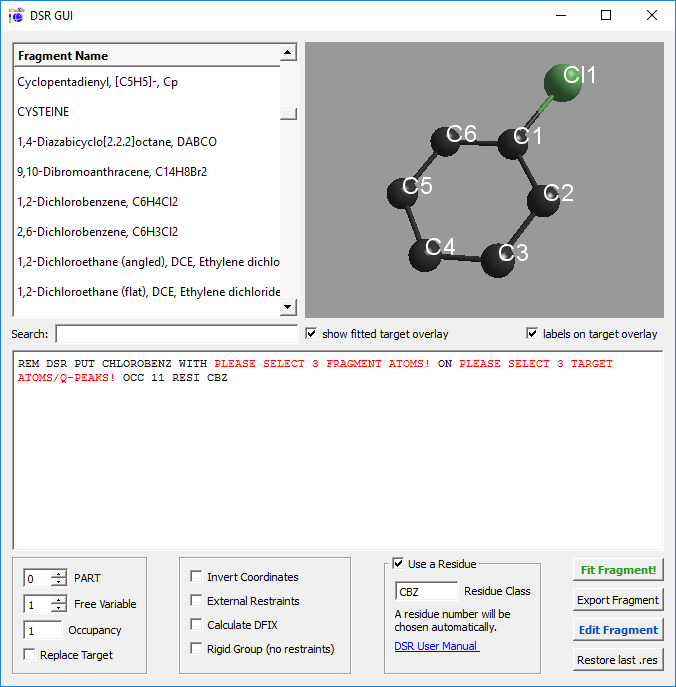
Or a graphical user interface in ShelXle:

1 maintainer

Release files for dsr-shelx 243
For a detailed explanation of source distributions (sdists) and built distributions (wheels), please see the package formats documentation.
Source distribution (sdist)
| File | Size | Uploaded | |
|---|---|---|---|
| dsr_shelx-243.tar.gz | 4.4 MB | Details |
Built distribution (wheel)
| File | Interpreter | ABI | Platform | Reset |
|---|---|---|---|---|
| dsr_shelx-243-py3-none-any.whl | Python 3 | none | any | Details |
Total release size:5.9 MB
Release files / dsr_shelx-243.tar.gz
| Download URL | dsr_shelx-243.tar.gz |
|---|---|
| Size | 4.4 MB |
| Tags | Source |
|
SHA-256 checksum How to use checksums |
514eae2ba60b18a80ba07e6800cd00bc07fcf53bb7ce636463f1f24f2dc493df
|
|
BLAKE2b-256 checksum How to use checksums |
12d4630665921879a296caf2592d6d72e05a395723376dccd5a278b8473f3acb
|
| Upload date | |
|
Uploaded using Trusted Publishing? What is trusted publishing? |
Yes |
| Uploaded via |
twine/7.0.0 CPython/3.13.14
|
Provenance
Provenance describes where a file came from. On PyPI, provenance is shared via attestations, which provide a verifiable record of the build or publishing details. View details, limitations and caveats.


PyPI Publish Attestation
PyPI verified that this artifact, at this checksum, originated from the publisher listed below.
Signed by GitHub Actions, verified by PyPI on Aug 12, 2026.
Transparency logRelease files / dsr_shelx-243-py3-none-any.whl
| Download URL | dsr_shelx-243-py3-none-any.whl |
|---|---|
| Size | 1.5 MB |
| Tags | Python 3 |
|
SHA-256 checksum How to use checksums |
b7e18490d2b185335812a37d5bc4d786ff5f5c79a58e68c905671773fd2ada61
|
|
BLAKE2b-256 checksum How to use checksums |
befa074d3497df3ede5d24fbb511af270976d8be07a71092cc097426c7ea10fa
|
| Upload date | |
|
Uploaded using Trusted Publishing? What is trusted publishing? |
Yes |
| Uploaded via |
twine/7.0.0 CPython/3.13.14
|
Provenance
Provenance describes where a file came from. On PyPI, provenance is shared via attestations, which provide a verifiable record of the build or publishing details. View details, limitations and caveats.
PyPI Publish Attestation
PyPI verified that this artifact, at this checksum, originated from the publisher listed below.
Signed by GitHub Actions, verified by PyPI on Aug 12, 2026.
Transparency log













