
dytr: Dynamic Transformer for Multi-Task Learning with Continual Learning Support

Project description
dytr - Dynamic Transformer Library
dytr is a flexible PyTorch library for multi-task learning with dynamic transformer architectures. Train multiple tasks sequentially or simultaneously while preserving performance on previous tasks through built-in continual learning techniques. it also supports to finetune and modify pretrained model such as bert.




Build dynamic transformers that learn multiple tasks.
🚀 What's New in v0.1.3
✨ Universal Pretrained Model Loader
Load ANY model architecture directly:
| Architecture | Supported Models | Loads As |
|---|---|---|
| Encoder-only | BERT, RoBERTa, DistilBERT, ALBERT | Shared encoder |
| Decoder-only | GPT-2, LLaMA, Mistral, Phi, Gemma, Qwen | Causal LM task |
| Encoder-decoder | T5, BART, MT5, Pegasus, Flan-T5 | Seq2Seq task |
from dytr import PretrainedModelLoader

loader = PretrainedModelLoader()
model = loader.load_pretrained("gpt2", task_name="text_generation")
🔧 LoRA Training Support
| Mode | Description |
|---|---|
| Single | One LoRA adapter across all tasks |
| Multi-Task | Separate LoRA adapters per task |
| Progressive | 4-phase training (Warmup → Expansion → Hybrid → Native) |
from dytr.training.lora import LoRATrainer

trainer = LoRATrainer(model, config, mode="multi", rank=8)
model = trainer.train(task_configs, train_datasets, val_datasets)
Why dytr?
- 🎯 Multi-Task Ready - Train classification, generation, and sequence tasks in one model
- 🧠 Never Forgets - Built-in EWC and experience replay prevent catastrophic forgetting
- 🔧 No Black Box - Full control over architecture, understand every component
- ⚡ Lightweight - Pure PyTorch, minimal dependencies
- 📦 Pretrained Support - Load BERT, RoBERTa, and more as your encoder backbone and fine tune it on multiple tasks.
- 🔧 LoRA Support - Parameter-efficient fine-tuning with fewer parameters
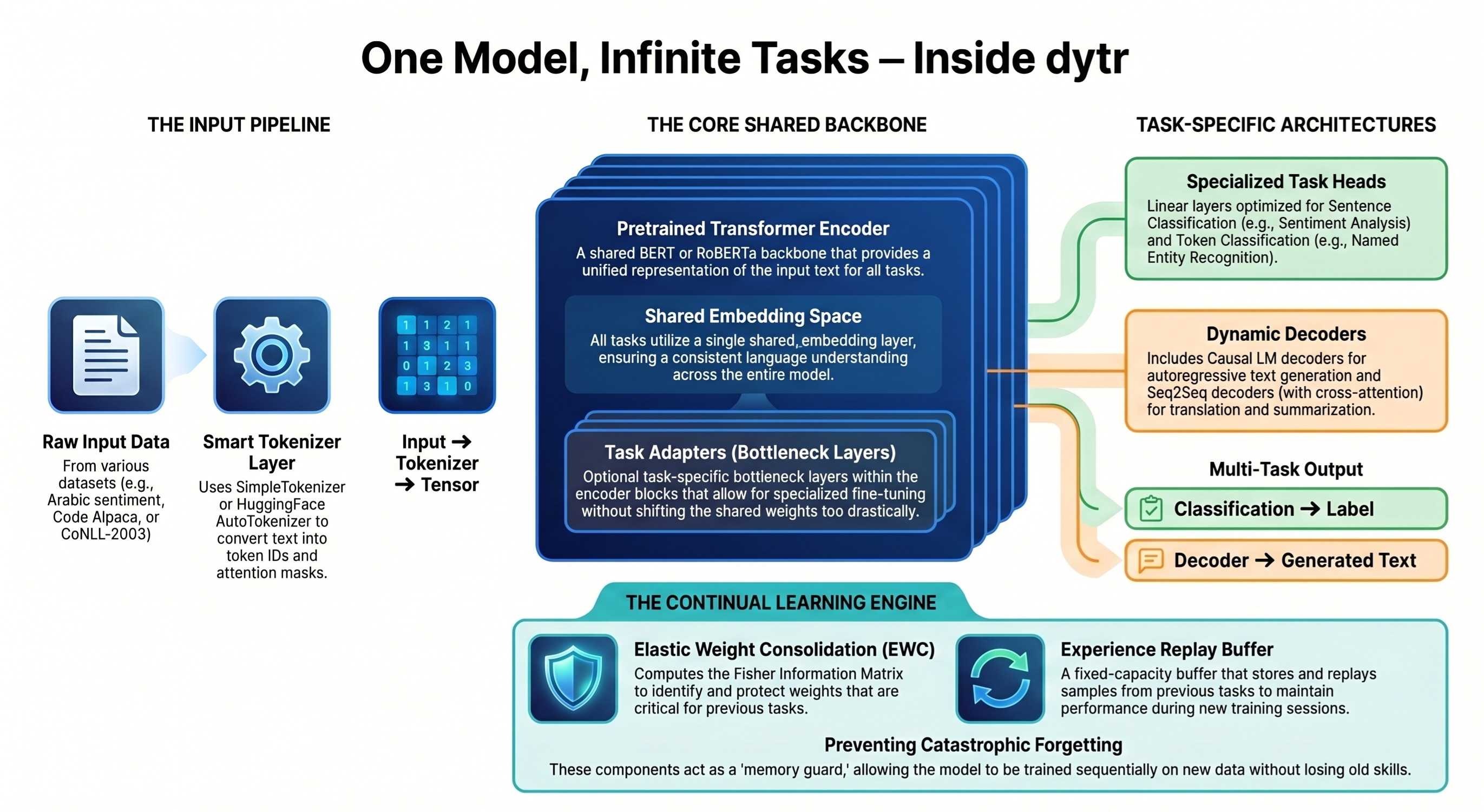
Architecture Overview
Installation
pip install dytr
pip install git+https://github.com/AAlsubari/dytr.git
Quick Start
from dytr import DynamicTransformer, ModelConfig, TaskConfig, TrainingStrategy, Trainer, SingleDatasetProcessing
import pandas as pd

# 1. Configure your transformer
config = ModelConfig(
    embed_dim=256,
    num_layers=6,
    num_heads=8,
    max_seq_len=256
)

# 2. Create the model
model = DynamicTransformer(config)

# data loading and processing
train_data = pd.DataFrame({
    'text': ['Great movie!', 'Terrible film.', 'Amazing acting!', 'Boring plot.'],
    'label': [1, 0, 1, 0]
})
train_dataset = SingleDatasetProcessing(
    df=train_data,
    tokenizer=model.tokenizer,
    max_len=128,
    task_name="sentiment_analysis",
    strategy=TrainingStrategy.SENTENCE_CLASSIFICATION,
    text_column="text",
    label_column="label"
)
# 3. Add a task
task = TaskConfig(
    task_name="sentiment_analysis",
    training_strategy=TrainingStrategy.SENTENCE_CLASSIFICATION,
    num_labels=2,# train_data.num_labels
)
#model.add_task(task) # not require it will be add automatically during the training process

# Initialize trainer and train
trainer = Trainer(model, config, exp_dir="./experiments")
train_datasets = {"sentiment_analysis": (train_dataset, TrainingStrategy.SENTENCE_CLASSIFICATION)}
model = trainer.train([task], train_datasets, {})# you can set more than one for list of tasks and dataset for multitasks training

# 4. Generate predictions
result = model.generate("This product is amazing!", task_name="sentiment_analysis")
print(f"Prediction: {result['prediction']}")

# Save the entire multi-task model
model.save_model("multi_task_model.pt")

# Load the model
loaded_model = DynamicTransformer.load_model("multi_task_model.pt")
Core Capabilities
Multiple Training Strategies
| Strategy | Purpose | Use Case |
|---|---|---|
| Causal LM | Autoregressive text generation | Chatbots, content creation |
| Seq2Seq | Input to output transformation | Translation, summarization |
| Sentence Classification | Document-level categorization | Sentiment, topic detection |
| Token Classification | Token-level labeling | Named entity recognition, POS tagging |
Continual Learning
Train tasks sequentially without losing previous knowledge:
config = ModelConfig(
    use_ewc=True,              # Protect important weights
    use_replay=True,           # Replay old samples
    use_task_adapters=True,    # Task-specific modules
    ewc_lambda=1000.0,
    replay_buffer_size=2000
)

model = DynamicTransformer(config)

# Train tasks one after another
for task in task_list:
    model.add_task(task)
    trainer.train([task], train_data, val_data)
    # Previous tasks remain accurate
    # The trainer automatically handles EWC and replay buffer, but you should add the samples to the pretrained model
Universal Pretrained Model Loader
Load any model architecture as your backbone:
from dytr import PretrainedModelLoader

loader = PretrainedModelLoader()

# Encoder-only (BERT) → Shared encoder
model = loader.load_pretrained("bert-base-uncased")

# Decoder-only (GPT-2) → Causal LM task
model = loader.load_pretrained("gpt2", task_name="generation")

# Encoder-decoder (T5) → Seq2Seq task
model = loader.load_pretrained("t5-small", task_name="translation")
Pretrained Encoders
Load powerful encoders as your backbone and extend them with tasks:
from dytr import PretrainedModelLoader
model_name='prajjwal1/bert-tiny'
loader = PretrainedModelLoader()
config = ModelConfig(tokenizer_name=model_name, per_device_train_batch_size=32, num_train_epochs=3, per_device_eval_batch_size=8, special_tokens={}, use_task_adapters=False, use_ewc=True, use_replay=True, use_rotary_embedding=False, training_from_scratch=False)

# Load pretrained BERT as your encoder
model = loader.load_pretrained(model_name, config)

# Now add your own tasks - the model is fully dytr compatible
class_train = pd.DataFrame(
        {
            "text": [
                "Great product!",
                "Poor quality.",
                "Excellent service!",
                "Very disappointed.",
                "Highly recommended!",
            ],
            "label": [1, 0, 1, 0, 1],
        }
    )
classification_task = TaskConfig(
        task_name="sentiment",
        training_strategy=TrainingStrategy.SENTENCE_CLASSIFICATION,
        num_labels=2,
        text_column="text",
        label_column="label",
        max_length=128,
    )
class_dataset = SingleDatasetProcessing(
        df=class_train,
        tokenizer=model.tokenizer,
        max_len=classification_task.max_length,
        task_name=classification_task.task_name,
        strategy=classification_task.training_strategy,
        num_labels=classification_task.num_labels,
        text_column=classification_task.text_column,
        label_column=classification_task.label_column,
    )
# Causal LM task data (text generation)
lm_train = pd.DataFrame(
        {
            "text": [
                "The sun rises in the east.",
                "Cats are adorable animals.",
                "Machine learning is fascinating.",
                "Python is a great programming language.",
                "Deep learning powers modern AI.",
            ]
        }
    )
lm_task = TaskConfig(
        task_name="text_generation",
        training_strategy=TrainingStrategy.CAUSAL_LM,
        max_length=256,
    )
lm_dataset = SingleDatasetProcessing(
        df=lm_train,
        tokenizer=model.tokenizer,
        max_len=lm_task.max_length,
        task_name=lm_task.task_name,
        strategy=lm_task.training_strategy,
        text_column="text",
    )
train_datasets = {
        classification_task.task_name: (class_dataset, classification_task.training_strategy),
        lm_task.task_name: (lm_dataset, lm_task.training_strategy),
    }
val_datasets = {
        #classification_task.task_name: (class_val_dataset, classification_task.training_strategy)
    }

# 6. Train model
print("\n6. Training model...")
trainer = Trainer(model, config, exp_dir="./multi_task_experiments")
model = trainer.train([classification_task, lm_task], train_datasets, val_datasets)

#model = trainer.train([ lm_task], train_datasets, val_datasets)
test_texts = ["This is amazing!", "I hate this."]
for text in test_texts:
      result = model.generate(text, task_name="sentiment")
      sentiment = "POSITIVE" if result["prediction"] == 1 else "NEGATIVE"
      print(f"      {text} -> {sentiment}")

# Test generation
print("\n   Text generation test:")
prompt = "The future of technology"
generated = model.generate(prompt, task_name="text_generation", max_new_tokens=20)
print(f"      Prompt: {prompt}")
print(f"      Generated: {generated}")


#model.add_task(sentiment_task)
#model.add_task(ner_task)
#model.add_task(translation_task)

# Train, generate, and use just like any dytr model
Task-Specific Learning Rates
Different components learn at different speeds:
config = ModelConfig(
    learning_rate=3e-4,
    head_lr_mult=2.0,      # Task heads: fast adaptation
    decoder_lr_mult=0.5,   # Decoders: moderate
    shared_lr_mult=0.1     # Shared encoder: preserve knowledge
)
Who Should Use dytr?
| Audience | Why It Matters |
|---|---|
| Researchers | Customize every aspect of the transformer architecture, Test continual learning algorithms with EWC and experience replay, experiment with multi-task architectures, Experiment with task-specific learning rates and adapters, Analyze forgetting behavior across sequential tasks |
| Developers | Add new tasks without retraining from scratch, Load pretrained models and extend them with your own tasks, Build production-ready multi-task systems without complex dependencies |
| Students | Understand transformers from scratch with transparent, readable code, Visualize the impact of hyperparameters on model size, Learn multi-task learning concepts hands-on |
| Organizations | Deploy single models that handle multiple tasks efficiently , Deploy lighter, faster inference systems, Maintain knowledge across task updates with continual learning |
Key Differentiators
- Full Transparency - No hidden complexity, understand every component
- Continual Learning First - Built from the ground up for sequential task learning
- Truly Dynamic - Add or remove tasks without retraining from scratch
- Pure PyTorch - No heavy dependencies, easy to customize
Requirements
- Python 3.8+
- PyTorch 1.10+
- NumPy
- pandas
- scikit-learn
- tqdm
- requests
Documentation
- ModelConfig: Architecture, training, and continual learning parameters
- TaskConfig: Dataset configuration, column mapping, task-specific settings
- TrainingStrategy: Causal LM, Seq2Seq, Sentence Classification, Token Classification
- PretrainedModelLoader: Pretrain models loader for encoder-only, decoder-only, and encoder-decoder models
- LoRATrainer: Parameter-efficient fine-tuning with single, multi-task, and progressive modes
License
Apache License 2.0
Author
Dr. Akram Alsubari
Contributing
Contributions are welcome! Open issues or share your use cases.
Support and Contact
For questions, issues, or suggestions: For questions, issues, or suggestions:
-
📧 Email: akram.alsubari@outlook.com
-
🔗 LinkedIn: https://www.linkedin.com/in/akram-alsubari/
-
📱 Connect: Feel free to reach out for collaborations, research discussions, or feedback
-
🎓 Research Interests: Natural Language Processing, Deep Learning, Transformers, Continual Learning, Multi-Task Learning, Large Language Models
Build once. Learn multiple tasks. Never forget.


Download files
Download the file for your platform. If you're not sure which to choose, learn more about installing packages.
Source Distribution
Built Distribution
Filter files by name, interpreter, ABI, and platform.
If you're not sure about the file name format, learn more about wheel file names.
Copy a direct link to the current filters
File details
Details for the file dytr-0.1.4.tar.gz.
File metadata
- Download URL: dytr-0.1.4.tar.gz
- Upload date:
- Size: 70.5 kB
- Tags: Source
- Uploaded using Trusted Publishing? No
- Uploaded via: twine/6.1.0 CPython/3.13.12
File hashes
| Algorithm | Hash digest | |
|---|---|---|
| SHA256 |
5c4a2a90c459e054085e219b6c1a5850cf75989f966e79570f3764791c716e51
|
|
| MD5 |
55126adab49cf6a598ff34183cf75c4c
|
|
| BLAKE2b-256 |
01056b811ede8bb8d80d5068343943fd2f2ef3db4afc5cba52c283e993a2203c
|
File details
Details for the file dytr-0.1.4-py3-none-any.whl.
File metadata
- Download URL: dytr-0.1.4-py3-none-any.whl
- Upload date:
- Size: 80.3 kB
- Tags: Python 3
- Uploaded using Trusted Publishing? No
- Uploaded via: twine/6.1.0 CPython/3.13.12
File hashes
| Algorithm | Hash digest | |
|---|---|---|
| SHA256 |
03cdd01ffb9c2ae8df9c1bc2b359685f3bad0e0811e9d0894725c605b3e1b557
|
|
| MD5 |
e3a54c5a6bbc934778e3c797b8a51244
|
|
| BLAKE2b-256 |
224c92070e8503ae5ad61a2704edd38228a756795b16fb78f9baadcce29090ba
|






