
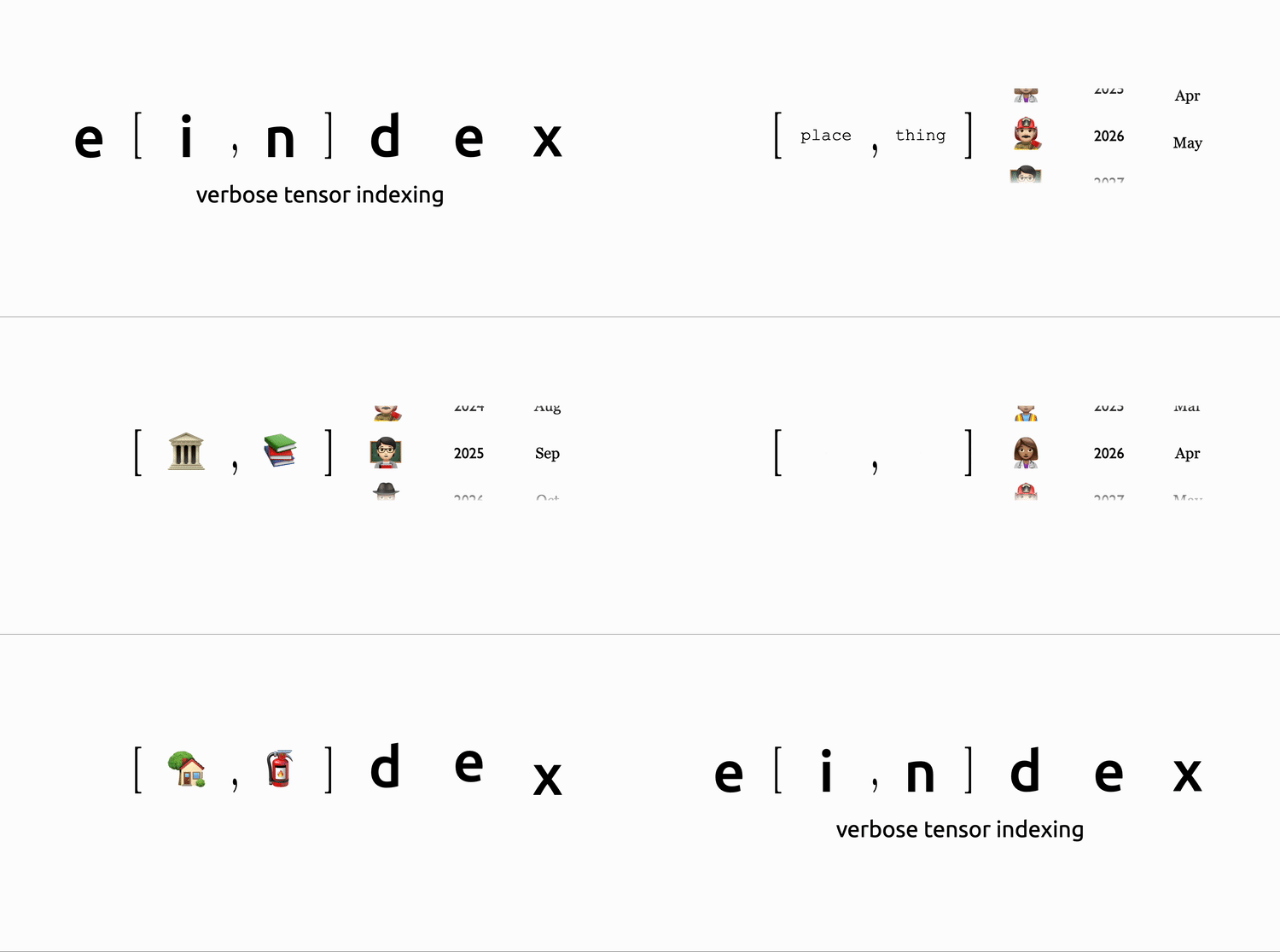
eindex
Concept of multidimensional indexing for tensors
Example of K-means clustering
Plain numpy
def kmeans(init_centers, X, n_iterations: int):
    n_clusters, n_dim = init_centers.shape
    n_onservations, n_dim = X.shape

    centers = init_centers.copy()
    for _ in range(n_iterations):
        d = cdist(centers, X)
        clusters = np.argmin(d, axis=0)
        new_centers_sum = np.zeros_like(centers)
        indices_dim = np.arange(n_dim)[None, :]
        np.add.at(new_centers_sum, (clusters[:, None], indices_dim), X)
        cluster_counts = np.bincount(clusters, minlength=n_clusters)
        centers = new_centers_sum / cluster_counts[:, None]
    return centers
With eindex
def kmeans_eindex(init_centers, X, n_iterations: int):
    centers = init_centers
    for _ in range(n_iterations):
        d = cdist(centers, X)
        clusters = EX.argmin(d, 'cluster i -> [cluster] i')
        centers = EX.scatter(X, clusters, 'i c, [cluster] i -> cluster c',
                             agg='mean', cluster=len(centers))
    return centers
Tutorial notebook
Goals
- Form helpful 'language' to think about indexing and index-related operations. Tools shape minds
- Cover most common cases of multidimensional indexing that are hard to implement using the standard API
- Approach should be applicable to most common tensor frameworks, autograd should work out-of-the-box
- Aim for readable and reliable code
- Allow simple adoption in existing codebases
- Implementation should base on fairly common tensor operations. No custom kernels allowed.
- Complexity should be visible: execution plan for every operation should form a static graph. Structure of the graph depends on the pattern, but not on tensor arguments.
Non-goals: there is no goal to develop 'the shortest notation' or 'the most advanced/comprehensive tool for indexing' or 'cover as many operations as possible' or 'completely replace default indexing'.
Examples
Follow tutorial first to learn about all operations provided.
Click to unfold
- how do I select a single embedding from every image in a batch?
Let's say you have pairs of images and captions, and you want to take closest embedding:
score = einsum(images_bhwc, sentences_btc, 'b h w c, b token c -> b h w token')
closest_index = argmax(score, 'b h w token -> [h, w] b token')
closest_emb = gather('b h w c, [h, w] b token -> b t c', images_bhwc, closest_index)
To adjust this example for video not image, replace 'h w' to 'h w t'. Yes, that simple.
- how to collect top-1 or top-3 predicted word for every position in audio/text?
[most_likely_words] = argmax(prob_tbc, 't b w -> [w] t b')
[top_words] = argsort(prob_tbc, 't b w -> [w] t b order')[..., -3:]
- how to average embeddings over neighbors in a graph?
# without batch (single graph)
gather('vin c, [vin, vout] edge -> vout', embeddings, edges)
# with batch (multile graphs)
gather('b vin c, [b, vin, vout] edge -> b vout', embeddings, edges)
- can eindex help with (complex) positional embeddings?
If we're speaking about trainable abspos, it can be just saved as emb_hwc and added every time to a batch.
There is no need for indexing.
But it can be very helpful for complex scenarios: for example in T5-relpos, when a bias is added to every logit before softmax-ing to compute attention? That's simple to implement for 1d, and much harder for 2d/3d. Let's implement for 2d with eindex:
N = None
pos # [I, J] i j
pos1 = pos[:, :, :, N, N]
pos2 = pos[:, N, N, :, :]
xy_diff = (pos1 - pos2) % image_side  # we make shifts positive by wrapping
attention_bias = gather('i j head , [i, j] i1 j1 i2 j2 -> i1 j1 i2 j2 head', biases, xy_diff)
Note that we indeed encounter relative position (shift in x and y), which is not done in most implementations that deal with flat sequence instead.
In a similar way we could produce vector-shift attention (another typical version of relpos):
vector_shift = gather('i j head c, [i, j] i1 j1 i2 j2 -> i1 j1 i2 j2 head c', biases, xy_diff)
Implementation
Repo provides two implementation:
-
array api standard. This implementation is based on a standard that multiple frameworks pre-agreed to follow. Implementation uses only API from standard, so all available operations support all frameworks that follow the standard.
At some point this should become the one and the only implementation.
Here is the catch: current support of array api standard is poor, that's why the second implementation exists
-
numpy implementation
This independent implementation works right now.
Numpy implementation is great to test things out, and is handy for a number of non-DL applications as well.
Development Status
API looks solid, but breaking changes are still possible, so lock the version in your projects (e.g. eindex==0.1.0)
Related projects
Other projects you likely want to look at:
- tullio by Michael Abbott (@mcabbott) provides Julia macros with a high level of flexibility. Resulting operations are then compiled.
- torchdim by Zachary DeVito (@zdevito) introduces "dimension objects", which in particular allow convenient multi-dim indexing
- einindex is an einops-inspired prototype by Jonathan Malmaud (@malmaud) to develop multi-dim indexing notation.
(Also, that's why this package isn't called
einindex)
Contributing
We welcome the following contributions:
- next time you deal with multidimensional indexing, do this with eindex
Worked? → great - let us know; didn't work or unclear how to implement → post in discussions - if you feel you're already fluent in eindex, help others
- guides/tutorials/video-guides are very welcome, and will be linked
- If you want to translate tutorial to other language and post it somewhere - welcome
Discussions
Use github discussions for this project https://github.com/arogozhnikov/eindex/discussions
1 maintainer

Metadata
1 maintainer
Release files for eindex 0.1.0
For a detailed explanation of source distributions (sdists) and built distributions (wheels), please see the package formats documentation.
Source distribution (sdist)
| File | Size | Uploaded | Provenance | |
|---|---|---|---|---|
| eindex-0.1.0.tar.gz | 34.3 kB | Without provenance | Details |
Built distribution (wheel)
| File | Interpreter | ABI | Platform | Reset |
|---|---|---|---|---|
| eindex-0.1.0-py3-none-any.whl | Python 3 | none | any | Details |
Total release size: 48.0 kB
Release files / eindex-0.1.0.tar.gz
| Download URL | eindex-0.1.0.tar.gz |
|---|---|
| Size | 34.3 kB |
| Tags | Source |
|
SHA-256 checksum How to use checksums |
f7225c5e478663931a2ccf25adfff932fd80c942e7c507ca54b709f1b1524954
|
|
BLAKE2b-256 checksum How to use checksums |
d5f8faa6a4a97d1e10ee3b4494ce764aa82daa5916adf562ef5155ca5c632d26
|
| Upload date | |
|
Uploaded using Trusted Publishing? What is trusted publishing? |
No |
| Uploaded via |
python-httpx/0.23.3
|
Release files / eindex-0.1.0-py3-none-any.whl
| Download URL | eindex-0.1.0-py3-none-any.whl |
|---|---|
| Size | 13.6 kB |
| Tags | Python 3 |
|
SHA-256 checksum How to use checksums |
a806489c30bc2f6ae61417763bc062780d3816b69716c6a7e2419d9c6c80c7c1
|
|
BLAKE2b-256 checksum How to use checksums |
14d0a8307baae963d97aea356f8573108b74b60b123ae8caa25efffd8bf607fa
|
| Upload date | |
|
Uploaded using Trusted Publishing? What is trusted publishing? |
No |
| Uploaded via |
python-httpx/0.23.3
|
Security for eindex 0.1.0
Provenance
Provenance describes where a file came from. On PyPI, provenance is shared via attestations, which provide a verifiable record of the build or publishing details. View details, limitations and caveats.
No provenance found
None of the files in this release were uploaded with provenance metadata.
A note on package security
PyPI is a repository for distributing packages, not a service for auditing them. While third-party security researchers and our staff do their best to detect and remove malicious packages, PyPI cannot guarantee the quality, security or suitability of any given package.
To learn more about protecting yourself from malicious actors, visit our package security documentation.













