




Epitome
Pipeline for predicting ChIP-seq peaks in novel cell types using chromatin accessibility.
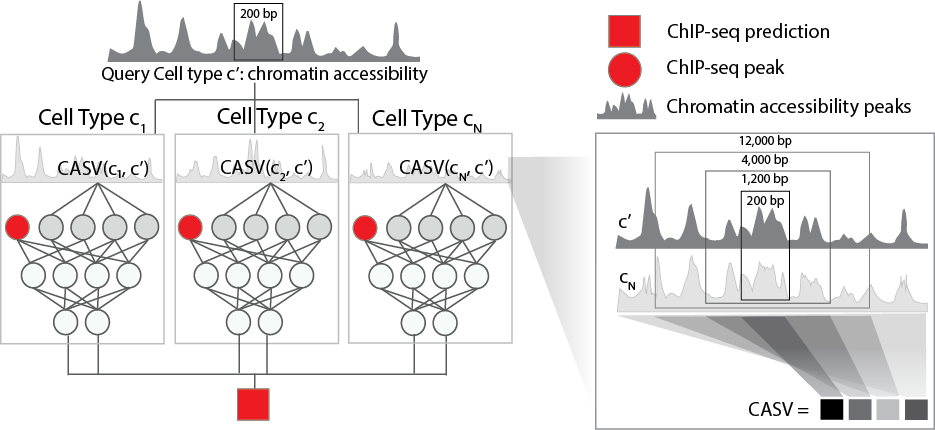
Epitome leverages chromatin accessibility (either DNase-seq or ATAC-seq) to predict epigenetic events in a novel cell type of interest. Such epigenetic events include transcription factor binding sites and histone modifications. Epitome computes chromatin accessibility similarity between ENCODE cell types and the novel cell type, and uses this information to transfer known epigentic signal to the novel cell type of interest.
Documentation
Epitome documentation is hosted at readthedocs. Documentation for Epitome includes tutorials for creating Epitome datasets, training, testing, and evaluated models.
Requirements
- conda
- python >= 3.6
Setup and Installation
- Create and activate a conda environment:
conda create --name EpitomeEnv python=3.6 pip
source activate EpitomeEnv
- Install Epitome:
pip install epitome
Training a Model
First, create an Epitome dataset that defines the cell types and ChIP-seq targets you want to train on,
    from epitome.dataset import *

    targets = ['CTCF','RAD21','SMC3']
    celltypes = ['K562', 'A549', 'GM12878']

    dataset = EpitomeDataset(targets=targets, cells=celltypes)
Now, you can create and train your model:
    from epitome.models import *

    model = EpitomeModel(dataset, test_celltypes = ["K562"])
    model.train(5000) # train for 5000 batches
Evaluate a Model:
model.test(1000) # evaluate how well the model performs on a validation chromosome
Using Epitome on your own dataset:
Epitome can perform genome wide predictions or region specific predictions on a sample that has either DNase-seq or ATAC-seq.
To score specific regions:
   chromatin_peak_file = ... # path to peak called ATAC-seq or DNase-seq in bed format
   regions_file = ...        # path to bed file of regions to score
   results = model.score_peak_file([chromatin_peak_file], regions_file)
To score on the whole genome:
   chromatin_peak_file = ... # path to peak called ATAC-seq or DNase-seq in bed format
   file_prefix = ...        # file to save compressed numpy predictions to.
   model.score_whole_genome([chromatin_peak_file], file_prefix)
Install Epitome for development
To build Epitome for development, run:
make develop
Running unit tests
make test
1 maintainer

Metadata
1 maintainer
Release files for epitome 0.0.1
For a detailed explanation of source distributions (sdists) and built distributions (wheels), please see the package formats documentation.
Source distribution (sdist)
| File | Size | Uploaded | Provenance | Actions |
|---|---|---|---|---|
| epitome-0.0.1.tar.gz | 40.7 kB | Without provenance | Details for epitome-0.0.1.tar.gz |
Built distribution (wheel)
| File | Interpreter | ABI | Platform | Actions Reset |
|---|---|---|---|---|
| epitome-0.0.1-py3.9.egg | Legacy Egg format | - | - | Details for epitome-0.0.1-py3.9.egg |
Total release size: 138.3 kB
Release files / epitome-0.0.1.tar.gz
| Download URL | epitome-0.0.1.tar.gz |
|---|---|
| Size | 40.7 kB |
| Tags | Source |
|
SHA-256 checksum How to use checksums |
b260b120074abe240fc9710520ae9ceadc99696550825428a7f6b3617835fb28
|
|
BLAKE2b-256 checksum How to use checksums |
fc3f18e18c72ff5d29dcaddc96f7437bab30bb8288157fccfe0d47c3b6f37f48
|
| Upload date | |
|
Uploaded using Trusted Publishing? What is trusted publishing? |
No |
| Uploaded via |
twine/3.4.2 importlib_metadata/4.8.1 pkginfo/1.7.1 requests/2.26.0 requests-toolbelt/0.9.1 tqdm/4.62.0 CPython/3.9.6
|
Release files / epitome-0.0.1-py3.9.egg
| Download URL | epitome-0.0.1-py3.9.egg |
|---|---|
| Size | 97.6 kB |
| Tags | Egg |
|
SHA-256 checksum How to use checksums |
18be680d3f7b2bbb0faeebc5b52d3038940b3310099c6f1b9dd05ba967cc3827
|
|
BLAKE2b-256 checksum How to use checksums |
f650d43031a6691a687829372133819ad5ac07c7a524884497cfa128814c3d4d
|
| Upload date | |
|
Uploaded using Trusted Publishing? What is trusted publishing? |
No |
| Uploaded via |
twine/3.4.2 importlib_metadata/4.8.1 pkginfo/1.7.1 requests/2.26.0 requests-toolbelt/0.9.1 tqdm/4.62.0 CPython/3.9.6
|
Security for epitome 0.0.1
Provenance
Provenance describes where a file came from. On PyPI, provenance is shared via attestations, which provide a verifiable record of the build or publishing details. View details, limitations and caveats.
No provenance found
None of the files in this release were uploaded with provenance metadata.
A note on package security
PyPI is a repository for distributing packages, not a service for auditing them. While third-party security researchers and our staff do their best to detect and remove malicious packages, PyPI cannot guarantee the quality, security or suitability of any given package.
To learn more about protecting yourself from malicious actors, visit our package security documentation.














