
EVM lab utilities
This package contains various tools to interact with the Ethereum virtual machine.
Project Structure
| Folder | Description |
|---|---|
| docs | Project documentation |
| evmlab | The evmlab package |
| utilities | Example utilities and proof-of-concepts |
| files | Sample trace files and trace logs |
| output | output directory for artefacts |
| templates | Web application templates (currently used with reproducer) |
| containers | Docker container files |
Installation
From source:
Consider creating a virtualenv.
#> virtualenv -p python3 .env3
#> . .env3/bin/activate
#> python3 -m pip install -r requirements.txt
#> python3 setup.py install
#> python3 -m evmlab  # verify installation
From PIP:
TODO: publish to pip!
#> python3 -m pip install evmlab
#> python3 -m evmlab[consolegui,abidecoder,docker]  # verify installation
EVMLab comes with a commandline utility that can be invoked by calling python3 -m evmlab <subcommand> <args>
Compiler
The 'compiler' is a tool to build evm binaries, using a pythonic way to construct the programs using assembly.
Here's an example that tests ecdsaRecover:
	p = compiler.Program()
	p.mstore(0 ,0x38d18acb67d25c8bb9942764b62f18e17054f66a817bd4295423adf9ed98873e)
	v = 0x000000000000000000000000000000000000000000000000000000000000001b
	p.mstore(32   , v)
	p.mstore(64   ,0x723841761d213b60ac1cbf063207cbeba6c2725bcaf7c189e63f13d93fc1dc07)
	p.mstore(96   ,0x789d1dd423d25f0772d2748d60f7e4b81bb14d086eba8e8e8efb6dcff8a4ae02)
	p.call(0xfff,1,0,0,0x80,0x80,0x20)
	p.rreturn(140,20)
	code = p.bytecode()
Here's an example of stuffing JUMPDEST into a program:
	p = compiler.Program()
	p.jump(0x3)
	p.jumpdest()
	p.rreturn()
	for i in range(0,20000):
		p.op(JUMPDEST)

	return p.bytecode()
VM
The vm module contais some abstractions to run arbitrary virtual machines, primarily geth evm and parity's parity-evm.
Etherchain
The etherchain package contains an API for interacting with the Etherchain API.
Reproduce
An example app is reproduce.py which can reproduce an on-chain transaction as a totally local event, and run it in the evm.
The app takes a txhash, and
- Fetch the transaction data from an API.
- Mark (source, destination) as need-to-fetch
- Fetch balance and nonce at source, add to
genesis - Execute transaction on the
evm - If transaction has any externally reaching ops (BALANCE, EXTCODECOPY, CALL etc),
- Add those accounts as need-to-fetch
- Go back to 3 until the execution does not result in any more accounts to be fetched.
- Save the transaction trace and genesis
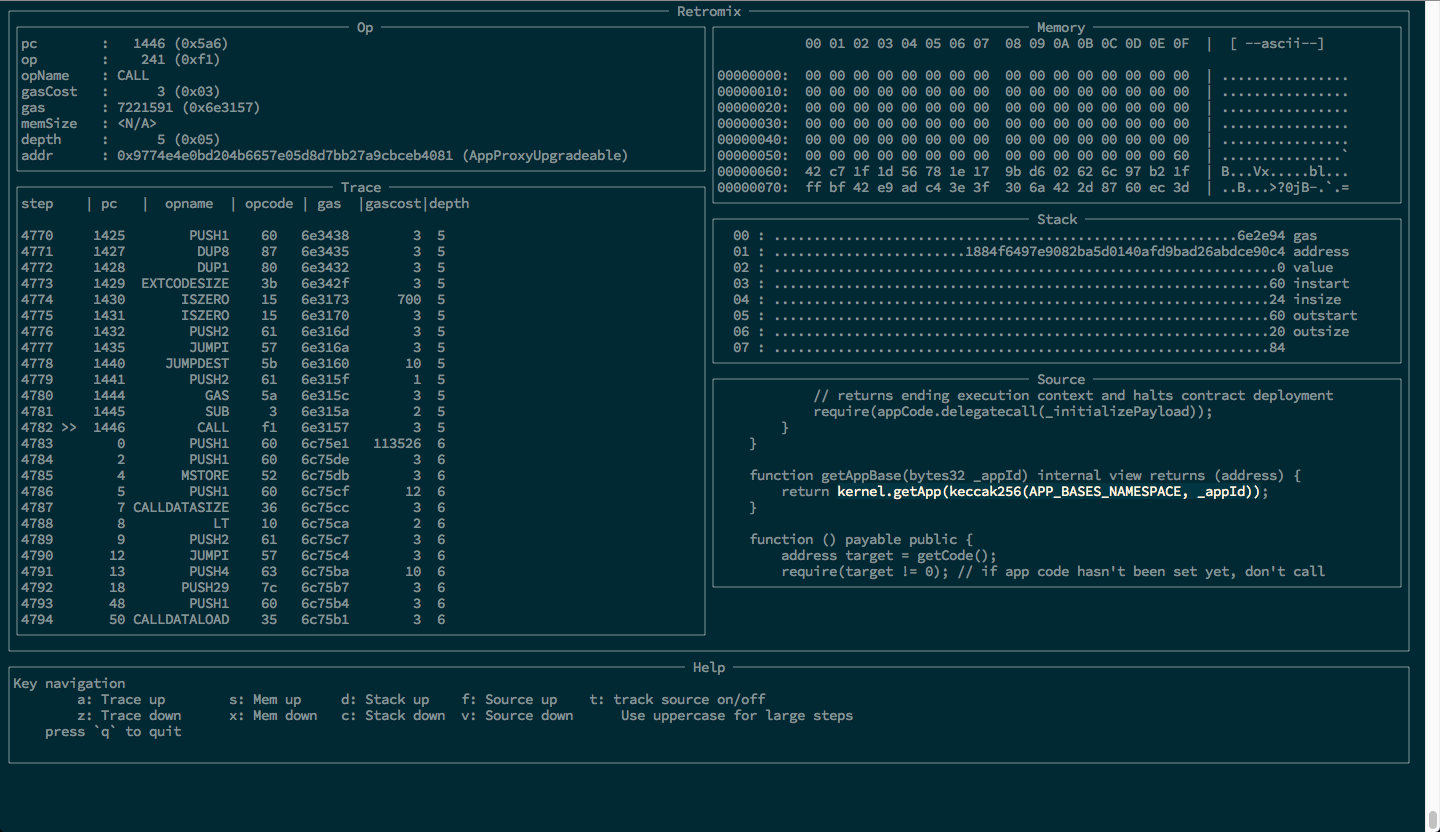
Opviewer
The 'opviewer.py' is a simple debugger-like trace-viewer. It can be used against an evm-trace and navigate the data in a bit more friendly manner than raw json.
Invoke via e.g. python opviewer.py -f example2.json
Running it
The easiest way to get it working is to use a docker image.
docker build . -t evmlab && docker run -it evmlab
The docker image should also be available at hub.docker.com, as an automated build:
docker pull holiman/evmlab && docker run -it holiman/evmlab
EVM
EVM format
Here's what to think about if you want to add an evm to evmlab.
Input
The evm should take the following inputs:
--code <code>- code to be executed.--codeFile <file>- file containing code to be executed. Sometimes really large chunks of input cannot be passed through bash.--gas <int>--price <int>--sender <address>- address ofORIGIN--receiver <address- address ofADDRESS--input <code>:CALLDATA--value <int>--json- boolean flag, output json output for each opcode or not (it's useful to disable json when benchmarking)--nomemory- disable showing the full memory output for each op--create- if specified, it's executed as initcode--prestate- a chain specification, the same one that the client normally would use.
Basically, the evm should be able to run things very simply, like so:
$evm --code 6040 --json run
{"pc":0,"op":96,"gas":"0x2540be400","gasCost":"0x3","memory":"0x","memSize":0,"stack":[],"depth":1,"error":null,"opName":"PUSH1"}
{"pc":2,"op":0,"gas":"0x2540be3fd","gasCost":"0x0","memory":"0x","memSize":0,"stack":["0x40"],"depth":1,"error":null,"opName":"STOP"}
{"output":"","gasUsed":"0x3","time":141485}
But it should also be able to reconstruct an actual on-chain transaction, with complex options including prestate, where no code is passed, since it's already been showed into the prestate:
$evm --prestate /home/martin/workspace/evmlab/output//0xd6d519-genesis-geth_wq38zsy5.json --gas 150000 --sender 0x69ea6b31ef305d6b99bb2d4c9d99456fa108b02a --receiver 0xb97048628db6b661d4c2aa833e95dbe1a905b280 --input a9059cbb0000000000000000000000008eef795fd9150f118bddeca556a5a2a2438ab865000000000000000000000000000000000000000000000081ebd8ffd6b2a58000 --json run
Output
The evm should output a json object for each operation. Example:
{"pc":0,"op":96,"gas":"0x2540be400","gasCost":"0x3","memory":"0x","memSize":0,"stack":[],"depth":1,"error":null,"opName":"PUSH1"}
Required: pc, op, gas, stack, depth
Optional: opName, gasCost, error
The stack, memory and memSize are the values before execution of the op.
At the end of execution, some summarical info is good, e.g.
{"output":"","gasUsed":"0x3","time":141485}
When errors occur, geth and parity handles them differently.
Minor changes to how things work is ok, we can handle discrepancies in format and minor quirks.


Release files for Evmlab 0.3.0.0.1
For a detailed explanation of source distributions (sdists) and built distributions (wheels), please see the package formats documentation.
Source distribution (sdist)
| File | Size | Uploaded | |
|---|---|---|---|
| Evmlab-0.3.0.0.1.tar.gz | 42.9 kB | Details |
Built distribution (wheel)
| File | Interpreter | ABI | Platform | Reset |
|---|---|---|---|---|
| Evmlab-0.3.0.0.1-py3-none-any.whl | Python 3 | none | any | Details |
Total release size: 91.8 kB
Release files / Evmlab-0.3.0.0.1.tar.gz
| Download URL | Evmlab-0.3.0.0.1.tar.gz |
|---|---|
| Size | 42.9 kB |
| Tags | Source |
|
SHA-256 checksum How to use checksums |
c94f2dd67fd1a43e69af5eb36d74d7404bc0259910d049df768f8d4d3991b436
|
|
BLAKE2b-256 checksum How to use checksums |
f845c77563be448382270b0b9b44de13bb3eb0ddd4a29f9f62bca0dfe408e085
|
| Upload date | |
|
Uploaded using Trusted Publishing? What is trusted publishing? |
No |
| Uploaded via |
twine/1.11.0 pkginfo/1.4.2 requests/2.18.4 setuptools/40.0.0 requests-toolbelt/0.8.0 tqdm/4.24.0 CPython/3.5.3
|
Release files / Evmlab-0.3.0.0.1-py3-none-any.whl
| Download URL | Evmlab-0.3.0.0.1-py3-none-any.whl |
|---|---|
| Size | 48.9 kB |
| Tags | Python 3 |
|
SHA-256 checksum How to use checksums |
1b7e91ea48e8372bbf4acdf2cdeb25c033de28a59167af49579346145b357553
|
|
BLAKE2b-256 checksum How to use checksums |
fd52eb6cf263afe4dd6d1e039e03def838b2c4968d56003e16c59d88969f6956
|
| Upload date | |
|
Uploaded using Trusted Publishing? What is trusted publishing? |
No |
| Uploaded via |
twine/1.11.0 pkginfo/1.4.2 requests/2.18.4 setuptools/40.0.0 requests-toolbelt/0.8.0 tqdm/4.24.0 CPython/3.5.3
|













