

Evoke: A Python package for evolutionary signalling games
- Tutorial | Google Colab
- Documentation | ReadTheDocs
- Package | PyPI
- Source code | GitHub
Evoke is a Python library for evolutionary simulations of signalling games. It offers a simple and intuitive API that can be used to analyze arbitrary game-theoretic models, and to easily reproduce and customize well-known results and figures from the literature.
Evoke comprises a library of methods from evolutionary game theory evoke/src/ and an ever-growing collection of user-friendly examples evoke/examples/.
Online tutorial
See the interactive tutorial on Google Colab.
Requirements
Evoke currently requires Python versions 3.9-3.12.
Further requirements are listed in pyproject.toml.
Installation
Install with pip: pip install evoke_signals.
Basic usage
Creating your own signalling games
Creating and running your own simulations requires you to specify payoff matrices, player strategies, and learning or evolutionary dynamics. See the tutorial or the documentation for details and examples.
Recreating figures from the literature
You can also recreate figures from the signalling game literature. For example, suppose you want to recreate Figure 1.1 from page 11 of Signals (Skyrms 2010). The figure depicts the replicator dynamics of a population repeatedly playing a two-player cooperative game where each agent in the population either always plays sender or always plays receiver. Senders observe one of two randomly chosen states of the world and produce one of two signals. Receivers observe the signal and produce one of two acts. If the act matches the state, both players gain a payoff.
The x-axis gives the proportion of receivers mapping the first signal to the second act and the second signal to the first act. The y-axis gives the proportion of senders mapping the first state to the second signal and the second state to the first signal.
The points at which the population is achieving the greatest coordination are thus (0,0) and (1,1), so we would expect to see the arrows in the grid pointing towards those two corners. Skyrms's figure shows exactly that.
For copyright reasons we can't show the original figure here. Fortunately, recreating the figure is as easy as importing the relevant class and creating an instance of it:
from evoke.examples.skyrms2010signals import Skyrms2010_1_1
fig1_1 = Skyrms2010_1_1()
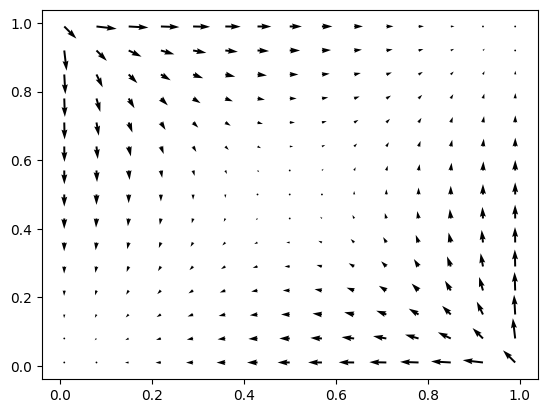
If you check page 11 of Signals you will see this plot closely matches Skyrms's Figure 1.1.
Recreating figures from the literature with different parameters
One of the useful features of Evoke is that it allows you to re-run existing figures with different data. In this way you can see how the results of a simulation would change if the parameters were tweaked.
Let's take Figure 3.3 of Skyrms (2010:40) as an example. The figure depicts the mutual information between signal and state over successive trials of a two-player cooperative game in which agents learn via reinforcement. There are two states, two signals and two acts. Typically the mutual information will increase over time as the agents learn to use specific signals as indicators of specific states.
Once again we can create the figure just by creating an instance of the object. Instead of the 100 iterations Skyrms uses, we will run the model for 1000 iterations:
from evoke.examples.skyrms2010signals import Skyrms2010_3_3
fig3_3 = Skyrms2010_3_3(iterations=1000)
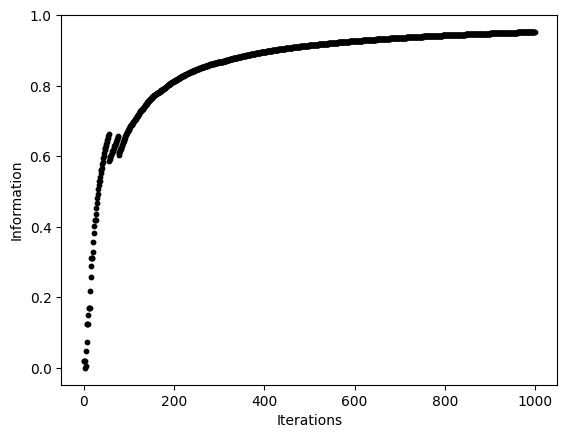
Running for 100 iterations would sometimes lead to high information transmission and sometimes not, due to the stochastic nature of the simulation. In contrast, running for 1000 iterations almost always leads to appreciable information transmission, as in the figure shown here.
Figures from the literature that are currently in the Evoke library can be found in the examples/ directory.
Contributions
We welcome contributions, especially those that add to the stock of example figures. See CONTRIBUTING.md for information about contributing to Evoke.
References
Skyrms, B. (2010). Signals: Evolution, Learning, and Information. Oxford University Press. https://doi.org/10.1093/acprof:oso/9780199580828.001.0001
1 maintainer

Metadata
1 maintainer
Release files for evoke-signals 0.1.4
For a detailed explanation of source distributions (sdists) and built distributions (wheels), please see the package formats documentation.
Source distribution (sdist)
| File | Size | Uploaded | |
|---|---|---|---|
| evoke_signals-0.1.4.tar.gz | 68.7 kB | Details |
Built distribution (wheel)
| File | Interpreter | ABI | Platform | Reset |
|---|---|---|---|---|
| evoke_signals-0.1.4-py3-none-any.whl | Python 3 | none | any | Details |
Total release size: 144.1 kB
Release files / evoke_signals-0.1.4.tar.gz
| Download URL | evoke_signals-0.1.4.tar.gz |
|---|---|
| Size | 68.7 kB |
| Tags | Source |
|
SHA-256 checksum How to use checksums |
f3186378813c54e293716d5f9d7e0cd0a582aa554303b9f52fa9c29fe59a4ce5
|
|
BLAKE2b-256 checksum How to use checksums |
c1f6dc484cef0499b16d34ed601cca323fa8896ef0b1e425ef29accd2f248f63
|
| Upload date | |
|
Uploaded using Trusted Publishing? What is trusted publishing? |
No |
| Uploaded via |
twine/6.0.1 CPython/3.12.3
|
Release files / evoke_signals-0.1.4-py3-none-any.whl
| Download URL | evoke_signals-0.1.4-py3-none-any.whl |
|---|---|
| Size | 75.4 kB |
| Tags | Python 3 |
|
SHA-256 checksum How to use checksums |
18b7f964a4a574c354272c6b2e7045ff95a26c06c85aeec1bb2b3ebb53721e09
|
|
BLAKE2b-256 checksum How to use checksums |
c40a79914cf0dde0a8898e5fdc9b7b7cf5fd6cfaf0e7e5fab780870d4b2a4745
|
| Upload date | |
|
Uploaded using Trusted Publishing? What is trusted publishing? |
No |
| Uploaded via |
twine/6.0.1 CPython/3.12.3
|














