






Read Latest Documentation - Browse GitHub Code Repository
eXamples (AKA: xamples for SEO) is a Python3 library enabling interactable, self-documenting, and self-verifying examples. These examples are attached directly to Python functions using decorators or via separate MODULE_examples.py source files.
Key Features:
- Simple and Obvious API: Add
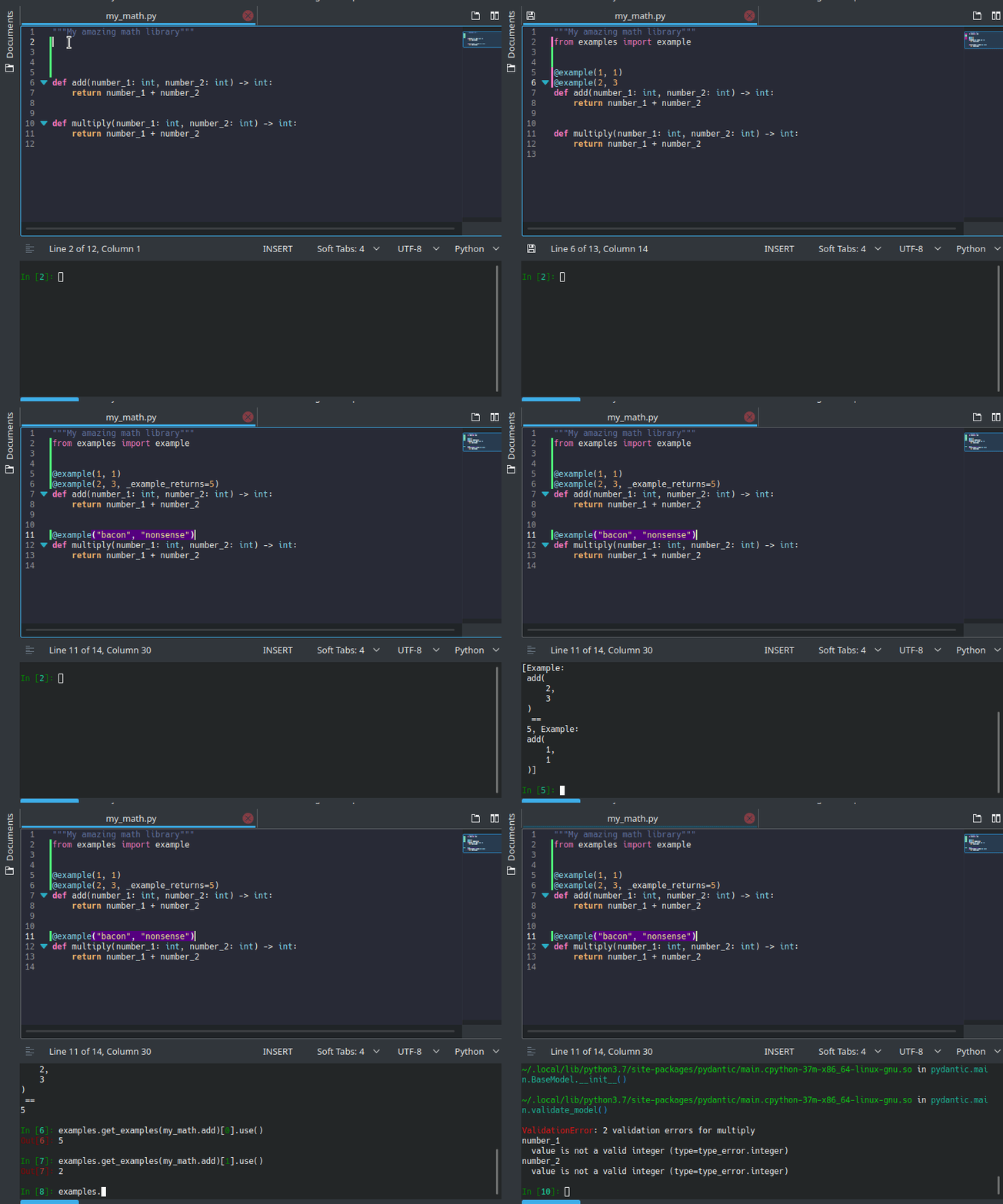
@examples.example(*args, **kwargs)decorators for each example you want to add to a function. - Auto Documenting: Examples, by default, get added to your functions docstring viewable both in interactive interpreters and when using portray or pdocs.
- Signature Validating: All examples can easily be checked to ensure they match the function signature (and type annotations!) with a single call (
examples.verify_all_signatures()). - Act as Tests: Examples act as additional test cases, that can easily be verified using a single test case in your favorite test runner: (
examples.test_all_examples()). - Async Compatibility: Examples can be attached and tested as easily against async functions as non-async ones.
What's Missing:
- Class Support: Currently examples can only be attached to individual functions. Class and method support is planned for a future release.
Quick Start
The following guides should get you up and running using eXamples in no time.
-
Installation - TL;DR: Run
pip3 install exampleswithin your projects virtual environment. -
Adding Examples - TL;DR: Add example decorators that represent each of your examples:
# my_module_with_examples.py from examples import example @example(1, number_2=1, _example_returns=2) def add(number_1: int, number_2: int) -> int: return number_1 + number_2 -
Verify and Test Examples - TL;DR: run
examples.verify_and_test_exampleswithin your projects test cases.# test_my_module_with_examples.py from examples import verify_and_test_examples import my_module_with_examples def test_examples_verifying_signature(): verify_and_test_examples(my_module_with_examples) -
Introspect Examples -
 import examples

 from my_module_with_examples import add


 examples.get_examples(add)[0].use() == 2
Why Create Examples?
I've always wanted a way to attach examples to functions in a way that would be re-useable for documentation, testing, and API proposes. Just like moving Python parameter types from comments into type annotations has made them more broadly useful, I hope examples can do the same for example calls.
I hope you too find eXamples useful!
~Timothy Crosley
1 maintainer

Metadata
1 maintainer
Release files for examples 1.0.2
For a detailed explanation of source distributions (sdists) and built distributions (wheels), please see the package formats documentation.
Source distribution (sdist)
| File | Size | Uploaded | Provenance | Actions |
|---|---|---|---|---|
| examples-1.0.2.tar.gz | 8.9 kB | Without provenance | Details for examples-1.0.2.tar.gz |
Built distribution (wheel)
| File | Interpreter | ABI | Platform | Actions Reset |
|---|---|---|---|---|
| examples-1.0.2-py3-none-any.whl | Python 3 | none | any | Details for examples-1.0.2-py3-none-any.whl |
Total release size: 17.2 kB
Release files / examples-1.0.2.tar.gz
| Download URL | examples-1.0.2.tar.gz |
|---|---|
| Size | 8.9 kB |
| Tags | Source |
|
SHA-256 checksum How to use checksums |
f29ba443f158bb47913ac21f098306a9749ed459a2290540ff1f86baac074597
|
|
BLAKE2b-256 checksum How to use checksums |
081a1a68ca1db40e06efdd016fcc59863f755f1bceb12b9a7551f52f90fd3253
|
| Upload date | |
|
Uploaded using Trusted Publishing? What is trusted publishing? |
No |
| Uploaded via |
poetry/1.0.0 CPython/2.7.16 Linux/5.3.0-7625-generic
|
Release files / examples-1.0.2-py3-none-any.whl
| Download URL | examples-1.0.2-py3-none-any.whl |
|---|---|
| Size | 8.2 kB |
| Tags | Python 3 |
|
SHA-256 checksum How to use checksums |
372fefd15d5a17bda3b003cf26edbc2d29632bc63f29c816b55ed33dcccb3e65
|
|
BLAKE2b-256 checksum How to use checksums |
505b1ba3532c18528e49a963664b70896933b2e59049482831953e9d1b387bb7
|
| Upload date | |
|
Uploaded using Trusted Publishing? What is trusted publishing? |
No |
| Uploaded via |
poetry/1.0.0 CPython/2.7.16 Linux/5.3.0-7625-generic
|
Security for examples 1.0.2
Provenance
Provenance describes where a file came from. On PyPI, provenance is shared via attestations, which provide a verifiable record of the build or publishing details. View details, limitations and caveats.
No provenance found
None of the files in this release were uploaded with provenance metadata.
A note on package security
PyPI is a repository for distributing packages, not a service for auditing them. While third-party security researchers and our staff do their best to detect and remove malicious packages, PyPI cannot guarantee the quality, security or suitability of any given package.
To learn more about protecting yourself from malicious actors, visit our package security documentation.














