
Excel Anonymizer
A Python script that anonymizes an Excel file and synthesizes new data in its place.
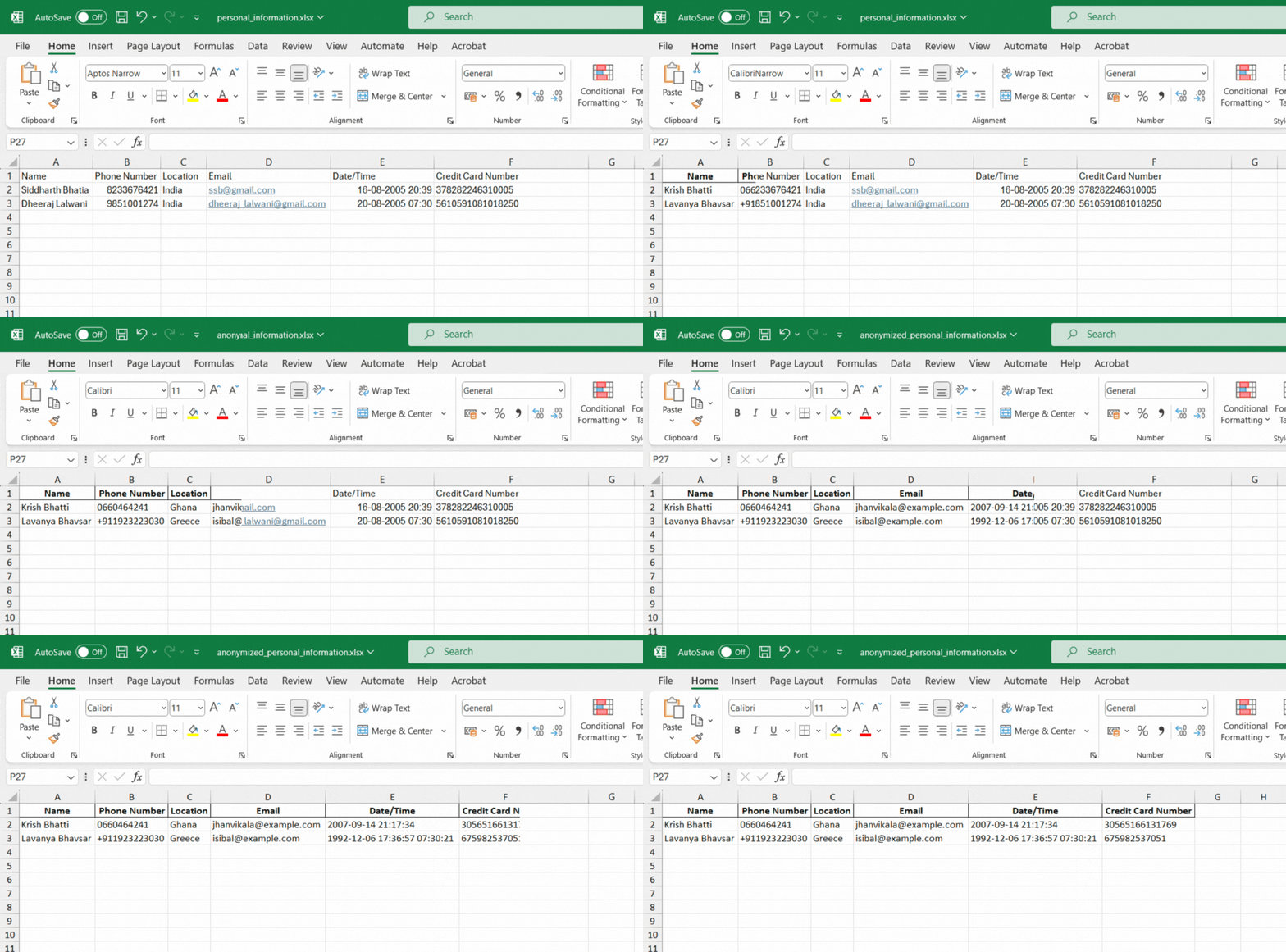
What is Excel Anonymizer
Excel Anonymizer is a python script that helps to ensure sensitive data is properly managed and governed. It provides fast identification and anonymization for private entities in text such as credit card numbers, names, locations, phone numbers, email address, date/time, with more entities to come.
Use case
Data anonymization is crucial because it helps protect privacy and maintain confidentiality. If data is not anonymized, sensitive information such as names, addresses, contact numbers, or other identifiers linked to specific individuals could potentially be learned and misused. Hence, by obscuring or removing this personally identifiable information (PII), data can be used freely without compromising individuals’ privacy rights or breaching data protection laws and regulations.
Overview
Anonymization consists of two steps:
- Identification: Identify all data fields that contain personally identifiable information (PII).
- Replacement: Replace all PIIs with pseudo values that do not reveal any personal information about the individual but can be used for reference.
Excel Anonymizer uses Microsoft Presidio together with Faker framework for anonymization purposes.
Quickstart
- Install the requirements
pip install presidio_analyzer pip install presidio_anonymizer python -m spacy download en_core_web_lg - Install the package
pip install excel-anonymizer
Note: Spacy will install a Natural Language Processing package on the first run (587.7MB).
- Run the demo
excel-anonymizer ../../personal_information.xlsx
That's it!
Usage
To use Excel Anonymizer with your Excel file, simply input the file.
excel-anonymizer your_excel_file_here.xlsx
Author
Siddharth Bhatia
License: MIT License
1 maintainer

Metadata
1 maintainer
Release files for excel-anonymizer 1.1.7
For a detailed explanation of source distributions (sdists) and built distributions (wheels), please see the package formats documentation.
Source distribution (sdist)
| File | Size | Uploaded | Provenance | Actions |
|---|---|---|---|---|
| excel_anonymizer-1.1.7.tar.gz | 15.4 kB | Without provenance | Details for excel_anonymizer-1.1.7.tar.gz |
Built distribution (wheel)
| File | Interpreter | ABI | Platform | Actions Reset |
|---|---|---|---|---|
| excel_anonymizer-1.1.7-py3-none-any.whl | Python 3 | none | any | Details for excel_anonymizer-1.1.7-py3-none-any.whl |
Total release size: 20.8 kB
Release files / excel_anonymizer-1.1.7.tar.gz
| Download URL | excel_anonymizer-1.1.7.tar.gz |
|---|---|
| Size | 15.4 kB |
| Tags | Source |
|
SHA-256 checksum How to use checksums |
4f8d702eca7ced4347aaca57e886981628a31f9e519413dd5d4f7dca432cb279
|
|
BLAKE2b-256 checksum How to use checksums |
d1088f4e856398bc119e42532561e2ade9b56beba1c46babe034beb5da9acd88
|
| Upload date | |
|
Uploaded using Trusted Publishing? What is trusted publishing? |
No |
| Uploaded via |
twine/5.0.0 CPython/3.9.13
|
Release files / excel_anonymizer-1.1.7-py3-none-any.whl
| Download URL | excel_anonymizer-1.1.7-py3-none-any.whl |
|---|---|
| Size | 5.4 kB |
| Tags | Python 3 |
|
SHA-256 checksum How to use checksums |
ad38aa39c72ba7b5014ed334e46098e111cd5095228b44081253a131e427fbd1
|
|
BLAKE2b-256 checksum How to use checksums |
c86dc09dc207d416d73dbe7230aa2d3dd9dbc29b49750202e182a5ef6acad822
|
| Upload date | |
|
Uploaded using Trusted Publishing? What is trusted publishing? |
No |
| Uploaded via |
twine/5.0.0 CPython/3.9.13
|
Security for excel-anonymizer 1.1.7
Provenance
Provenance describes where a file came from. On PyPI, provenance is shared via attestations, which provide a verifiable record of the build or publishing details. View details, limitations and caveats.
No provenance found
None of the files in this release were uploaded with provenance metadata.
A note on package security
PyPI is a repository for distributing packages, not a service for auditing them. While third-party security researchers and our staff do their best to detect and remove malicious packages, PyPI cannot guarantee the quality, security or suitability of any given package.
To learn more about protecting yourself from malicious actors, visit our package security documentation.














