

explainy - black-box model explanations for humans







explainy is a library for generating machine learning models explanations in Python. It uses methods from Machine Learning Explainability and provides a standardized API to create feature importance explanations for samples.
The API is inspired by scikit-learn and has three core methods explain(), plot() and, importance(). The explanations are generated in the form of texts and plots.
explainy comes with four different algorithms to create either global or local and contrastive or non-contrastive model explanations.
| Method | Type | Explanations | Classification | Regression |
|---|---|---|---|---|
| Permutation Feature Importance | non-contrastive | global | ⭐ | ⭐ |
| Shap Values | non-contrastive | local | ⭐ | ⭐ |
| Surrogate Model | contrastive | global | ⭐ | ⭐ |
| Counterfactual Example | contrastive | local | ⭐ | ⭐ |
Description:
- global: explanation of system functionality (all samples have the same explanation)
- local: explanation of decision rationale (each sample has its own explanation)
- contrastive: tracing of decision path (differences to other outcomes are described)
- non-contrastive: parameter weighting (the feature importance is reported)
Documentation
https://explainy.readthedocs.io
Install explainy
pip install explainy
Further, install graphviz (version 9.0.0 or later) for plotting tree surrogate models:
Windows
choco install graphviz
Mac
brew install graphviz
Linux: Ubuntu packages
sudo apt install graphviz
Further details on how to install graphviz can be found in the official graphviz docs.
Also, make sure that the folder with the dot executable is added to your systems PATH. You can find further details here.
Usage
📚 A comprehensive example of the explainy API can be found in this

📖 Or in the example section of the documentation
Initialize and train a scikit-learn model:
import pandas as pd
from sklearn.datasets import load_diabetes
from sklearn.ensemble import RandomForestRegressor
from sklearn.model_selection import train_test_split

diabetes = load_diabetes()
X_train, X_test, y_train, y_test = train_test_split(
    diabetes.data, diabetes.target, random_state=0
)
X_test = pd.DataFrame(X_test, columns=diabetes.feature_names)
y_test = pd.DataFrame(y_test)

model = RandomForestRegressor(random_state=0)
model.fit(X_train, y_train)
Initialize the PermutationExplanation (or any other explanation) object and pass in the trained model and the to be explained dataset.
Addtionally, define the number of features used in the explanation. This allows you to configure the verbosity of your exaplanation.
Set the index of the sample that should be explained.
from explainy.explanations import PermutationExplanation

number_of_features = 4

explainer = PermutationExplanation(
    X_test, y_test, model, number_of_features
)
Call the explain() method and print the explanation for the sample (in case of a local explanation every sample has a different explanation).
explanation = explainer.explain(sample_index=1)
print(explanation)
The RandomForestRegressor used 10 features to produce the predictions. The prediction of this sample was 251.8.
The feature importance was calculated using the Permutation Feature Importance method.
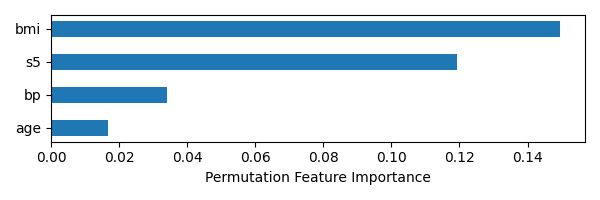
The four features which were most important for the predictions were (from highest to lowest): 'bmi' (0.15), 's5' (0.12), 'bp' (0.03), and 'age' (0.02).
Use the plot() method to create a feature importance plot of that sample.
explainer.plot()
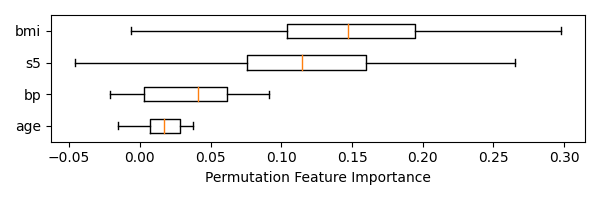
If your prefer, you can also create another type of plot, as for example a boxplot.
explainer.plot(kind='box')
Finally, you can also look at the importance values of the features (in form of a pd.DataFrame).
feature_importance = explainer.importance()
print(feature_importance)
  Feature  Importance
0     bmi        0.15
1      s5        0.12
2      bp        0.03
3     age        0.02
4      s2       -0.00
5     sex       -0.00
6      s3       -0.00
7      s1       -0.01
8      s6       -0.01
9      s4       -0.01
Features
- Algorithms for inspecting black-box machine learning models
- Support for the machine learning frameworks
scikit-learnandxgboost - explainy offers a standardized API with three core methods
explain(),plot(),importance()
Other Machine Learning Explainability libraries to watch
- shap: A game theoretic approach to explain the output of any machine learning model
- eli5: A library for debugging/inspecting machine learning classifiers and explaining their predictions
- alibi: Algorithms for explaining machine learning models
- interpret: Fit interpretable models. Explain blackbox machine learning
Source
Molnar, Christoph. "Interpretable machine learning. A Guide for Making Black Box Models Explainable", 2019. https://christophm.github.io/interpretable-ml-book/
Author
Mauro Luzzatto - Maurol
1 maintainer

Metadata
1 maintainer
Release files for explainy 0.2.12
For a detailed explanation of source distributions (sdists) and built distributions (wheels), please see the package formats documentation.
Source distribution (sdist)
| File | Size | Uploaded | |
|---|---|---|---|
| explainy-0.2.12.tar.gz | 654.9 kB | Details |
Built distribution (wheel)
| File | Interpreter | ABI | Platform | Reset |
|---|---|---|---|---|
| explainy-0.2.12-py2.py3-none-any.whl | Python 2, Python 3 | none | any | Details |
Total release size: 683.1 kB
Release files / explainy-0.2.12.tar.gz
| Download URL | explainy-0.2.12.tar.gz |
|---|---|
| Size | 654.9 kB |
| Tags | Source |
|
SHA-256 checksum How to use checksums |
49ceaf243ebe0cd8502088b657937ff520464d9797dcab39123df377b69a2176
|
|
BLAKE2b-256 checksum How to use checksums |
ffaa10800a79c5cb00d9927862566e37ed467bbbe1179976f36d0a73c204af1f
|
| Upload date | |
|
Uploaded using Trusted Publishing? What is trusted publishing? |
No |
| Uploaded via |
twine/3.3.0 pkginfo/1.9.6 requests/2.31.0 setuptools/65.5.0 requests-toolbelt/1.0.0 tqdm/4.66.1 CPython/3.11.3
|
Release files / explainy-0.2.12-py2.py3-none-any.whl
| Download URL | explainy-0.2.12-py2.py3-none-any.whl |
|---|---|
| Size | 28.3 kB |
| Tags | Python 2 Python 3 |
|
SHA-256 checksum How to use checksums |
04357526c810330f3f215fb5f530cd86898e1d9f6fd26400fdbcc7fef5bd3f44
|
|
BLAKE2b-256 checksum How to use checksums |
e84fea46fa92bbdc4e3b66b4f99af7b6de122e48a9bc1ea07539906c81e8fea5
|
| Upload date | |
|
Uploaded using Trusted Publishing? What is trusted publishing? |
No |
| Uploaded via |
twine/3.3.0 pkginfo/1.9.6 requests/2.31.0 setuptools/65.5.0 requests-toolbelt/1.0.0 tqdm/4.66.1 CPython/3.11.3
|














