
Extensible Splines




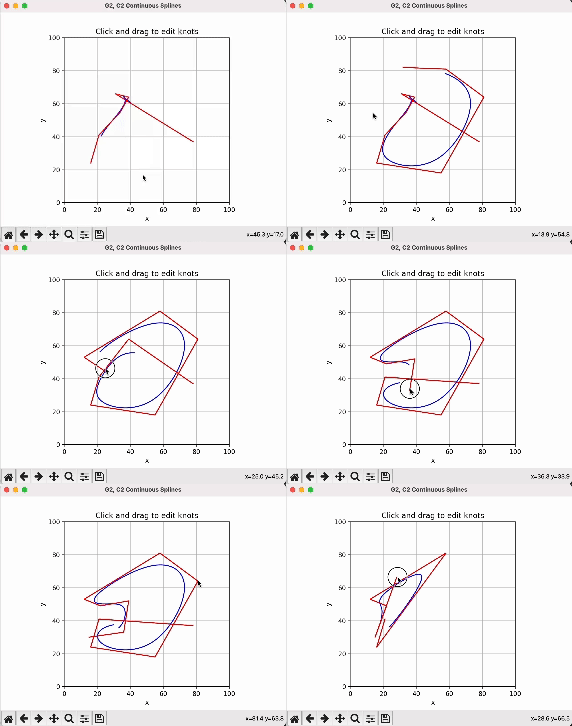
Python Spline Interpolation. Interactive plot for quick testing of new spline kernels or control point usage.
Why?
If you look at the source of extensible_splines/splines.py you will notice that the most commonly used varieties of spline can be defined with only one or two of four possible overloads or attribute definitions relative to the base class.
- The kernel itself. That is, the square matrix by which we will multiply the powers of the parameter--in the form of a vector.
- The scaling factor. This defaults to 1.0, but supplying a value on the open unit interval is fine.
- Any filter on the segments themselves.
- How to transform the knots. In the case of the Hermite spline, this is p0, (δx,δy), p2, (δx,δy). Points p0 and p2 are unchanged, but p1 and p3 are tranformed to relative offsets from p0 and p2, respectively.
Installation
pip install extensible-splines
Usage
Create an instance of SplineMatrix
For example:
my_kernel = SplineMatrix(np.array([[1, 0, 0, 0],[0, 1, 0, 0],[-3, -2, 3, -1],[2, 1, -2, 1]],float))
Define a Subclass of BaseSpline
This can be as simple as (1) defining the abstract methods with super calls and (2) passing the kernel to the base constructor.
class MySpline(BaseSpline):
    def __init__(self) -> None:
        super().__init__(my_kernel)

    def filter_segments(self, raw_segments: Iterable[Tuple[Tuple[int, int]]]):
        return super().filter_segments(raw_segments)

    def transform_control_points(self, points: Tuple[Tuple[int, int]]) -> np.ndarray:
        return super().transform_control_points(points)
Notice that other than super() calls and type hinting, the kernel is the only aspect of the type definition to be handled above.
Test the New Spline Interactively
# Kernel instance and Spline class go here
# ....
##

def main():
    editor = interactive.SplineEditor(MySpline())
    editor.init_figure(caption='Testing New Splines')


if __name__ == '__main__':
    main()
1 maintainer

Metadata
1 maintainer
Release files for extensible-splines 0.2.1
For a detailed explanation of source distributions (sdists) and built distributions (wheels), please see the package formats documentation.
Source distribution (sdist)
| File | Size | Uploaded | Provenance | Actions |
|---|---|---|---|---|
| extensible_splines-0.2.1.tar.gz | 9.2 kB | Without provenance | Details for extensible_splines-0.2.1.tar.gz |
Built distribution (wheel)
| File | Interpreter | ABI | Platform | Actions Reset |
|---|---|---|---|---|
| extensible_splines-0.2.1-py3-none-any.whl | Python 3 | none | any | Details for extensible_splines-0.2.1-py3-none-any.whl |
Total release size: 17.2 kB
Release files / extensible_splines-0.2.1.tar.gz
| Download URL | extensible_splines-0.2.1.tar.gz |
|---|---|
| Size | 9.2 kB |
| Tags | Source |
|
SHA-256 checksum How to use checksums |
b98115d3539ae49ebb266d78a8a65ce57b87f1695ab529fe1409475ea995c5fc
|
|
BLAKE2b-256 checksum How to use checksums |
96f667d3d353662106f2af5931cda621a6fdd14fe23d48aed74f7edeeff83255
|
| Upload date | |
|
Uploaded using Trusted Publishing? What is trusted publishing? |
No |
| Uploaded via |
twine/4.0.2 CPython/3.9.18
|
Release files / extensible_splines-0.2.1-py3-none-any.whl
| Download URL | extensible_splines-0.2.1-py3-none-any.whl |
|---|---|
| Size | 8.1 kB |
| Tags | Python 3 |
|
SHA-256 checksum How to use checksums |
4070cf8a53941daf0ab2a3fa12a4ea35fc1c59c7e8ac85d7cb193b33105a8fdd
|
|
BLAKE2b-256 checksum How to use checksums |
9ed645ac122488c4f5f06ce09cd8f53df8e75335a12950a016c085ae96e72bf3
|
| Upload date | |
|
Uploaded using Trusted Publishing? What is trusted publishing? |
No |
| Uploaded via |
twine/4.0.2 CPython/3.9.18
|
Security for extensible-splines 0.2.1
Provenance
Provenance describes where a file came from. On PyPI, provenance is shared via attestations, which provide a verifiable record of the build or publishing details. View details, limitations and caveats.
No provenance found
None of the files in this release were uploaded with provenance metadata.
A note on package security
PyPI is a repository for distributing packages, not a service for auditing them. While third-party security researchers and our staff do their best to detect and remove malicious packages, PyPI cannot guarantee the quality, security or suitability of any given package.
To learn more about protecting yourself from malicious actors, visit our package security documentation.














