
FastFuels-Python
Python client library for the FastFuels API
Install
You can install FastFuels through the Python Package Index.
pip install fastfuels
Quickstart
Connecting to a .fio resource
A .fio resource is a directory-in-file object where important metadata and fuel arrays are stored. Start by importing the FastFuels module and open a .fio resource. If you have one locally, specify the path and file name.
>>> import fastfuels
>>> fio = fastfuels.open('./demo.fio', ftype='local')
If you have the appropriate credentials, you can connect to the remote resource stored in AWS S3.
>>> fio = fastfuels.open('./ca.fio', ftype='s3', username='username', password='password')
Explore the metadata
Let's take a look at some metadata. You can get the extent of the data in geographic coordinates (longitude and latitude) or in projected coordinates by changing the mode argument.
>>> print(fio.get_extent(mode='geographic'))
(-120.73665218037868, 38.93933418427242, -120.6511979123941, 38.90135366961076)
>>> print(fio.get_extent(mode='projected'))
(-2100315.0, 2043015.0, -2094315.0, 2037015.0)
And the projection system is stored in the proj attribute.
>>> print(fio.proj)
You can also view metadata for resolution and units
>>> print(fio.res)
(1,1,1)
>>> print(fio.units)
'meters'
Spatial queries
You can perform spatial queries by specifying geographic coordinates in decimal degrees and a radius in meters. The radius parameter defines the size of the bounding square in which fuels are queried.
# this command will return a square kilometer of fuels (radius=500 meters)
roi = fio.query(-122.191, 41.208, 500)
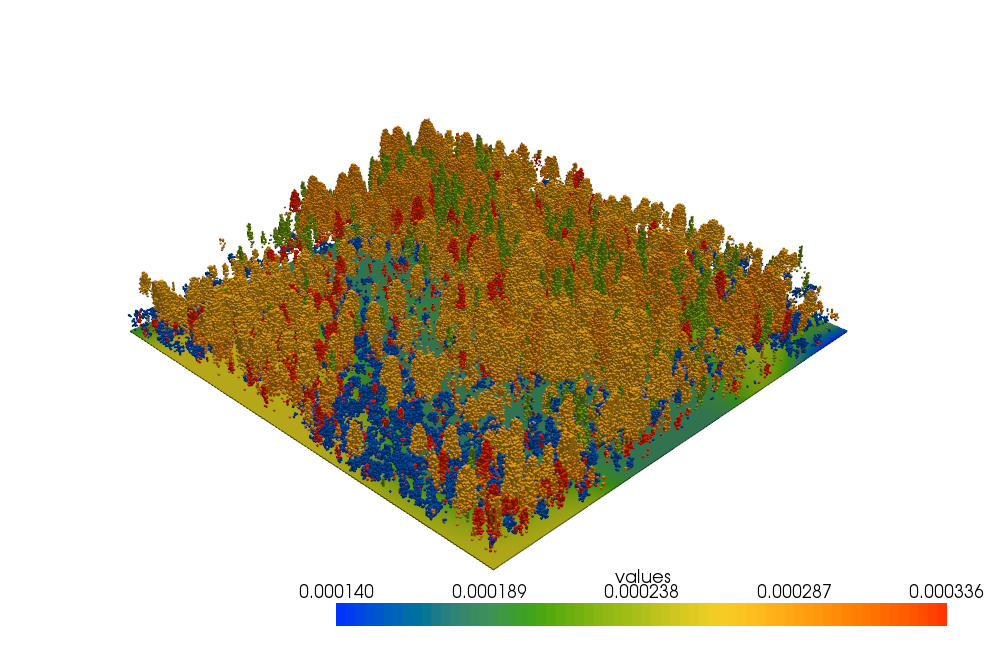
Viewing fuels in 3D
Fuel parameter arrays can be viewed interactively in 3D. To see the available parameters run
print(roi.get_properties())
Then specify one of the properties in the view() method on the roi object.
roi.view('sav')
Writing fire model input files
With the roi object, you can write input files for various fire models. Here,
you may also decrease the resolution to save computation.
roi.write('./outputs', model='quicfire', res_xyz=[2,2,1])
1 maintainer

Metadata
1 maintainer
Release files for fastfuels 1.0.7
For a detailed explanation of source distributions (sdists) and built distributions (wheels), please see the package formats documentation.
Source distribution (sdist)
| File | Size | Uploaded | Provenance | Actions |
|---|---|---|---|---|
| fastfuels-1.0.7.tar.gz | 26.7 kB | Without provenance | Details for fastfuels-1.0.7.tar.gz |
Built distribution (wheel)
| File | Interpreter | ABI | Platform | Actions Reset |
|---|---|---|---|---|
| fastfuels-1.0.7-py3-none-any.whl | Python 3 | none | any | Details for fastfuels-1.0.7-py3-none-any.whl |
Total release size: 54.2 kB
Release files / fastfuels-1.0.7.tar.gz
| Download URL | fastfuels-1.0.7.tar.gz |
|---|---|
| Size | 26.7 kB |
| Tags | Source |
|
SHA-256 checksum How to use checksums |
4e89a4b7d80ef8b163b77733fa171d96bc1592ad55d1ce21360764b1376e76b1
|
|
BLAKE2b-256 checksum How to use checksums |
099eabae204073173028fb2135a01268895b69751642b078ab997199e54ee3d0
|
| Upload date | |
|
Uploaded using Trusted Publishing? What is trusted publishing? |
No |
| Uploaded via |
twine/5.0.0 CPython/3.12.0
|
Release files / fastfuels-1.0.7-py3-none-any.whl
| Download URL | fastfuels-1.0.7-py3-none-any.whl |
|---|---|
| Size | 27.5 kB |
| Tags | Python 3 |
|
SHA-256 checksum How to use checksums |
8b8d9581401f5286903ac6d3565de28cdedee9d727eb96a3e99d5ca2b2d8c972
|
|
BLAKE2b-256 checksum How to use checksums |
df715058503de7ce3f88bd5e5c9c0dead906b29eea0a2c6499c89adbc2a63767
|
| Upload date | |
|
Uploaded using Trusted Publishing? What is trusted publishing? |
No |
| Uploaded via |
twine/5.0.0 CPython/3.12.0
|
Security for fastfuels 1.0.7
Provenance
Provenance describes where a file came from. On PyPI, provenance is shared via attestations, which provide a verifiable record of the build or publishing details. View details, limitations and caveats.
No provenance found
None of the files in this release were uploaded with provenance metadata.
A note on package security
PyPI is a repository for distributing packages, not a service for auditing them. While third-party security researchers and our staff do their best to detect and remove malicious packages, PyPI cannot guarantee the quality, security or suitability of any given package.
To learn more about protecting yourself from malicious actors, visit our package security documentation.














