





Fiberoripy
This python package provides basic functionality and tools for fiber orientations and closure models.
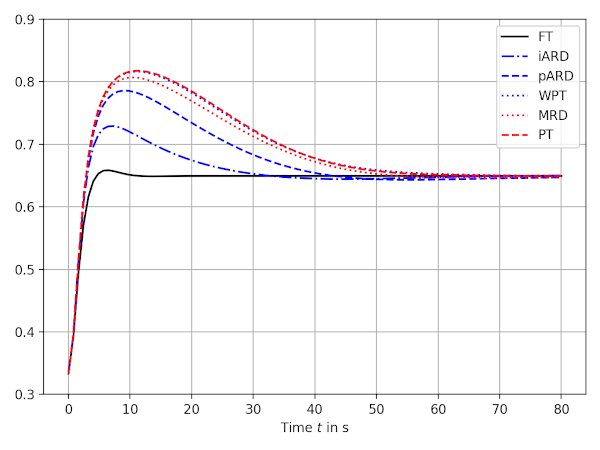
For example, the model comparison notebook reproduces Figure 2 in Favaloro, A.J., Tucker III, C.L., Composites Part A, 126 (2019):
Installation
pip install fiberoripy              # library
pip install "fiberoripy[examples]"  # plus interactive plotting for the notebooks
Quickstart
import numpy as np
from scipy.integrate import solve_ivp

from fiberoripy.closures import IBOF_closure, compute_closure
from fiberoripy.orientation import folgar_tucker_ode, integrate_ori_ode

# Close a second-order orientation tensor to fourth order.
A = compute_closure(np.diag([0.7, 0.2, 0.1]), "IBOF")


# Evolve an orientation state in simple shear.
def L(t):
    return np.array([[0.0, 0.0, 0.0], [1.0, 0.0, 0.0], [0.0, 0.0, 0.0]])


t = np.linspace(0.0, 100.0, 500)
solution = solve_ivp(
    integrate_ori_ode,
    (t.min(), t.max()),
    (np.eye(3) / 3.0).ravel(),
    t_eval=t,
    args=(L, IBOF_closure, folgar_tucker_ode, {"xi": 1.0, "Ci": 0.01}),
)
a = solution.y.T.reshape(-1, 3, 3)
Closures also accept stacked input of shape (N, 3, 3) or (N, 3, 3, 3, 3).
See the examples and the
API reference in the documentation.
Orientation models
Following models have been implemented:
- Jeffery:
G.B. Jeffery,
'The motion of ellipsoidal particles immersed in a viscous fluid',
Proceedings of the Royal Society A, 1922.
(https://doi.org/10.1098/rspa.1922.0078) - Folgar-Tucker:
F. Folgar, C.L. Tucker,
'Orientation behavior of fibers in concentrated suspensions',
Journal of Reinforced Plastic Composites 3, 98-119, 1984.
(https://doi.org/10.1177%2F073168448400300201) - FTMS:
A. Latz, U. Strautins, D. Niedziela,
'Comparative numerical study of two concentrated fiber suspension models',
Journal of Non-Newtonian Fluid Mechanics 165, 764-781, 2010.
(https://doi.org/10.1016/j.jnnfm.2010.04.001) - iARD(-RPR):
H.C. Tseng, R.Y. Chang, C.H. Hsu,
'An objective tensor to predict anisotropic fiber orientation in concentrated susp ensions',
Journal of Rheology 60, 215, 2016.
(https://doi.org/10.1122/1.4939098) - pARD(-RPR):
H.C. Tseng, R.Y. Chang, C.H. Hsu,
'The use of principal spatial tensor to predict anisotropic fiber orientation in concentrated fiber suspensions',
Journal of Rheology 62, 313, 2017.
(https://doi.org/10.1122/1.4998520) - MRD:
A. Bakharev, H. Yu, R. Speight and J. Wang,
“Using New Anisotropic Rotational Diffusion Model To Improve Prediction Of Short Fibers in Thermoplastic Injection Molding",
ANTEC, Orlando, 2018. - RSC:
J. Wang, J.F. O'Gara, and C.L. Tucker,
'An objective model for slow orientation kinetics in concentrated fiber suspensions: Theory and rheological evidence',
Journal of Rheology 52, 1179, 2008.
(https://doi.org/10.1122/1.2946437) - ARD-RSC:
J. H. Phelps, C. L. Tucker,
'An anisotropic rotary diffusion model for fiber orientation in short- and long-fiber thermoplastics',
Journal of Non-Newtonian Fluid Mechanics 156, 165-176, 2009.
(https://doi.org/10.1016/j.jnnfm.2008.08.002) - Mori-Tanaka:
T. Karl, T. Böhlke,
'Generalized Micromechanical Formulation of Fiber Orientation Tensor Evolution Equations',
International Journal of Mechanical Sciences, 2023.
(https://doi.org/10.1016/j.ijmecsci.2023.108771)
Closures
Closures are selected by name via compute_closure(a, closure=...).
Second- to fourth-order ((N,)3x3 -> (N,)3x3x3x3)
Accepted names: IBOF (default), LINEAR, QUADRATIC, HYBRID, ORF, ORW,
ORW3, SQC, SIQ, SIHYB.
- Linear, Quadratic, Hybrid:
Kyeong-Hee Han and Yong-Taek Im,
'Modified hybrid closure approximation for prediction of flow-induced fiber orientation',
Journal of Rheology 43, 569, 1999.
(https://doi.org/10.1122/1.551002) - IBOF:
Du Hwan Chung and Tai Hun Kwon,
'Invariant-based optimal fitting closure approximation for the numerical prediction of flow-induced fiber orientation',
Journal of Rheology 46(1), 169-194, 2002.
(https://doi.org/10.1122/1.1423312) - ORF, ORW, ORW3:
Joaquim S. Cintra and Charles L. Tucker III,
'Orthotropic closure approximations for flow-induced fiber orientation',
Journal of Rheology, 39(6), 1095-1122, 1995. (https://doi.org/10.1122/1.550630)
Du Hwan Chung and Tai Hun Kwon,
'Improved model of orthotropic closure approximation for flow induced fiber orientation',
Polymer Composites, 22(5), 636-649, 2001.
(https://doi.org/10.1002/pc.10566) - SQC:
Tobias Karl, Davide Gatti, Bettina Frohnapfel and Thomas Böhlke,
'Asymptotic fiber orientation states of the quadratically closed Folgar-Tucker equation and a subsequent closure improvement',
Journal of Rheology 65(5) : 999-1022, 2021
(https://doi.org/10.1122/8.0000245) - SIQ, SIHYB:
Tobias Karl, Matti Schneider and Thomas Böhlke,
'On fully symmetric implicit closure approximations for fiber orientation tensors',
Journal of Non-Newtonian Fluid Mechanics 318 : 105049, 2023.
(https://doi.org/10.1016/j.jnnfm.2023.105049)
Fourth- to sixth-order ((N,)3x3x3x3 -> (N,)3x3x3x3x3x3)
Accepted names: LINEAR, QUADRATIC, HYBRID.
- Linear, Quadratic, Hybrid:
Suresh G. Advani and Charles L. Tucker III,
'The Use of Tensors to Describe and Predict Fiber Orientation in Short Fiber Composites',
Journal of Rheology 31(8), 751-784, 1987.
(https://doi.org/10.1122/1.549945)
Approximations for equivalent aspect ratios
- Cox:
R.G. Cox,
'The motion of long slender bodies in a viscous fluid. Part 2. Shear flow.',
J. Fluid Mech. 1971, 45, 625–657.
(http://doi.org/10.1017/S0022112071000259) - Zhang:
D. Zhang, D.E. Smith, D.A. Jack, S. Montgomery-Smith,
'Numerical Evaluation of Single Fiber Motion for Short-Fiber-Reinforced Composite Materials Processing',
J. Manuf. Sci. Eng. 2011, 133, 51002.
(http://doi.org/10.1115/1.4004831)
Citing
Please cite the archived release, 10.5281/zenodo.4679755; full metadata is in CITATION.cff.
1 maintainer

Metadata
1 maintainer
Release files for fiberoripy 1.4.0
For a detailed explanation of source distributions (sdists) and built distributions (wheels), please see the package formats documentation.
Source distribution (sdist)
| File | Size | Uploaded | Provenance | Actions |
|---|---|---|---|---|
| fiberoripy-1.4.0.tar.gz | 23.2 kB | With provenance | Details for fiberoripy-1.4.0.tar.gz |
Built distribution (wheel)
| File | Interpreter | ABI | Platform | Actions Reset |
|---|---|---|---|---|
| fiberoripy-1.4.0-py3-none-any.whl | Python 3 | none | any | Details for fiberoripy-1.4.0-py3-none-any.whl |
Total release size: 43.6 kB
Release files / fiberoripy-1.4.0.tar.gz
| Download URL | fiberoripy-1.4.0.tar.gz |
|---|---|
| Size | 23.2 kB |
| Tags | Source |
|
SHA-256 checksum How to use checksums |
385df9099e110fae350dc2f652b1ce4b9e61be68f5fbf30b4f40c018b4dcac8b
|
|
BLAKE2b-256 checksum How to use checksums |
69614694ac9f83fa61a74754e51db80b9387803c0dc0ffc5ef067b07057ae5da
|
| Upload date | |
|
Uploaded using Trusted Publishing? What is trusted publishing? |
Yes |
| Uploaded via |
twine/7.0.0 CPython/3.13.14
|
Provenance
Provenance describes where a file came from. On PyPI, provenance is shared via attestations, which provide a verifiable record of the build or publishing details. View details, limitations and caveats.


PyPI Publish Attestation
PyPI verified that this artifact, at this checksum, originated from the publisher listed below.
Signed by GitHub Actions, verified by PyPI on Sep 16, 2026.
Transparency logRelease files / fiberoripy-1.4.0-py3-none-any.whl
| Download URL | fiberoripy-1.4.0-py3-none-any.whl |
|---|---|
| Size | 20.4 kB |
| Tags | Python 3 |
|
SHA-256 checksum How to use checksums |
aaebbcf88f6dd296bedad7c3a2ec806bec606934d1bbbc982000b398e941fb9b
|
|
BLAKE2b-256 checksum How to use checksums |
e99b1edf2b99c95bd4fb6e052579cf44b474fb6140561822ff3f329b2c5ed114
|
| Upload date | |
|
Uploaded using Trusted Publishing? What is trusted publishing? |
Yes |
| Uploaded via |
twine/7.0.0 CPython/3.13.14
|
Provenance
Provenance describes where a file came from. On PyPI, provenance is shared via attestations, which provide a verifiable record of the build or publishing details. View details, limitations and caveats.
PyPI Publish Attestation
PyPI verified that this artifact, at this checksum, originated from the publisher listed below.
Signed by GitHub Actions, verified by PyPI on Sep 16, 2026.
Transparency logSecurity for fiberoripy 1.4.0
Provenance
Provenance describes where a file came from. On PyPI, provenance is shared via attestations, which provide a verifiable record of the build or publishing details. View details, limitations and caveats.
Full provenance
All 2 files in this release have been uploaded with provenance metadata.
Attestation for fiberoripy-1.4.0.tar.gz
PyPI Publish Attestation
PyPI verified that this artifact, at this checksum, originated from the publisher listed below.
Signed by GitHub Actions, verified by PyPI on Sep 16, 2026.
Transparency logA note on package security
PyPI is a repository for distributing packages, not a service for auditing them. While third-party security researchers and our staff do their best to detect and remove malicious packages, PyPI cannot guarantee the quality, security or suitability of any given package.
To learn more about protecting yourself from malicious actors, visit our package security documentation.














