
forge-work
A single command to run everything you need for Django development at once.
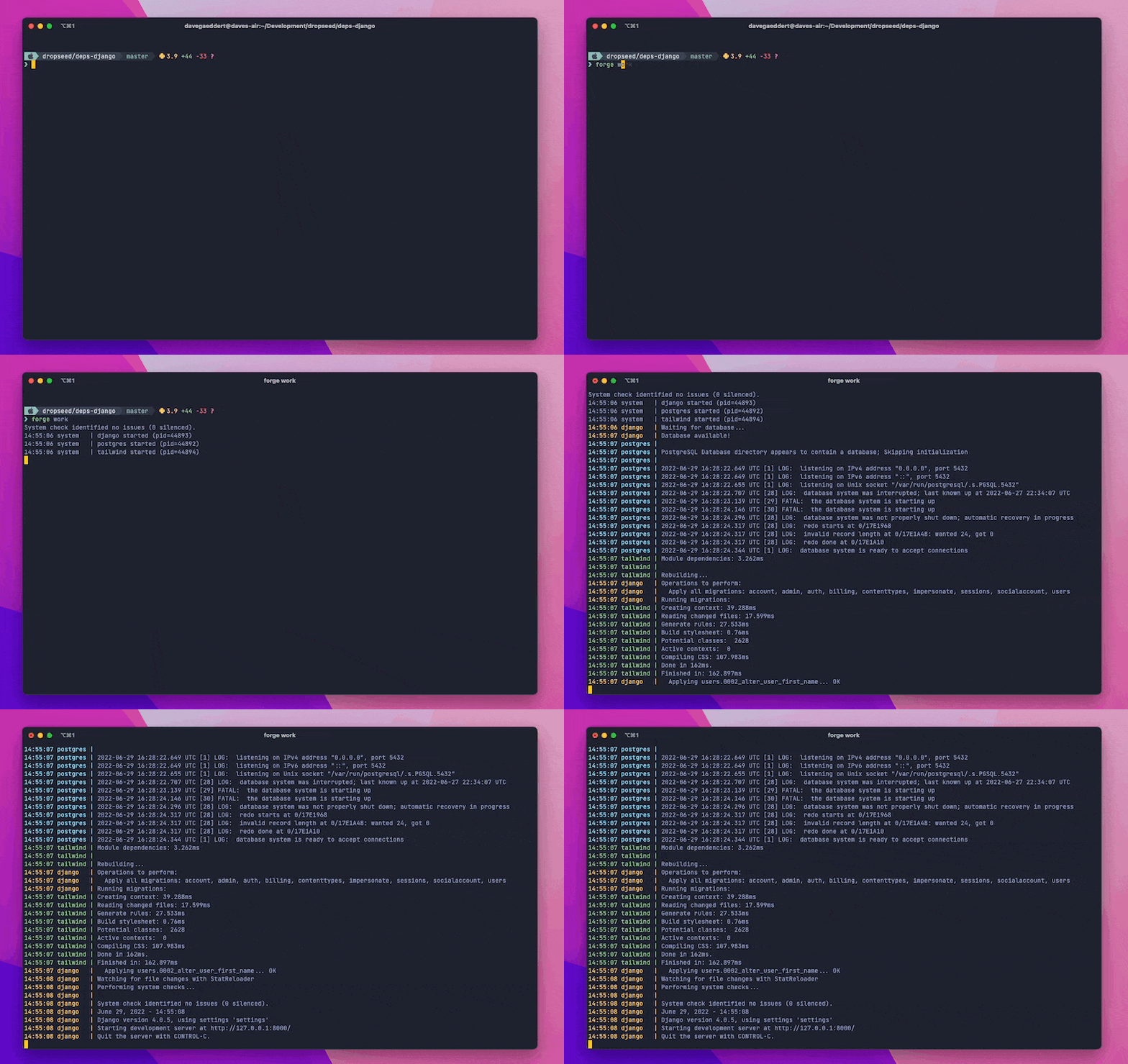
The following processes will run simultaneously (some will only run if they are detected as available):
manage.py runserver(and migrations)forge-db start --logsforge-tailwind compile --watchnpm run watchstripe listen --forward-tongrok http --subdomain
Installation
Forge installation
The forge-work package is a dependency of forge and is available as forge work.
If you use the Forge quickstart, everything you need will already be set up.
The standard Django installation can give you an idea of the steps involved.
Standard Django installation
This package can be used without forge by installing it as a regular Django app.
First, install forge-work from PyPI:
pip install forge-work
Then add it to your INSTALLED_APPS in settings.py:
INSTALLED_APPS = [
    ...
    "forgework",
]
Now instead of using the basic manage.py runserver (and a bunch of commands before and during that process), you can simply do:
python manage.py work
Processes
Runserver
The key process here is still manage.py runserver.
But, before that runs, it will also wait for the database to be available and run manage.py migrate.
forge-db
The forge-db package uses Docker to run a local Postgres database.
If forge-db is installed, it will automatically start and show the logs of the running database container.
forge-tailwind
The forge-tailwind package compiles Tailwind CSS using the Tailwind standalone CLI.
If forge-tailwind is installed, it will automatically run the Tailwind compile --watch process.
package.json
If a package.json file is found and contains a watch script,
it will automatically run.
This is an easy place to run your own custom JavaScript watch process.
Stripe
If a STRIPE_WEBHOOK_PATH env variable is set then this will add a STRIPE_WEBHOOK_SECRET to .env (using stripe listen --print-secret) and it will then run stripe listen --forward-to <runserver:port/stripe-webhook-path>.
Ngrok
If an NGROK_SUBDOMAIN env variable is set then this will run ngrok http <runserver_port> --subdomain <subdomain>.
1 maintainer

Metadata
1 maintainer
Release files for forge-work 0.2.0
For a detailed explanation of source distributions (sdists) and built distributions (wheels), please see the package formats documentation.
Source distribution (sdist)
| File | Size | Uploaded | Provenance | Actions |
|---|---|---|---|---|
| forge-work-0.2.0.tar.gz | 5.2 kB | Without provenance | Details for forge-work-0.2.0.tar.gz |
Built distribution (wheel)
| File | Interpreter | ABI | Platform | Actions Reset |
|---|---|---|---|---|
| forge_work-0.2.0-py3-none-any.whl | Python 3 | none | any | Details for forge_work-0.2.0-py3-none-any.whl |
Total release size: 11.8 kB
Release files / forge-work-0.2.0.tar.gz
| Download URL | forge-work-0.2.0.tar.gz |
|---|---|
| Size | 5.2 kB |
| Tags | Source |
|
SHA-256 checksum How to use checksums |
9eabd3689e16acdbe76718870314610857d67b990a396e1b363f2afb81f0fa9b
|
|
BLAKE2b-256 checksum How to use checksums |
08c65e37bcec1ba4325716f606c0417fe14840db471369a358d0c82165b47e61
|
| Upload date | |
|
Uploaded using Trusted Publishing? What is trusted publishing? |
No |
| Uploaded via |
poetry/1.1.13 CPython/3.10.5 Linux/5.13.0-1031-azure
|
Release files / forge_work-0.2.0-py3-none-any.whl
| Download URL | forge_work-0.2.0-py3-none-any.whl |
|---|---|
| Size | 6.5 kB |
| Tags | Python 3 |
|
SHA-256 checksum How to use checksums |
fb4e4025e1870ababa5e48e778c6bff47ddbfc40aa880554a2e437192b8fc199
|
|
BLAKE2b-256 checksum How to use checksums |
5e8f8546395e185390fd677962ccddb58fd1f9401e4ccdd4dc337127341075e0
|
| Upload date | |
|
Uploaded using Trusted Publishing? What is trusted publishing? |
No |
| Uploaded via |
poetry/1.1.13 CPython/3.10.5 Linux/5.13.0-1031-azure
|
Security for forge-work 0.2.0
Provenance
Provenance describes where a file came from. On PyPI, provenance is shared via attestations, which provide a verifiable record of the build or publishing details. View details, limitations and caveats.
No provenance found
None of the files in this release were uploaded with provenance metadata.
A note on package security
PyPI is a repository for distributing packages, not a service for auditing them. While third-party security researchers and our staff do their best to detect and remove malicious packages, PyPI cannot guarantee the quality, security or suitability of any given package.
To learn more about protecting yourself from malicious actors, visit our package security documentation.














