
This project has been archived by its maintainers, and is no longer receiving any updates.
Foxglove WebSocket server
⚠️ Important Notice: This package is no longer maintained and has been replaced by foxglove-sdk. We recommend migrating to the Foxglove SDK for future development.
This package provides a server implementation of the Foxglove WebSocket protocol with examples. The protocol enables Foxglove to ingest arbitrary “live” streamed data.
Example servers
This package includes example servers demonstrating how to use JSON and Protobuf data. To install additional dependencies required for the examples, run:
$ pip install 'foxglove-websocket[examples]'
Run a simple example server that publishes messages on a single example_msg topic:
-
JSON server – Uses JSON to encode message data and JSON Schema to describe the message layout.
python -m foxglove_websocket.examples.json_server -
Protobuf server – Uses Protobuf to encode message data.
python -m foxglove_websocket.examples.protobuf_server
Note: You must exit each server (control + c) before starting up another.
To see data from any server, open Foxglove with a Foxglove WebSocket connection to ws://localhost:8765/:
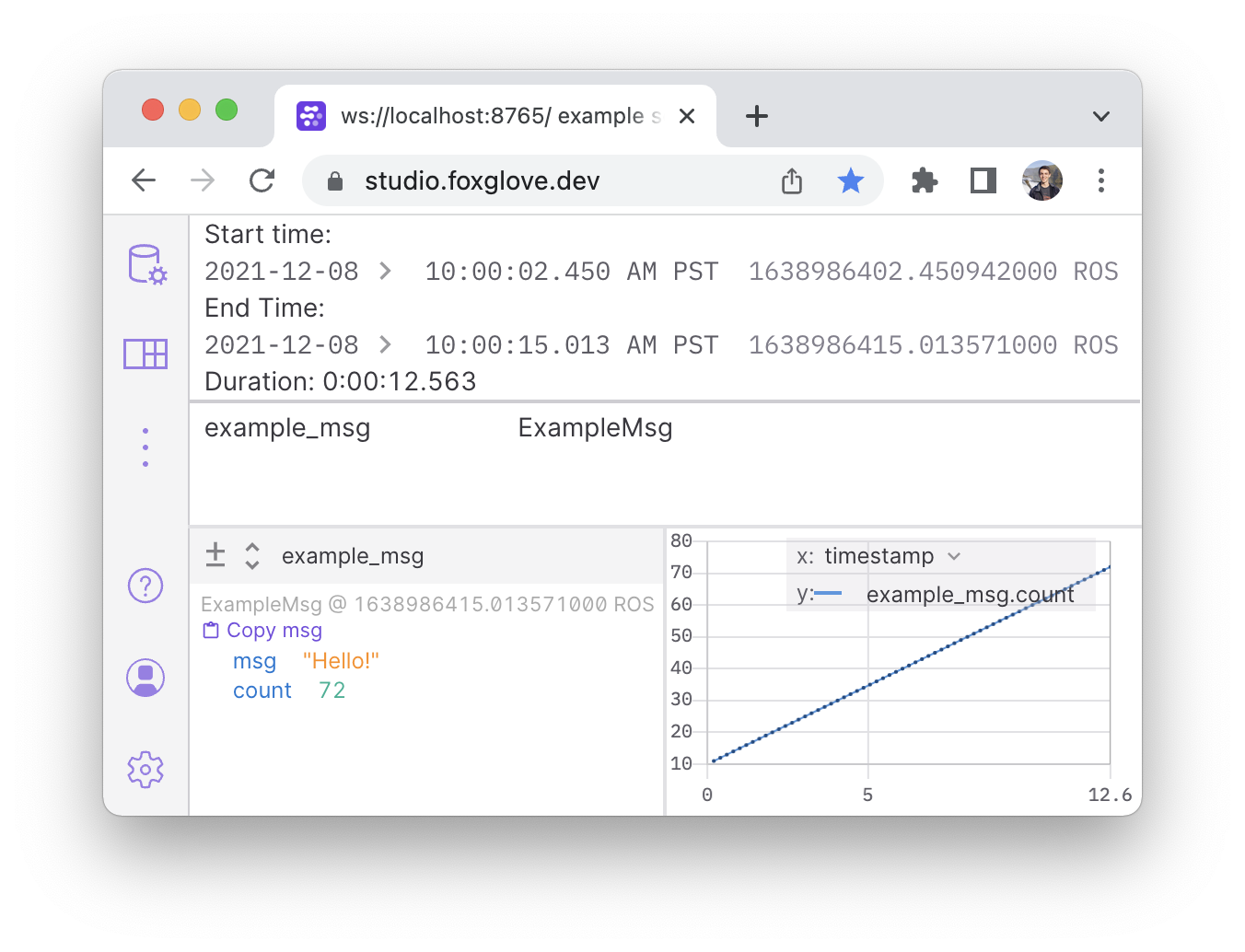
To customize each server for your specifications, copy either server into a separate file like server.py and make the desired adjustments to this template. Start up your server from the command line, using python3 server.py.
Multi-threaded usage
The threaded_server example demonstrates how to use the FoxgloveServer class in a thread-safe way when interacting with a threaded middleware. Run the server using:
python -m foxglove_websocket.examples.threaded_server
When connected to the server in Foxglove, use the Data Source Info panel to see channels appearing and disappearing, and a Plot panel to visualize data on each channel.
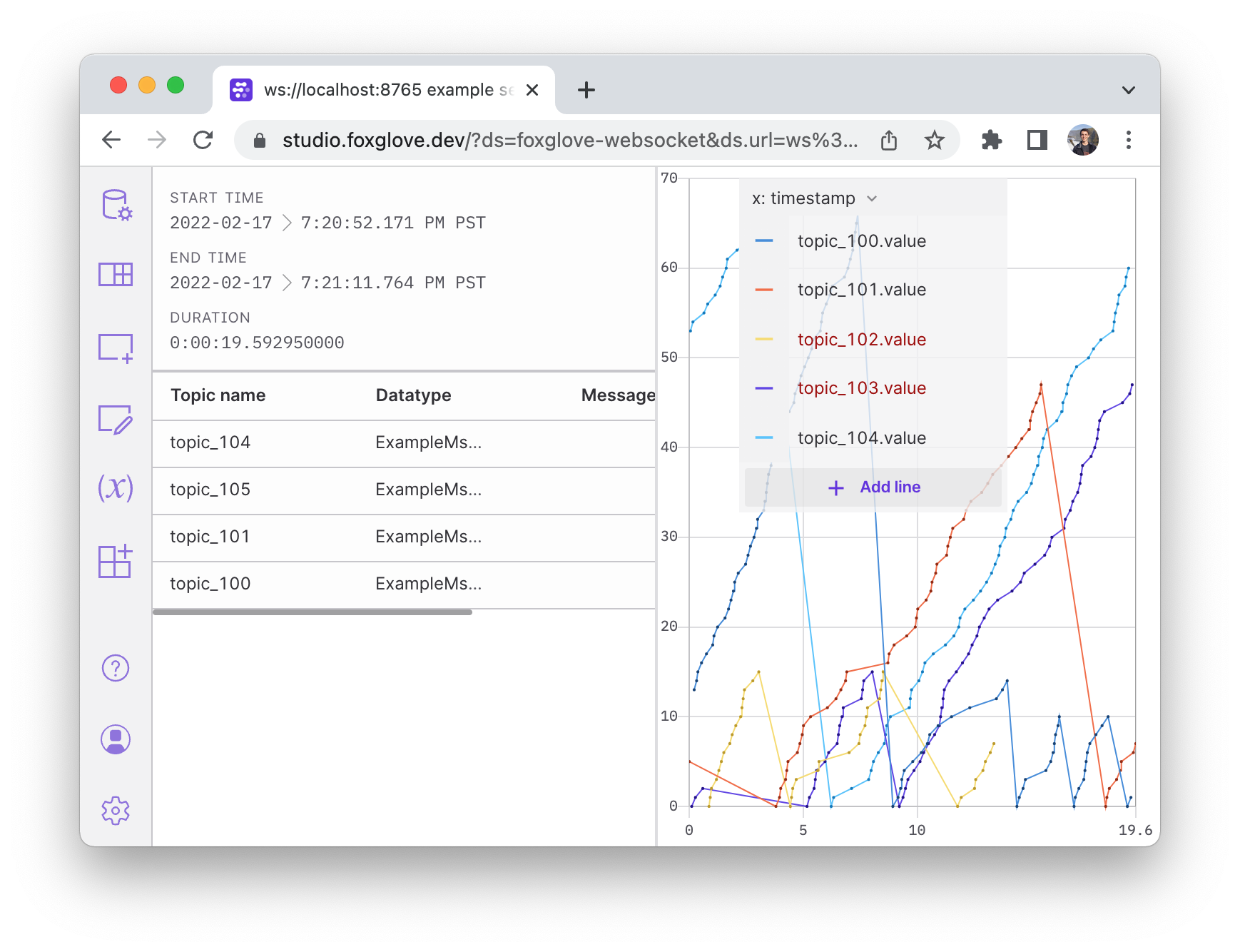
For a more detailed explanation, read the example's source code.
Development
When developing or maintaining the foxglove-websocket package, it is recommended to use pipenv to manage development dependencies and virtualenv.
pipenv install --dev– Create avirtualenvand install development dependenciespipenv shell– Enter thevirtualenv
Metadata
Release files for foxglove-websocket 0.1.4
For a detailed explanation of source distributions (sdists) and built distributions (wheels), please see the package formats documentation.
Source distribution (sdist)
| File | Size | Uploaded | Provenance | |
|---|---|---|---|---|
| foxglove_websocket-0.1.4.tar.gz | 16.6 kB | With provenance | Details |
Built distribution (wheel)
| File | Interpreter | ABI | Platform | Reset |
|---|---|---|---|---|
| foxglove_websocket-0.1.4-py3-none-any.whl | Python 3 | none | any | Details |
Total release size: 31.0 kB
Release files / foxglove_websocket-0.1.4.tar.gz
| Download URL | foxglove_websocket-0.1.4.tar.gz |
|---|---|
| Size | 16.6 kB |
| Tags | Source |
|
SHA-256 checksum How to use checksums |
2ec8936982e478d103dd90268a572599fc0cce45a4ab95490d5bc31f7c8a8af8
|
|
BLAKE2b-256 checksum How to use checksums |
dbb5df32ac550eb0df9000ed78d872eb19738edecfd88f47fe08588d5066f317
|
| Upload date | |
|
Uploaded using Trusted Publishing? What is trusted publishing? |
Yes |
| Uploaded via |
twine/6.1.0 CPython/3.12.9
|
Provenance
Provenance describes where a file came from. On PyPI, provenance is shared via attestations, which provide a verifiable record of the build or publishing details. View details, limitations and caveats.


PyPI Publish Attestation
PyPI verified that this artifact, at this checksum, originated from the publisher listed below.
Signed by GitHub Actions, verified by PyPI on Jul 14, 2025.
Transparency logRelease files / foxglove_websocket-0.1.4-py3-none-any.whl
| Download URL | foxglove_websocket-0.1.4-py3-none-any.whl |
|---|---|
| Size | 14.4 kB |
| Tags | Python 3 |
|
SHA-256 checksum How to use checksums |
772e24e2c98bdfc704df53f7177c8ff5bab0abc4dac59a91463aca16debdd83a
|
|
BLAKE2b-256 checksum How to use checksums |
c4733a3e6cb864ddf98800a9236ad497d32e5b50eb1682ac659f7d669d92faec
|
| Upload date | |
|
Uploaded using Trusted Publishing? What is trusted publishing? |
Yes |
| Uploaded via |
twine/6.1.0 CPython/3.12.9
|
Provenance
Provenance describes where a file came from. On PyPI, provenance is shared via attestations, which provide a verifiable record of the build or publishing details. View details, limitations and caveats.
PyPI Publish Attestation
PyPI verified that this artifact, at this checksum, originated from the publisher listed below.
Signed by GitHub Actions, verified by PyPI on Jul 14, 2025.
Transparency logSecurity for foxglove-websocket 0.1.4
Provenance
Provenance describes where a file came from. On PyPI, provenance is shared via attestations, which provide a verifiable record of the build or publishing details. View details, limitations and caveats.
Full provenance
All 2 files in this release have been uploaded with provenance metadata.
Attestation for foxglove_websocket-0.1.4.tar.gz
PyPI Publish Attestation
PyPI verified that this artifact, at this checksum, originated from the publisher listed below.
Signed by GitHub Actions, verified by PyPI on Jul 14, 2025.
Transparency logA note on package security
PyPI is a repository for distributing packages, not a service for auditing them. While third-party security researchers and our staff do their best to detect and remove malicious packages, PyPI cannot guarantee the quality, security or suitability of any given package.














