
functional-streams
Writing concise functional code in python
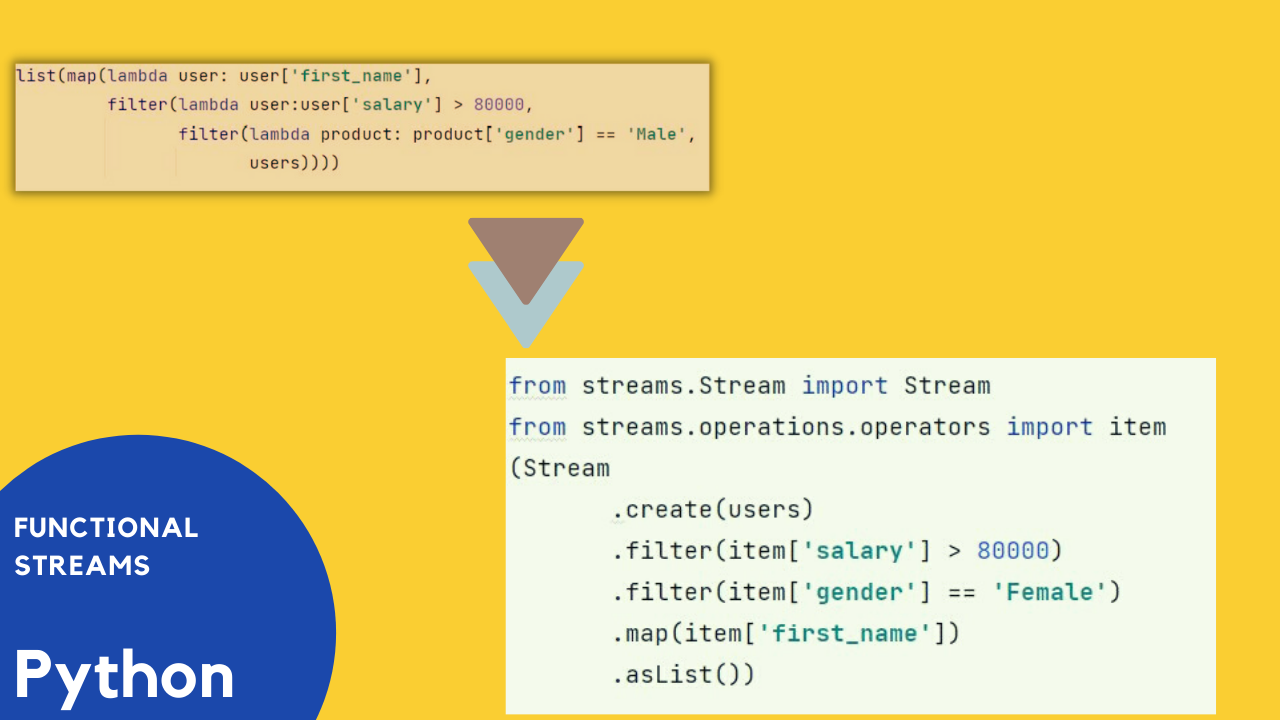
#To Fetch from a list of users
#       Get their firstname , if their salary greater than 80000 and gender is male

#Instead of writing like this


list(map(lambda user: user['first_name'],
         filter(lambda user:user['salary'] > 80000,
                filter(lambda product: product['gender'] == 'Male',
                       users))))


#Write this
from streams.Stream import Stream
from streams.operations.operators import item

(Stream
   .create(users)
   .filter(item['salary'] > 80000)
   .filter(item['gender'] == 'Female')
   .map(item['first_name'])
   .asList())


# You could have seen there is no lambdas involved in above code, for transformation
# You are free to use lambdas or functions as well , something like below


(Stream
   .create(users)
   .filter(lambda user:user['salary'] > 80000)
   .filter(lambda product: product['gender'] == 'Male')
   .map(lambda user: user['first_name'])
   .asList())


#A concise way to write functional code in python
from streams.Stream import Stream
from streams.operations.operators import item
users = [
    {
        "id": 1,
        "first_name": "Mandy",
        "last_name": "Gowan",
        "email": "mgowan0@aol.com",
        "gender": "Female",
        "loves": ['Soccer','Cricket','Golf'],
        "salary": 119885
    },
    {
        "id": 2,
        "first_name": "Janessa",
        "last_name": "Cotterell",
        "email": "jcotterell1@aol.com",
        "gender": "Female",
        "loves": ['Cricket'],
        "salary": 107629
    },
    {
        "id": 6,
        "first_name": "Jasen",
        "last_name": "Franzini",
        "email": "jfranzini5@aol.com",
        "gender": "Male",
        "loves": ['Soccer','Golf'],
        "salary": 78373
    }
]

#Using Map Filter
results = (Stream
           .create(users)
           .filter(item['salary'] > 80000)
           .map(item['first_name'])
           .asList())
#['Mandy', 'Janessa']

#Using flatMap Distinct
results = (Stream
           .create(users)
           .flatmap(item['loves'] )
           .distinct()
           .asList())
#['Cricket', 'Golf', 'Soccer']

#Using skip take
results = (Stream
           .create(users)
           .skip(1)
           .take(1)
           .map(item['first_name'])
           .asList())
#['Janessa']


#Even you can peek results
results = (Stream
           .create(users)
           .peek(lambda data:print("User",data))
           .map(item['first_name'])
           .asList())

#also for peek with item.print or can use side effects inside
(Stream
   .create(users)
   .peek(item.print)
   .map(item['first_name'])
   .asList())

#Will list out all users


#Also To find product within range of 5 elements
(Stream
   .create(range(5))
   .map(item * 2)
   .asList())
#Result [0, 2, 4, 6, 8]
babynames.csv

Id,Male name,Female name
1,Liam,Olivia
2,Noah,Emma
#From CSV to csv
from streams.FileStream import FileStream
from streams.operations.operators import item

(FileStream.createFromCsv(full_path_of_input_csv)
         .filter(item['Female name'].startswith("A"))
         .map(item['Female name'])
         .peek(item.print)
         .asCSV(full_path_of_output_csv))
#From text and to text
from streams.FileStream import FileStream


(FileStream.createFromText(full_path_of_input_text)
         .filter(lambda value: value.startswith("A"))
         .peek(lambda val: print(val))
         .asTextFile(full_path_of_output_text))
Additional Information
Design
Most of the functions underneath uses the same functions available in python (map uses map , filter uses filter etc..). Only we have added wrapper to make the code concise
Abstractions
If you need to use abstract items, use the same chaining and just invoke the stream when you are using it as the generators used get corrupted by the very first expansion For Example
from streams.Stream import Stream
from streams.operations.operators import item

stream_of_users = (Stream
                   .create(users)
                   )

# The below code might not work , as the genrators expire once you aggregate it
total_users = (stream_of_users
               .length())

firstname_of_users = (stream_of_users
                      .map(lambda user: user['first_name'])
                      .asList())

# The above code should be rewritten as
total_users = (stream_of_users
               .stream()
               .length())

firstname_of_users = (stream_of_users
                      .stream()
                      .map(lambda user: user['first_name'])
                      .asList())

# The stream will make use of copying the generators
Transducers
If you need to use transducers, create with Stream.transducer and connect with pipe whenever required
For Example
skip_five_and_take_three_items = (Stream
                                  .transducer()
                                  .skip(5)
                                  .take(3)
                                  )

skip_five_and_take_three_items_within_zero_to_hundred = (Stream
                                                         .createFromText(range(100))
                                                         .pipe(skip_five_and_take_three_items)
                                                         .asList()
                                                         )
# Result [5, 6, 7]

skip_five_and_take_three_items_within_700_to_800 = (Stream
                                                    .createFromText(range(700, 800))
                                                    .pipe(skip_five_and_take_three_items)
                                                    .asList()
                                                    )
# Result [705, 706, 707]
Known Constraints
This section will list down the constraints of library
Single Operator with item
The item object will support only one operation, for more than one operations use lambda or refactor code
from streams.Stream import Stream
from streams.operations.operators import item

(Stream
   .create(range(5))
    .map(item + 1)
    .reduce(item.sum)
    .asSingle())
# Output 15


(Stream
   .create(range(5))
    .map(item + 1)
    .reduce(item.sum)
    .asSingle())
# Result 15

(Stream
   .create(range(10))
    .filter(item.isodd)
    .asList()
    )

#Result  [1, 3, 5, 7, 9]

#All the above will work , as

#The below will not work , as filter has two operators mod (%)  && Equal to (==)
(Stream
   .create(range(10))
    .filter(item % 2 == 1)
    .asList()
    )

#For these scenarios use lambda
(Stream
   .create(range(10))
    .filter(lambda value: value % 2 == 1)
    .asList()
    )
Contributors
This is just a syntactic sugar, with no other third party software involved. Everything has been written with built-in modules, Because of very hard fights with yawpitch. I started taking performance,space complexity seriously. Thanks for the extremely valuable suggestions. I would like to appreciate him for all his suggestions
1 maintainer

Metadata
1 maintainer
Release files for functional-streams 1.6.4
For a detailed explanation of source distributions (sdists) and built distributions (wheels), please see the package formats documentation.
Source distribution (sdist)
| File | Size | Uploaded | |
|---|---|---|---|
| functional-streams-1.6.4.tar.gz | 8.1 kB | Details |
Built distribution (wheel)
| File | Interpreter | ABI | Platform | Reset |
|---|---|---|---|---|
| functional_streams-1.6.4-py3-none-any.whl | Python 3 | none | any | Details |
Total release size: 17.3 kB
Release files / functional-streams-1.6.4.tar.gz
| Download URL | functional-streams-1.6.4.tar.gz |
|---|---|
| Size | 8.1 kB |
| Tags | Source |
|
SHA-256 checksum How to use checksums |
a955ccf92dcf8b1b6196fa19bd9689013e9d9ee9d5e4c26221de8f19efcc1000
|
|
BLAKE2b-256 checksum How to use checksums |
ac1113205602532a1f954aa21fa4ea69ea1726dcdef0f3cb9383340c62dfa557
|
| Upload date | |
|
Uploaded using Trusted Publishing? What is trusted publishing? |
No |
| Uploaded via |
twine/3.4.1 importlib_metadata/3.10.0 pkginfo/1.7.0 requests/2.25.1 requests-toolbelt/0.9.1 tqdm/4.59.0 CPython/3.8.8
|
Release files / functional_streams-1.6.4-py3-none-any.whl
| Download URL | functional_streams-1.6.4-py3-none-any.whl |
|---|---|
| Size | 9.2 kB |
| Tags | Python 3 |
|
SHA-256 checksum How to use checksums |
242c550322622cdb4662aa510e53e5dd7a3ae5ef8c8bb13ba54868d6237f2e4f
|
|
BLAKE2b-256 checksum How to use checksums |
4bee98555d0313762e6e0b5c58f12013cdf72edfe2aacbb40986f6faedf6db33
|
| Upload date | |
|
Uploaded using Trusted Publishing? What is trusted publishing? |
No |
| Uploaded via |
twine/3.4.1 importlib_metadata/3.10.0 pkginfo/1.7.0 requests/2.25.1 requests-toolbelt/0.9.1 tqdm/4.59.0 CPython/3.8.8
|














