
Gecos - Generated Color Schemes for sequence alignment visualizations
Multiple sequence alignments are often visualized by coloring the symbols according to some kind of properties. For example a color scheme for amino acids could use one color for hydrophobic residues, another color for positively charged residues and so forth. Usually, such color schemes are manually created by experienced people who have knowledge about the characteristics of the e.g. amino acids, so they can assign equal or similar colors to amino acids that share similar properties.
The Gecos software follows a different approach: Instead of looking at specific, sometimes subjective properties, it uses another source for estimating the similarity of symbols: the substitution matrix itself. Similar colors are assigned to high scoring pairs of symbols, low scoring pairs get distant colors - in a completely automatic manner. As a result the distance of two symbols in the substitution matrix corresponds to the perceptual differences in the color scheme.
How about an example? The following command line invocation creates a light color scheme. An example alignment using the newly generated color scheme is displayed below.
$ gecos --matrix BLOSUM62 --lmin 60 --lmax 75 -f awesome_colors.json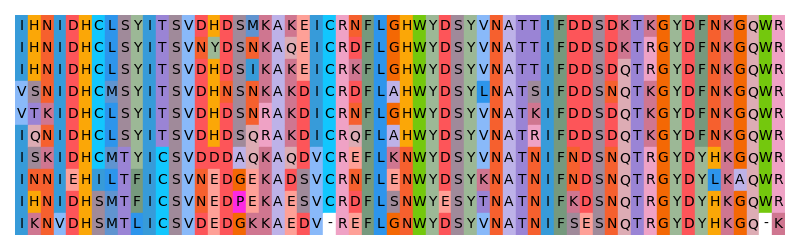
Installation
In order to use Gecos you need to have Python (at least 3.6) installed. Furthermore, the following Python packages are required:
biotite
numpy
matplotlib
scikit-image
If these prerequisites are met, Gecos is simply installed via
$ pip install gecosAlternatively, Gecos can be installed via Conda:
$ conda install -c conda-forge gecosCitation
If you use Gecos in a scientific publication, please cite:
P. Kunzmann, B. E. Mayer, K. Hamacher, “Substitution matrix based color schemes for sequence alignment visualization,” BMC Bioinformatics, vol. 21, pp. 209, 2020. doi: 10.1186/s12859-020-3526-6
2 maintainers


Metadata
2 maintainers
Release files for gecos 2.0.0
For a detailed explanation of source distributions (sdists) and built distributions (wheels), please see the package formats documentation.
Source distribution (sdist)
| File | Size | Uploaded | Provenance | Actions |
|---|---|---|---|---|
| gecos-2.0.0.tar.gz | 49.2 kB | Without provenance | Details for gecos-2.0.0.tar.gz |
Built distribution (wheel)
| File | Interpreter | ABI | Platform | Actions Reset |
|---|---|---|---|---|
| gecos-2.0.0-py3-none-any.whl | Python 3 | none | any | Details for gecos-2.0.0-py3-none-any.whl |
Total release size: 107.7 kB
Release files / gecos-2.0.0.tar.gz
| Download URL | gecos-2.0.0.tar.gz |
|---|---|
| Size | 49.2 kB |
| Tags | Source |
|
SHA-256 checksum How to use checksums |
1b2e2b7be3f4977a191e5caf664307f5a463e73bdd1f22c175d8bafd4472a3fe
|
|
BLAKE2b-256 checksum How to use checksums |
eb12a3cc14b604f495702e5c15144aa7a47838f737c22a92fdee88735c700c42
|
| Upload date | |
|
Uploaded using Trusted Publishing? What is trusted publishing? |
No |
| Uploaded via |
twine/3.7.1 importlib_metadata/4.11.3 pkginfo/1.8.2 requests/2.27.1 requests-toolbelt/0.9.1 tqdm/4.64.0 CPython/3.9.12
|
Release files / gecos-2.0.0-py3-none-any.whl
| Download URL | gecos-2.0.0-py3-none-any.whl |
|---|---|
| Size | 58.5 kB |
| Tags | Python 3 |
|
SHA-256 checksum How to use checksums |
d3866ec738f9f6ae01ed3f18a5bef92038e6826d01e2c30d67fec2e03ce7937f
|
|
BLAKE2b-256 checksum How to use checksums |
535412333e741a8767e26a95365bc6aa8b5b075d6aa505e5cb8a68d75da08fff
|
| Upload date | |
|
Uploaded using Trusted Publishing? What is trusted publishing? |
No |
| Uploaded via |
twine/3.7.1 importlib_metadata/4.11.3 pkginfo/1.8.2 requests/2.27.1 requests-toolbelt/0.9.1 tqdm/4.64.0 CPython/3.9.12
|
Security for gecos 2.0.0
Provenance
Provenance describes where a file came from. On PyPI, provenance is shared via attestations, which provide a verifiable record of the build or publishing details. View details, limitations and caveats.
No provenance found
None of the files in this release were uploaded with provenance metadata.
A note on package security
PyPI is a repository for distributing packages, not a service for auditing them. While third-party security researchers and our staff do their best to detect and remove malicious packages, PyPI cannot guarantee the quality, security or suitability of any given package.
To learn more about protecting yourself from malicious actors, visit our package security documentation.














