
gym-sapientino














OpenAI Gym Sapientino environment using Pygame.
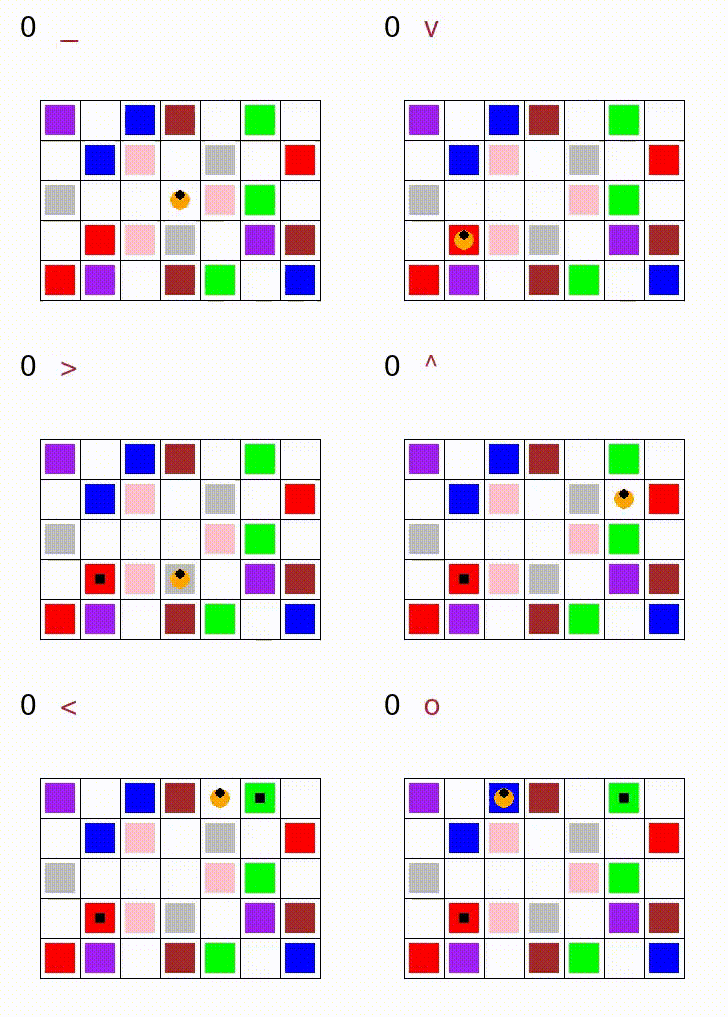
Description
The environment is inspired by a game for kids called Sapientino.
A robot moves on a gridworld-like environment, where each cell can be coloured. When a robot is on a coloured cell, it can run a beep, meaning it has visited the cell.
The environment is compliant with the OpenAI Gym APIs. The idea is that the designer of the experiment should implement the actual reward by wrapping the environment.
Dependencies
The environment is implemented using Pygame.
On Ubuntu, you need the following libraries:
sudo apt-get install python3-dev \
    libsdl-image1.2-dev libsdl-mixer1.2-dev libsdl-ttf2.0-dev libsmpeg-dev \
    libsdl1.2-dev  libportmidi-dev libswscale-dev libavformat-dev libavcodec-dev libfreetype6-dev
On MacOS (not tested):
brew install sdl sdl_ttf sdl_image sdl_mixer portmidi  # brew or use equivalent means
conda install -c https://conda.binstar.org/quasiben pygame  # using Anaconda
Install
Install with pip:
pip install gym_sapientino
Or, install from source:
git clone https://github.com/whitemech/gym-sapientino.git
cd gym-sapientino
pip install .
Development
- clone the repo:
git clone https://github.com/whitemech/gym-sapientino.git
cd gym-sapientino
- Create/activate the virtual environment:
poetry shell --python=python3.7
- Install development dependencies:
poetry install
Tests
To run tests: tox
To run only the code tests: tox -e py3.7
To run only the linters:
tox -e flake8tox -e mypytox -e black-checktox -e isort-check
Please look at the tox.ini file for the full list of supported commands.
Docs
To build the docs: mkdocs build
To view documentation in a browser: mkdocs serve
and then go to http://localhost:8000
License
gym-sapientino is released under the GNU General Public License v3.0 or later (GPLv3+).
Copyright 2019-2020 Marco Favorito, Luca Iocchi
Authors
Credits
The code is largely inspired by RLGames
If you want to use this environment in your research, please consider citing this conference paper:
@inproceedings{Giacomo2019FoundationsFR,
  title={Foundations for Restraining Bolts: Reinforcement Learning with LTLf/LDLf Restraining Specifications},
  author={Giuseppe De Giacomo and L. Iocchi and Marco Favorito and F. Patrizi},
  booktitle={ICAPS},
  year={2019}
}
1 maintainer

Metadata
1 maintainer
Release files for gym-sapientino 0.2.0
For a detailed explanation of source distributions (sdists) and built distributions (wheels), please see the package formats documentation.
Source distribution (sdist)
| File | Size | Uploaded | Provenance | |
|---|---|---|---|---|
| gym_sapientino-0.2.0.tar.gz | 26.4 kB | Without provenance | Details |
Built distribution (wheel)
| File | Interpreter | ABI | Platform | Reset |
|---|---|---|---|---|
| gym_sapientino-0.2.0-py3-none-any.whl | Python 3 | none | any | Details |
Total release size: 61.6 kB
Release files / gym_sapientino-0.2.0.tar.gz
| Download URL | gym_sapientino-0.2.0.tar.gz |
|---|---|
| Size | 26.4 kB |
| Tags | Source |
|
SHA-256 checksum How to use checksums |
040e253c3572bc4027b98a79d69ada15c35c8cfd8ee1c8cc60949f02ec60180b
|
|
BLAKE2b-256 checksum How to use checksums |
2a03c582044ce54bae5c1045a66ad2e1b5ac6029e2377700096a5464aed1459e
|
| Upload date | |
|
Uploaded using Trusted Publishing? What is trusted publishing? |
No |
| Uploaded via |
twine/3.2.0 pkginfo/1.5.0.1 requests/2.24.0 setuptools/40.8.0 requests-toolbelt/0.9.1 tqdm/4.48.2 CPython/3.7.5
|
Release files / gym_sapientino-0.2.0-py3-none-any.whl
| Download URL | gym_sapientino-0.2.0-py3-none-any.whl |
|---|---|
| Size | 35.2 kB |
| Tags | Python 3 |
|
SHA-256 checksum How to use checksums |
5902e5b63825f08c305eaa9c14abc63220a5334ae4f6d0e25db47e3bbba6fb2f
|
|
BLAKE2b-256 checksum How to use checksums |
b688f3c9d956a9081240fda54c711027cabbc59fe668ee6b665743936559832f
|
| Upload date | |
|
Uploaded using Trusted Publishing? What is trusted publishing? |
No |
| Uploaded via |
twine/3.2.0 pkginfo/1.5.0.1 requests/2.24.0 setuptools/40.8.0 requests-toolbelt/0.9.1 tqdm/4.48.2 CPython/3.7.5
|
Security for gym-sapientino 0.2.0
Provenance
Provenance describes where a file came from. On PyPI, provenance is shared via attestations, which provide a verifiable record of the build or publishing details. View details, limitations and caveats.
No provenance found
None of the files in this release were uploaded with provenance metadata.
A note on package security
PyPI is a repository for distributing packages, not a service for auditing them. While third-party security researchers and our staff do their best to detect and remove malicious packages, PyPI cannot guarantee the quality, security or suitability of any given package.
To learn more about protecting yourself from malicious actors, visit our package security documentation.














