
HashDate


Turns Python datetimes (or iso dates with cli) into hashes.
The hashes support shortening to reduce precision, so a prefix of a hash will be the same datetime rounded to the given hashlength.
Cli usage
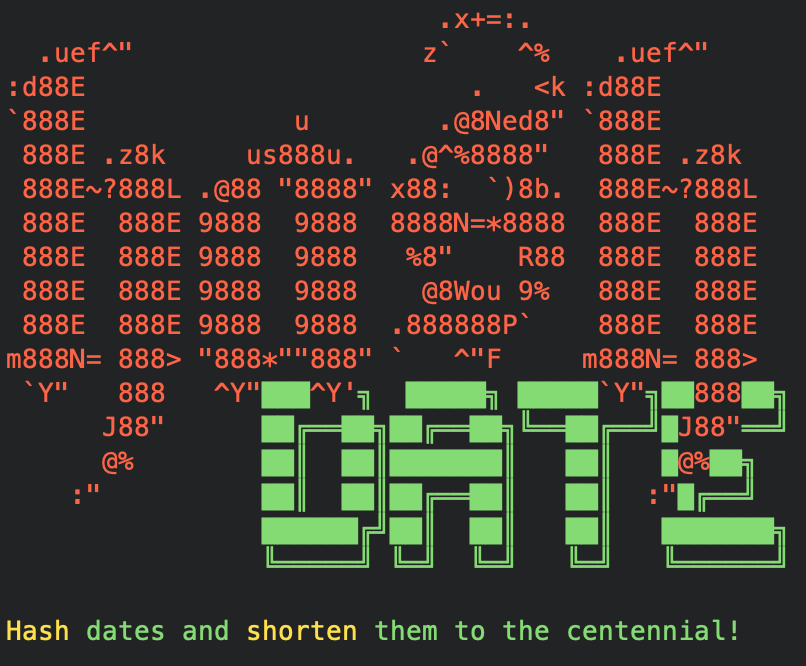
Check out the demo:
$ hashdate demo
Its full of colors:

Turn your iso date into a hash:
$ hashdate date2hash 2020-05-13T22:30:47.136450
hash: UCABCBDCCDAEHBDGEFA
Then if you only take the first 11 chars you get a datetime with less precision:
$ hashdate hash2date UCABCBDCCDA
datetime: 2020-05-13T22:30:00
you can also secify to use emojis for charset if you want to:
$ hashdate date2hash 2020-05-13T22:30:47.136450 -c emoji
hash: 🌹🐲🌼🥕🐲🥕🌲🐲🐲🌲🌼🍇🐐🥕🌲🌴🍇🐂🌼
and back again:
$ hash2date 🌹🐲🌼🥕🐲🥕🌲🐲🐲🌲🌼🍇🐐🥕🌲🌴🍇🐂🌼 -c emoji
datetime: 2020-05-13T22:30:47.136450
Module usage
import datetime
from hashdate import datetime_to_hash, hash_to_datetime

now = datetime.datetime.now()
hash = datetime_to_hash(now)
dt = hash_to_datetime(hash)
assert now == dt
Advanced
Use emojis:
import datetime
from hashdate import datetime_to_hash, hash_to_datetime

now = datetime.datetime.now()
hash = datetime_to_hash(now, charset='emoji')
dt = hash_to_datetime(hash, charset='emoji')
assert now == dt
Register more charsets:
import datetime
from hashdate import register_charset, datetime_to_hash, hash_to_datetime

charset = "🌼🥕🐲🌲🍇🐂🌴🐐🍉🌺🍊🐽🍆🦎🍟🌱🐫🐍🐃🍍🌹🍕☘🌿🥓🐪🌷🏵🔥🐷🌳🌶🥒🐊🐗🐏🌵🌻🌽🐢🍋🍈💮🎃🌊🥔🌰🍀🍃💧💐🍂🐮🌸🐄🍄🍁🍞🥜🐑🥀🌭🐸🐖"

register_charset('my_emojis', charset)

now = datetime.datetime.now()
hash = datetime_to_hash(now, charset='my_emojis')
dt = hash_to_datetime(hash, charset='my_emojis')
assert now == dt
Structure of a hashdate
centenial: [...19,20,21...]
|    quarter start month: [0,3,6,9]
|    |   day in tens: [0:3]
|    |   |   hour in tens: [0:5]
|    |   |   |   minute in tens: [0:5]
|    |   |   |   |   second in tens: [0:5]
|    |   |   |   |   |   microsecond digits:[0:999999]
|    |   |   |   |   |   |
U CA B C B D C B A F C E BCDAAB
  |    |   |   |   |   |
  |    |   |   |   |   second: [0:9]
  |    |   |   |   minute: [0:9]
  |    |   |   hour: [0:9]
  |    |   day: [0:9]
  |    month in quarter: [0,1,2]
  year: [0:99]
1 maintainer

Metadata
1 maintainer
Release files for hashdate 1.0.3
For a detailed explanation of source distributions (sdists) and built distributions (wheels), please see the package formats documentation.
Source distribution (sdist)
| File | Size | Uploaded | Provenance | Actions |
|---|---|---|---|---|
| hashdate-1.0.3.tar.gz | 6.7 kB | Without provenance | Details for hashdate-1.0.3.tar.gz |
Built distribution (wheel)
| File | Interpreter | ABI | Platform | Actions Reset |
|---|---|---|---|---|
| hashdate-1.0.3-py3-none-any.whl | Python 3 | none | any | Details for hashdate-1.0.3-py3-none-any.whl |
Total release size: 13.9 kB
Release files / hashdate-1.0.3.tar.gz
| Download URL | hashdate-1.0.3.tar.gz |
|---|---|
| Size | 6.7 kB |
| Tags | Source |
|
SHA-256 checksum How to use checksums |
a6884148b905f2b6b09706d47d17db1bd6b1609dd909b2e9da21107841ad6158
|
|
BLAKE2b-256 checksum How to use checksums |
ca2548a7439c035e74b28eb859943d2d1c508670f4dad1bbca5eb09b7391a9c5
|
| Upload date | |
|
Uploaded using Trusted Publishing? What is trusted publishing? |
No |
| Uploaded via |
poetry/1.0.5 CPython/3.7.3 Darwin/19.0.0
|
Release files / hashdate-1.0.3-py3-none-any.whl
| Download URL | hashdate-1.0.3-py3-none-any.whl |
|---|---|
| Size | 7.2 kB |
| Tags | Python 3 |
|
SHA-256 checksum How to use checksums |
5f786cebf908bc4adf4296050bff249e35821dd2390f109d14bbf389e576bc01
|
|
BLAKE2b-256 checksum How to use checksums |
4a1b6bd9a36df4d4ec7df6ecf80722018e3eb2afa6ac5f38c7db288eec63c068
|
| Upload date | |
|
Uploaded using Trusted Publishing? What is trusted publishing? |
No |
| Uploaded via |
poetry/1.0.5 CPython/3.7.3 Darwin/19.0.0
|
Security for hashdate 1.0.3
Provenance
Provenance describes where a file came from. On PyPI, provenance is shared via attestations, which provide a verifiable record of the build or publishing details. View details, limitations and caveats.
No provenance found
None of the files in this release were uploaded with provenance metadata.
A note on package security
PyPI is a repository for distributing packages, not a service for auditing them. While third-party security researchers and our staff do their best to detect and remove malicious packages, PyPI cannot guarantee the quality, security or suitability of any given package.
To learn more about protecting yourself from malicious actors, visit our package security documentation.














