
=============================================================================
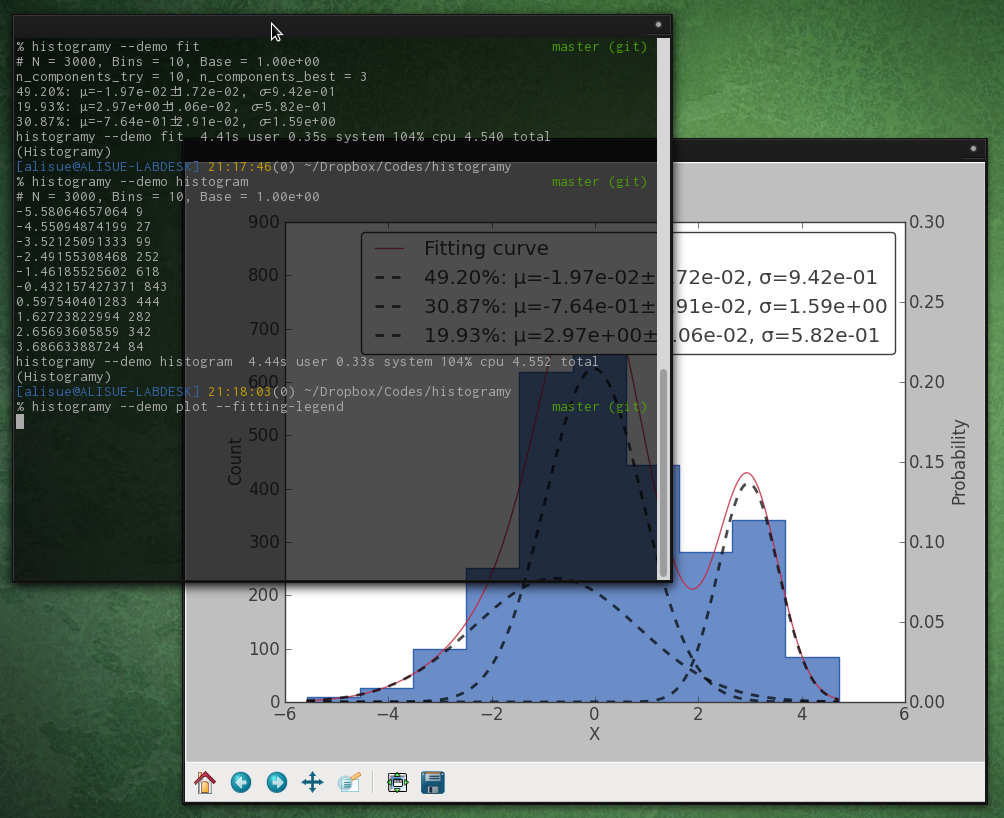
Histogramy is a CUI program to analyze 1-dimensional data.
It draw a histogram with specified data and it also can draw the fitting curve
estimated by a Gaussian Mixture Model probability distribution.
Requirements
-----------------------------------------------------------------------------
- [Python][]
- [numpy][]
- [matplotlib][]
- [scikit-learn][]
[Python]: http://www.python.org/
[numpy]: http://www.numpy.org/
[matplotlib]: http://matplotlib.org/
[scikit-learn]: http://scikit-learn.org/dev/index.html
Install
-----------------------------------------------------------------------------
1. You have to install [Python][]. Follow the instruction at
http://www.python.org/getit/
2. You also have to instal [numpy][], and [matplotlib][].
Follow the instructions below
1. numpy: http://docs.scipy.org/doc/numpy/user/install.html
2. matplotlib: http://matplotlib.org/users/installing.html
3. Now, you can install Histogramy with [pip][] or [easy_install][].
[scikit-learn][] will be installed automatically when you install
Histogramy
1. Install [pip][] or [easy_install][], follow the instrcutions below
- pip: http://www.pip-installer.org/en/latest/installing.html
- easy_install: http://pypi.python.org/pypi/setuptools
2. Install Histogramy with the following command in Terminal (Command
Prompt)
~~~
pip install histogramy
~~~
or
~~~
easy_install histogramy
~~~
[pip]: http://www.pip-installer.org/
[easy_install]: http://pypi.python.org/pypi/setuptools
Usage
-----------------------------------------------------------------------------
usage: histogramy [-h] [-b BINS] [-c N] [-C N] [--base BASE] [--auto-base]
[--min-threshold MIN] [--max-threshold MAX]
[--covariance-type TYPE] [--min-covar MIN_COVAR]
[--delimiter DELIMITER] [--encoding ENCODING] [--demo]
[filenames [filenames ...]] {histogram,fit,plot} ...
positional arguments:
filenames
{histogram,fit,plot}
histogram Show histogram data
fit Show fitting data
plot Create graph by matplotlib
optional arguments:
-h, --help show this help message and exit
-b BINS, --bins BINS It defines the number of equal-width bins.
-c N, --column N A number of column in data file used for analysis
-C N, --classifiers N
The maximum number classifiers to simulate the fitting
--base BASE Base value to modulate the data
--auto-base Automatically find the base value to modulate the data
--min-threshold MIN Minimum threshold. Value smaller than this will be
ignored
--max-threshold MAX Maximum threshold. Value grater than this will be
ignored
--covariance-type TYPE
Type of covariance. Default is "diag"
--min-covar MIN_COVAR
Minimum value of covariance
--delimiter DELIMITER
Delimiter used to parse the data file
--encoding ENCODING Encoding used to open the data file
--demo Use demo data to analysis
1 maintainer

Metadata
1 maintainer
Release files for histogramy 0.1.5
For a detailed explanation of source distributions (sdists) and built distributions (wheels), please see the package formats documentation.
Source distribution (sdist)
| File | Size | Uploaded | Provenance | |
|---|---|---|---|---|
| histogramy-0.1.5.tar.gz | 465.7 kB | Without provenance | Details |
Release files / histogramy-0.1.5.tar.gz
| Download URL | histogramy-0.1.5.tar.gz |
|---|---|
| Size | 465.7 kB |
| Tags | Source |
|
SHA-256 checksum How to use checksums |
4cc05e03a597be6812283f3c1daa40df8a5dff7064d983200d0ad887588e20e7
|
|
BLAKE2b-256 checksum How to use checksums |
6493b8372fd52dc43180a3d082460be2d78e9d4afdab158c470a651fea484a42
|
| Upload date | |
|
Uploaded using Trusted Publishing? What is trusted publishing? |
No |
Security for histogramy 0.1.5
Provenance
Provenance describes where a file came from. On PyPI, provenance is shared via attestations, which provide a verifiable record of the build or publishing details. View details, limitations and caveats.
No provenance found
None of the files in this release were uploaded with provenance metadata.
A note on package security
PyPI is a repository for distributing packages, not a service for auditing them. While third-party security researchers and our staff do their best to detect and remove malicious packages, PyPI cannot guarantee the quality, security or suitability of any given package.
To learn more about protecting yourself from malicious actors, visit our package security documentation.














