
identYwaf



identYwaf is an identification tool that can recognize web protection type (i.e. WAF) based on blind inference. Blind inference is being done by inspecting responses provoked by a set of predefined offensive (non-destructive) payloads, where those are used only to trigger the web protection system in between (e.g. http://<host>?aeD0oowi=1 AND 2>1). Currently it supports more than 80 different protection products (e.g. aeSecure, Airlock, CleanTalk, CrawlProtect, Imunify360, MalCare, ModSecurity, Palo Alto, SiteGuard, UrlScan, Wallarm, WatchGuard, Wordfence, etc.), while the knowledge-base is constantly growing.
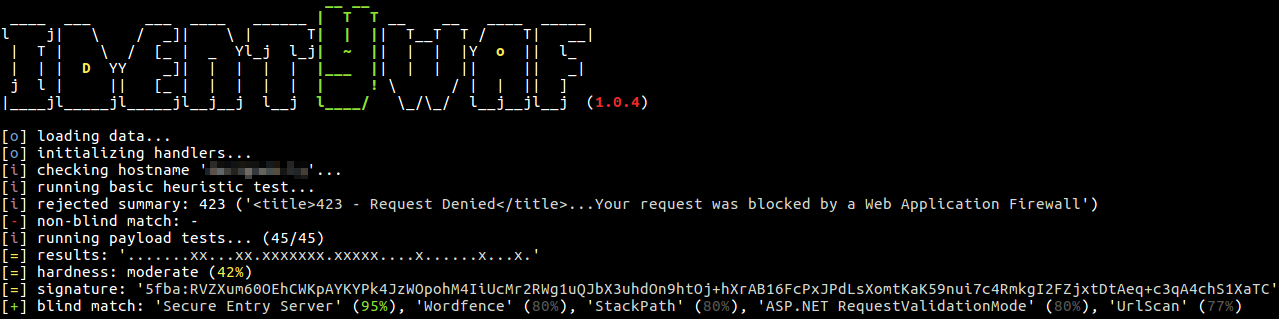
For more information you can check slides for a talk “Blind WAF identification” held at Sh3llCON 2019 (Santander / Spain).
Installation
You can use pip to install and/or upgrade the identYwaf to latest (PyPI) version with:
pip install --upgrade identYwaf
Alternatively, you can download the latest tarball by clicking here or latest zipball by clicking here.
identYwaf works out of the box with Python version 2.6, 2.7 and 3.x on any platform.
Usage
To get a list of basic options and switches use:
identYwaf -h
1 maintainer

Metadata
1 maintainer
Release files for identYwaf 1.0.127
For a detailed explanation of source distributions (sdists) and built distributions (wheels), please see the package formats documentation.
Source distribution (sdist)
| File | Size | Uploaded | Provenance | Actions |
|---|---|---|---|---|
| identYwaf-1.0.127.tar.gz | 21.5 kB | Without provenance | Details for identYwaf-1.0.127.tar.gz |
Release files / identYwaf-1.0.127.tar.gz
| Download URL | identYwaf-1.0.127.tar.gz |
|---|---|
| Size | 21.5 kB |
| Tags | Source |
|
SHA-256 checksum How to use checksums |
34ab6da210c5d455d7ef66de5b8a29357008522d22c2901f5cd6dfa8614f83fb
|
|
BLAKE2b-256 checksum How to use checksums |
250fd62373bf1b942ad2dccc84542fd9787879232de426e4ec423025b02cb97e
|
| Upload date | |
|
Uploaded using Trusted Publishing? What is trusted publishing? |
No |
| Uploaded via |
Python-urllib/2.7
|
Security for identYwaf 1.0.127
Provenance
Provenance describes where a file came from. On PyPI, provenance is shared via attestations, which provide a verifiable record of the build or publishing details. View details, limitations and caveats.
No provenance found
None of the files in this release were uploaded with provenance metadata.
A note on package security
PyPI is a repository for distributing packages, not a service for auditing them. While third-party security researchers and our staff do their best to detect and remove malicious packages, PyPI cannot guarantee the quality, security or suitability of any given package.
To learn more about protecting yourself from malicious actors, visit our package security documentation.













