




The iscan-dag library is a Python 3 package designed for detecting which variables, if any, have undergo a casual mechanism shift given multiple datasets.
iSCAN operates through a systematic process:
- For each dataset, iSCAN initially evaluates at each sample the Hessian of the data distribution. This step is helpful in identifying the leaf variables (nodes) for all the datasets.
- Subsequently, for the identified leaf variable, iSCAN evaluates at each sample the Hessian of the data distribution for the pooled data (resembling a mixture distribution). Then, based on the variance of the Hessian values, iSCAN determines if the given leaf node has undergone a mechanism shift (termed shifted node).
The steps above are applied iteratively, eliminating the identified leaf variable across all datasets at each iteration. See iscan.est_node_shifts for more details.
As an optional step, the library also includes a function to detect structural changes (termed shifted edges). As a by-product of detecting shifted nodes, iSCAN also estimates a topological ordering of the causal variables. Thus, allowing for the use of recent methods on variable (parents) selection. The current implementation of iSCAN employs FOCI to identify the parent set of shifted nodes in each dataset. See iscan.est_struct_shifts for more details.
Citation
This is an implementation of the following paper:
[1] Chen T., Bello K., Aragam B., Ravikumar P. (2023). "iSCAN: Identifying Causal Mechanism Shifts among Nonlinear Additive Noise Models". Neural Information Processing Systems (NeurIPS).
If you find this code useful, please consider citing:
BibTeX
@article{chen2023iscan,
    author = {Chen, Tianyu and Bello, Kevin and Aragam, Bryon and Ravikumar, Pradeep},
    title = {{iSCAN: Identifying Causal Mechanism Shifts among Nonlinear Additive Noise Models}},
    journal = {arXiv preprint arXiv:2306.17361},
    year = {2023}
}
Features
- Shifted nodes are detected without the need to estimate the DAG structure for each dataset.
- iSCAN is agnostic to the type of score's Jacobian estimator. The current implementation is based on a kernelized Stein's estimator. See
stein_hessfor details. - iSCAN's time complexity is not influenced by the underlying graph density, and will run faster than methods such as DCI or UT-IGSP for large number of variables due to its omission of (non)parametric conditional independence tests.
Getting Started
Install the package
We recommend using a virtual environment via virtualenv or conda, and use pip to install the iscan-dag package.
$ pip install -U iscan-dag
Using iSCAN
See an example on how to use iSCAN in this iPython notebook.
An Overview of iSCAN
We propose a new method for directly identifying changes (shifts) of causal mechanisms from multiple heterogeneous datasets, which are assumed to be originated by related structural causal models (SCMs) over the same set of variables.
iSCAN considers that each SCM belongs to the general class of nonlinear additive noise models (ANMs), thus, generalizing prior work that assumed linear models. We assume that each dataset is generated from an interventional (observational if no variables are intervened) distribution of an underlying graph $G^*$. See the figure below.
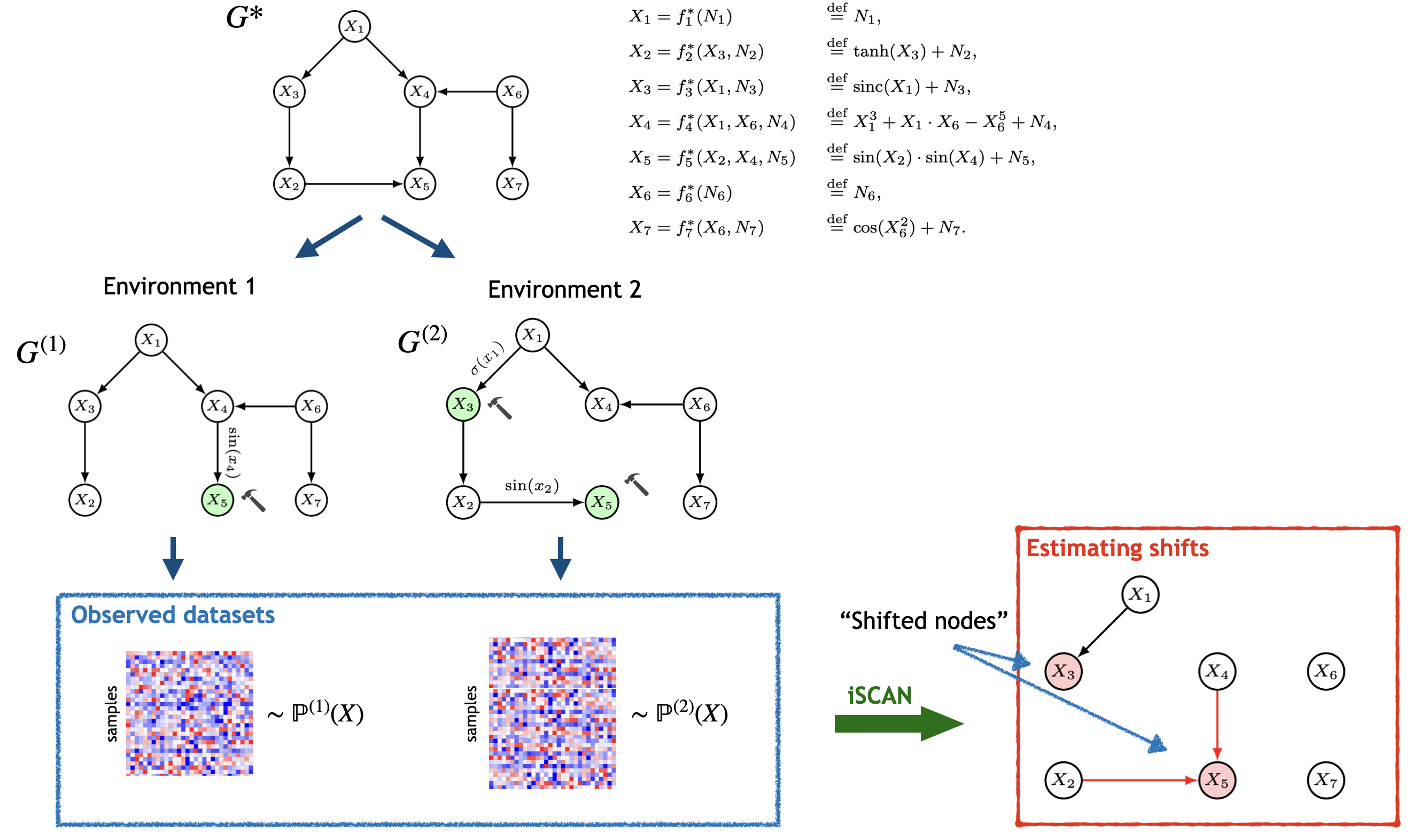
In [1], we prove that the Hessian of the log-density function of the mixture distribution reveals information about changes (shifts) in general non-parametric functional mechanisms for the leaf variables. Thus, allowing for the detection of shifted nodes. Our method leads to significant improvements in identifying shifted nodes.
Theorem 1 (see [1]). Let $h$ be the index of the environment (dataset), and $p^h(x)$ denote the pdf of the $h$-th environment. Let $q(x)$ be the pdf of the mixture distribution of the all $H$ environments such that $q(x) = \sum_h w_h p^h(x)$. Also, let $s(x) = \nabla \log q(x)$ be the associated score function. Then, under mild assumptions, if $j$ is a leaf variable in all environments, we have:
$$ j \text{ is a shifted node } \iff \text{Var}_{q}\left[ \frac{\partial s_j(X)}{\partial x_j} \right] > 0. $$
Requirements
- Python 3.6+
numpyigraphtorchscikit-learnrpy2(R interface to use theFOCIlibrary).GPy(Library to sample from Gaussian processes)kneed(Used for the elbow heuristic)pandas
Contents
score_estimator.py: Estimates the diagonal of the Hessian of $\log p(x)$ at the provided samples points.utils.py: Utility functions for generating synthetic data, and evaluate the resultsshifted_nodes.py: Implements iSCAN, providing detected shifted nodes.shifted_edges.py: Implements the discovery of structural changes (shifted edges).my_foci.R: R implementation that usesFOCIfor finding parents based on given nodes and topological order.
Acknowledgements
We thank the authors of the SCORE for making their code available. Part of our code is based on their implementation, specially the score_estimator.py file.
1 maintainer

Metadata
1 maintainer
Release files for iscan-dag 0.0.5
For a detailed explanation of source distributions (sdists) and built distributions (wheels), please see the package formats documentation.
Source distribution (sdist)
| File | Size | Uploaded | Provenance | Actions |
|---|---|---|---|---|
| iscan-dag-0.0.5.tar.gz | 18.5 kB | Without provenance | Details for iscan-dag-0.0.5.tar.gz |
Built distribution (wheel)
| File | Interpreter | ABI | Platform | Actions Reset |
|---|---|---|---|---|
| iscan_dag-0.0.5-py3-none-any.whl | Python 3 | none | any | Details for iscan_dag-0.0.5-py3-none-any.whl |
Total release size: 35.6 kB
Release files / iscan-dag-0.0.5.tar.gz
| Download URL | iscan-dag-0.0.5.tar.gz |
|---|---|
| Size | 18.5 kB |
| Tags | Source |
|
SHA-256 checksum How to use checksums |
6234e723ecfa961179478ed36cab1814f5a85efd262702223c4012a0a7da384b
|
|
BLAKE2b-256 checksum How to use checksums |
a3dd4410c7cd07dd3d7306236f838ff0eadb6837c1b4d5628ff1474841a20d84
|
| Upload date | |
|
Uploaded using Trusted Publishing? What is trusted publishing? |
No |
| Uploaded via |
twine/4.0.2 CPython/3.8.16
|
Release files / iscan_dag-0.0.5-py3-none-any.whl
| Download URL | iscan_dag-0.0.5-py3-none-any.whl |
|---|---|
| Size | 17.0 kB |
| Tags | Python 3 |
|
SHA-256 checksum How to use checksums |
54bf4ee69558224b3b93bd86b82561adbb2b1c26c66ecf692850ae25a9e0dbde
|
|
BLAKE2b-256 checksum How to use checksums |
7e69d706d2ad3e3d4dba889273374d7cbe7a980e3fa5291f6697a13f2186e19b
|
| Upload date | |
|
Uploaded using Trusted Publishing? What is trusted publishing? |
No |
| Uploaded via |
twine/4.0.2 CPython/3.8.16
|
Security for iscan-dag 0.0.5
Provenance
Provenance describes where a file came from. On PyPI, provenance is shared via attestations, which provide a verifiable record of the build or publishing details. View details, limitations and caveats.
No provenance found
None of the files in this release were uploaded with provenance metadata.
A note on package security
PyPI is a repository for distributing packages, not a service for auditing them. While third-party security researchers and our staff do their best to detect and remove malicious packages, PyPI cannot guarantee the quality, security or suitability of any given package.
To learn more about protecting yourself from malicious actors, visit our package security documentation.














