
This project has been archived by its maintainers, and is no longer receiving any updates.
jeig - Eigendecompositions wrapped for jax


Overview
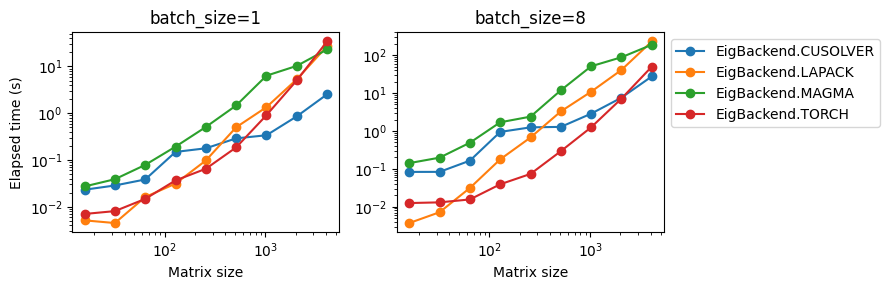
This package wraps eigendecompositions as provided by jax, cusolver, magma, numpy, scipy, and torch for use with jax. Depending upon your system and your versions of these packages, you may observe significant speed differences. The following were obtained using jax 0.8.0 on a system with 28-core Intel Xeon w7-3465X and NVIDIA RTX4090.
Install
jeig can be installed via pip,
pip install jeig
This will also install torch. If you only need torch for use with jeig, then the CPU-only version could be sufficient and you may wish to install manually as described in the pytorch docs.
Example usage
import jax
import jeig

matrix = jax.random.normal(jax.random.PRNGKey(0), (1, 2048, 2048)).astype(complex)

%timeit jax.block_until_ready(jeig.eig(matrix, backend="cusolver"))
%timeit jax.block_until_ready(jeig.eig(matrix, backend="lapack"))
%timeit jax.block_until_ready(jeig.eig(matrix, backend="magma"))
%timeit jax.block_until_ready(jeig.eig(matrix, backend="torch"))
1.31 s ± 43 ms per loop (mean ± std. dev. of 7 runs, 1 loop each)
5.44 s ± 379 ms per loop (mean ± std. dev. of 7 runs, 1 loop each)
11.1 s ± 937 ms per loop (mean ± std. dev. of 7 runs, 1 loop each)
4.93 s ± 92.1 ms per loop (mean ± std. dev. of 7 runs, 1 loop each)
The default torch backend has good performance when performing batched eigendecomposition on many-core CPUs.
matrix = jax.random.normal(jax.random.PRNGKey(0), (8, 2048, 2048)).astype(complex)

%timeit jax.block_until_ready(jeig.eig(matrix, backend="cusolver"))
%timeit jax.block_until_ready(jeig.eig(matrix, backend="lapack"))
%timeit jax.block_until_ready(jeig.eig(matrix, backend="magma"))
%timeit jax.block_until_ready(jeig.eig(matrix, backend="torch"))
10.4 s ± 116 ms per loop (mean ± std. dev. of 7 runs, 1 loop each)
48.1 s ± 6.74 s per loop (mean ± std. dev. of 7 runs, 1 loop each)
1min 33s ± 1.49 s per loop (mean ± std. dev. of 7 runs, 1 loop each)
7.18 s ± 91.6 ms per loop (mean ± std. dev. of 7 runs, 1 loop each)
Credit
The torch implementation of eigendecomposition is due to a comment by @YouJiacheng.
1 maintainer

Metadata
1 maintainer
Release files for jeig 0.5.1
For a detailed explanation of source distributions (sdists) and built distributions (wheels), please see the package formats documentation.
Source distribution (sdist)
| File | Size | Uploaded | Provenance | Actions |
|---|---|---|---|---|
| jeig-0.5.1.tar.gz | 7.5 kB | Without provenance | Details for jeig-0.5.1.tar.gz |
Built distribution (wheel)
| File | Interpreter | ABI | Platform | Actions Reset |
|---|---|---|---|---|
| jeig-0.5.1-py3-none-any.whl | Python 3 | none | any | Details for jeig-0.5.1-py3-none-any.whl |
Total release size: 13.8 kB
Release files / jeig-0.5.1.tar.gz
| Download URL | jeig-0.5.1.tar.gz |
|---|---|
| Size | 7.5 kB |
| Tags | Source |
|
SHA-256 checksum How to use checksums |
bdc0846cbd84cd8c48e56ed616490f1a0dca3952aff9e6199d6a340fc8647a34
|
|
BLAKE2b-256 checksum How to use checksums |
3f42b95626c73ce8835cb4b74a2ab067fbaddd83f643e3e83e6ab352231a4654
|
| Upload date | |
|
Uploaded using Trusted Publishing? What is trusted publishing? |
No |
| Uploaded via |
twine/6.2.0 CPython/3.13.7
|
Release files / jeig-0.5.1-py3-none-any.whl
| Download URL | jeig-0.5.1-py3-none-any.whl |
|---|---|
| Size | 6.3 kB |
| Tags | Python 3 |
|
SHA-256 checksum How to use checksums |
e5b22841d81a5b511bcf1353c9bbe68e005a585e3641600ee2552be85ca5d184
|
|
BLAKE2b-256 checksum How to use checksums |
07dcedafbd0164ca25695be3240f149fec0dd607643c0d60ee23f47818843694
|
| Upload date | |
|
Uploaded using Trusted Publishing? What is trusted publishing? |
No |
| Uploaded via |
twine/6.2.0 CPython/3.13.7
|
Security for jeig 0.5.1
Provenance
Provenance describes where a file came from. On PyPI, provenance is shared via attestations, which provide a verifiable record of the build or publishing details. View details, limitations and caveats.
No provenance found
None of the files in this release were uploaded with provenance metadata.
A note on package security
PyPI is a repository for distributing packages, not a service for auditing them. While third-party security researchers and our staff do their best to detect and remove malicious packages, PyPI cannot guarantee the quality, security or suitability of any given package.
To learn more about protecting yourself from malicious actors, visit our package security documentation.














