

A basic account management system for Jellyfin.
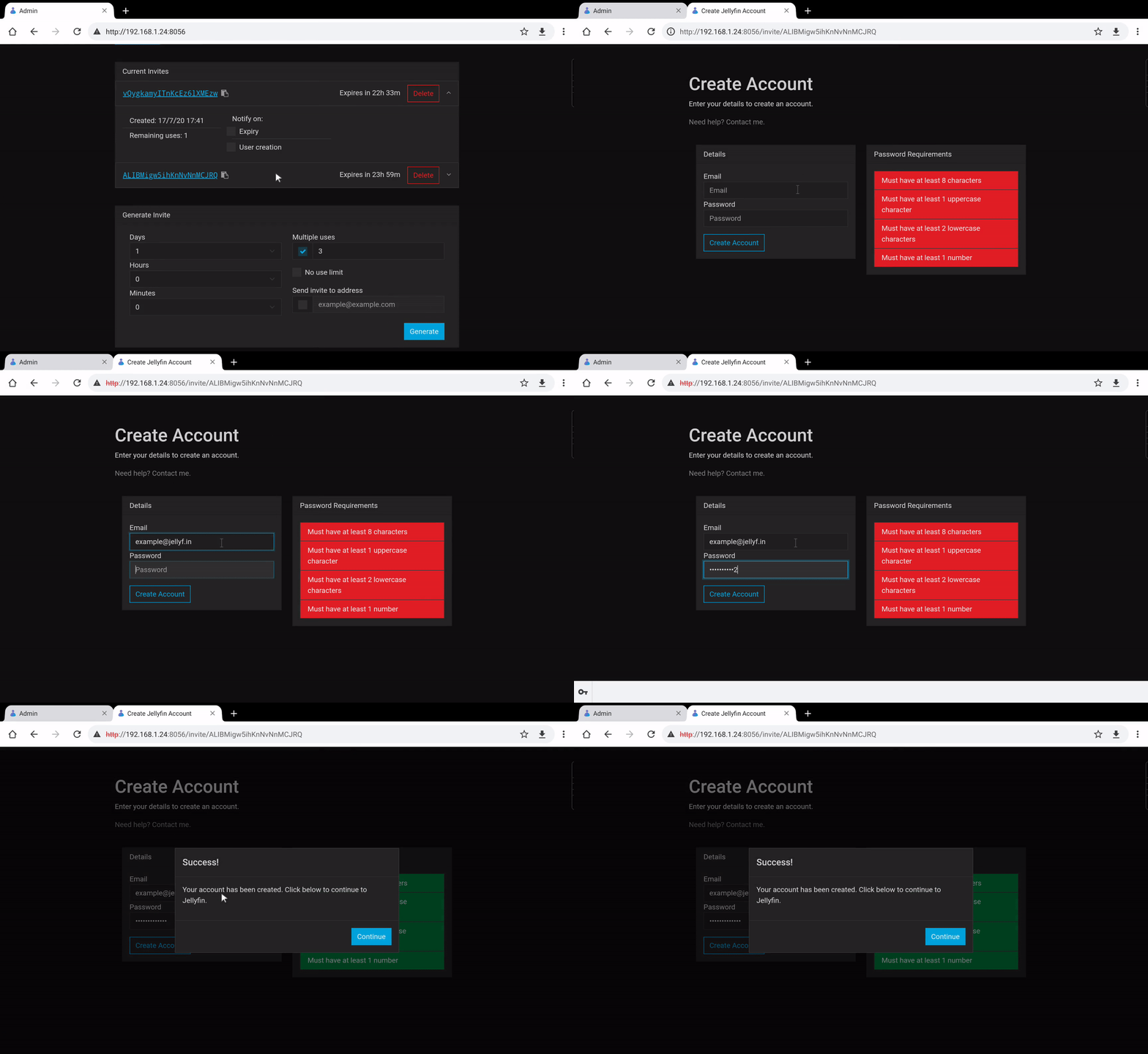
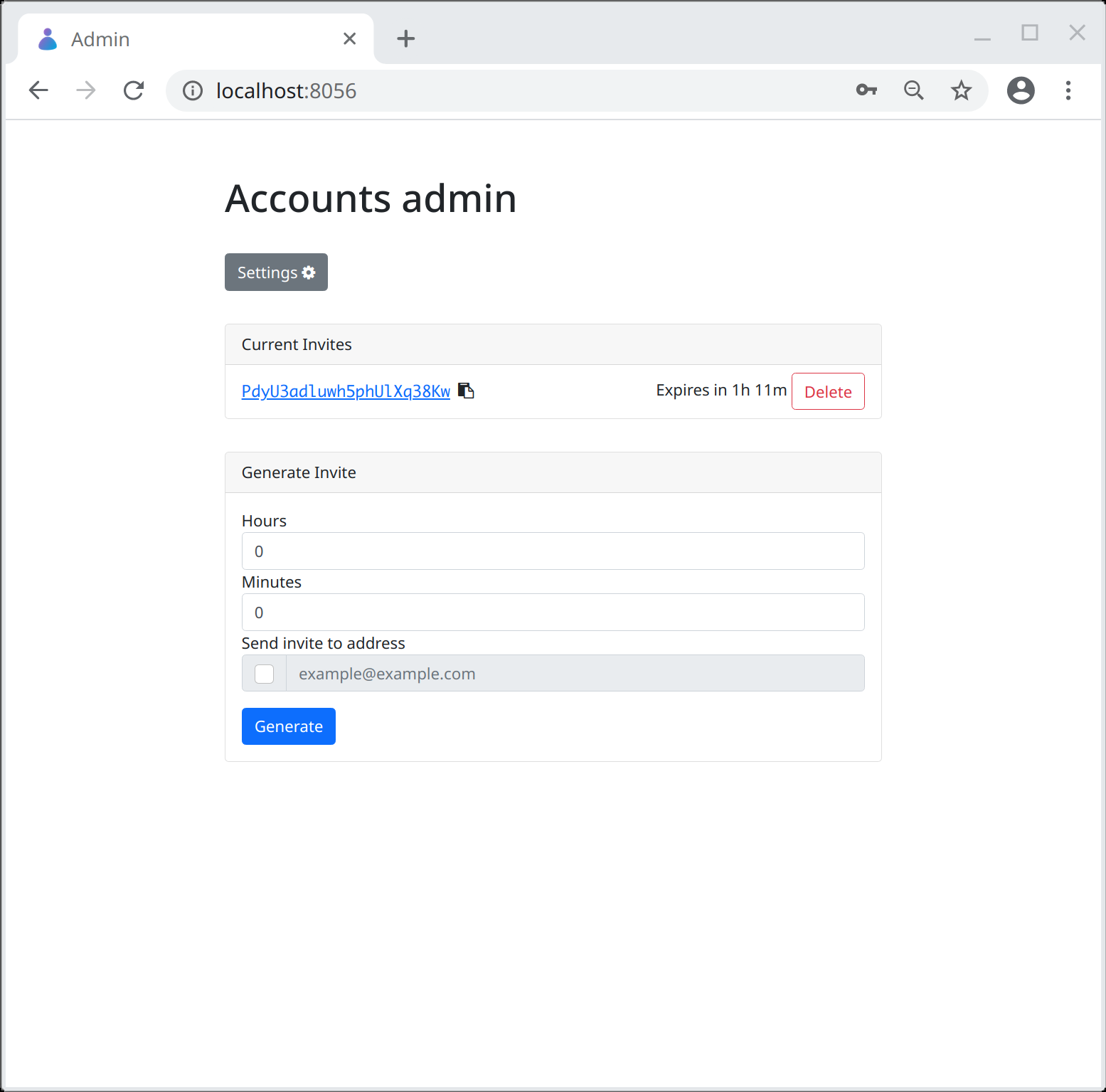
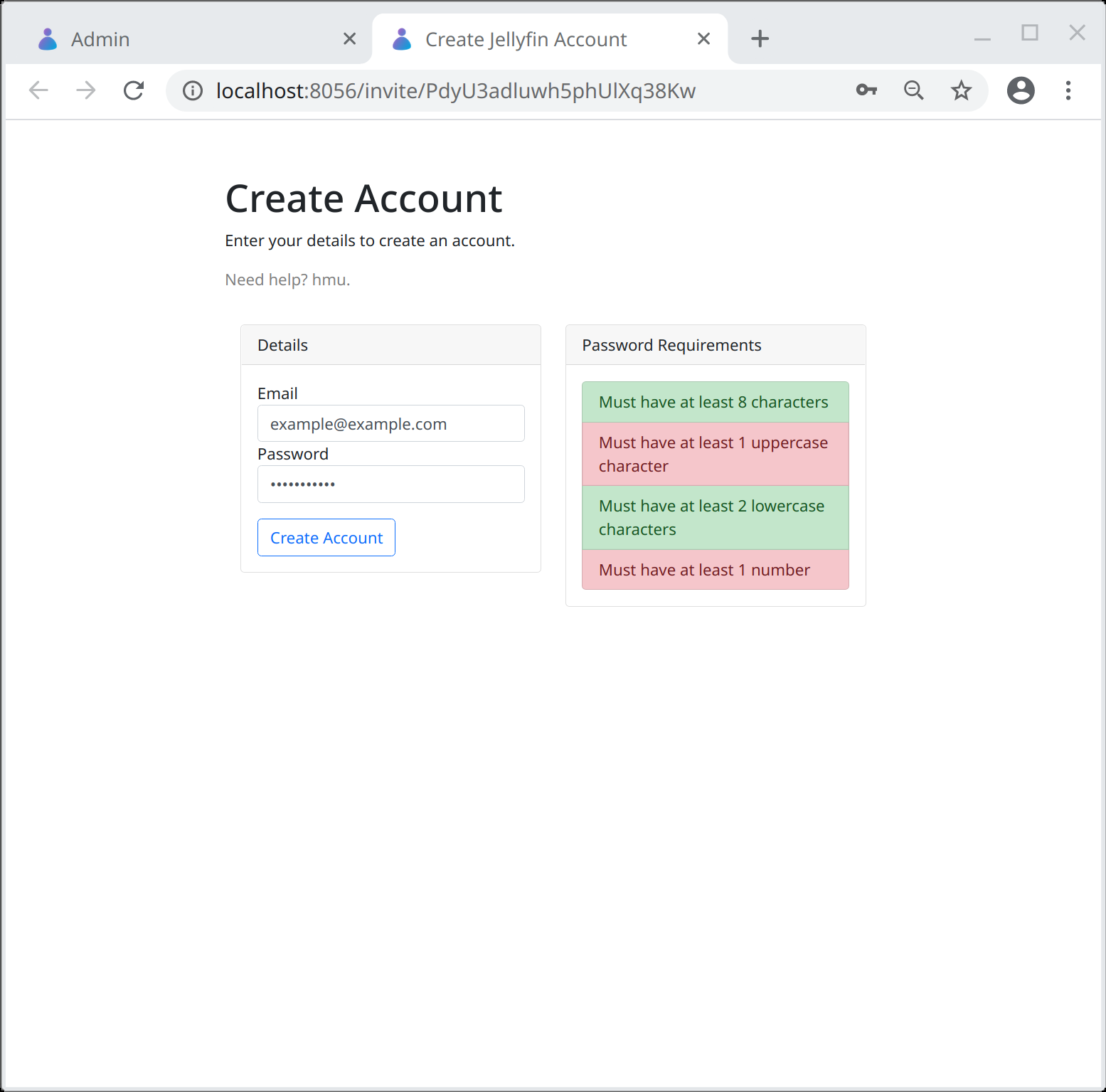
- Provides a web interface for creating/sending invites
- Sends out emails when a user requests a password reset
- Uses a basic python jellyfin API client for communication with the server.
- Uses Flask, HTTPAuth, itsdangerous, and Waitress
- Frontend uses Bootstrap
- Password resets are handled using smtplib, requests, and jinja
Interface
Get it
Requirements
- This should work anywhere Python does, i've tried to not use anything OS-specific. Drop an issue if there's a problem, of course.
* python >= 3.6
* flask
* flask_httpauth
* jinja2
* requests
* itsdangerous
* passlib
* pyOpenSSL
* waitress
* pytz
* python-dateutil
* watchdog
* packaging
Install
Usually as simple as:
pip install jellyfin-accounts
If not, or if you want to use docker, see install.
Usage
- Passing no arguments will run the server
usage: jf-accounts [-h] [-c CONFIG] [-d DATA] [--host HOST] [-p PORT] [-g]

jellyfin-accounts

optional arguments:
  -h, --help            show this help message and exit
  -c CONFIG, --config CONFIG
                        specifies path to configuration file.
  -d DATA, --data DATA  specifies directory to store data in. defaults to
                        ~/.jf-accounts.
  --host HOST           address to host web ui on.
  -p PORT, --port PORT  port to host web ui on.
  -g, --get_defaults    tool to grab a JF users policy (access, perms, etc.)
                        and homescreen layout and output it as json to be used
                        as a user template.
Setup
New user template
- You may want to restrict a user from accessing certain libraries (e.g 4K Movies), display their account on the login screen by default, or set a default homecrseen layout. Jellyfin stores these settings in the user's policy, configuration and displayPreferences.
- Make a temporary account and configure it, then in the web UI, go into "Settings => Set new account defaults". Choose the account, and its configuration will be stored for future use.
Emails/Password Resets
- When someone initiates forget password on Jellyfin, a file named
passwordreset*.jsonis created in its configuration directory. This directory is monitored and when created, the program reads the username, expiry time and PIN, puts it into a template and sends it to whatever address is specified inemails.json. - The default forget password popup references the
passwordreset*.jsonfile created. This is confusing for users, so a quick fix is to edit theMessageForgotPasswordFileCreatedstring in Jellyfin's language folder. - Currently, jellyfin-accounts supports generic SSL/TLS or STARTTLS secured SMTP, and the mailgun REST API.
- Email html is created using mjml, and jinja templating is used. If you wish to create your own, ensure you use the same jinja expressions (
{{ pin }}, etc.) as used indata/email.mjmlorinvite-email.mjml, and also create plain text versions for legacy email clients.
Configuration
- Note: Make sure to put this behind a reverse proxy with HTTPS.
On first run, access the setup wizard at 0.0.0.0:8056. When finished, restart the program.
The configuration is stored at ~/.jf-accounts/config.ini. Settings can be changed through the web UI, or by manually editing the file.
For detailed descriptions of each setting, see setup.
Donations
I strongly suggest you send your money to Jellyfin or a good charity, but for those who want to help me out, a Paypal link is below.
1 maintainer

Metadata
1 maintainer
Release files for jellyfin-accounts 0.3.9
For a detailed explanation of source distributions (sdists) and built distributions (wheels), please see the package formats documentation.
Source distribution (sdist)
| File | Size | Uploaded | |
|---|---|---|---|
| jellyfin-accounts-0.3.9.tar.gz | 203.8 kB | Details |
Built distribution (wheel)
| File | Interpreter | ABI | Platform | Reset |
|---|---|---|---|---|
| jellyfin_accounts-0.3.9-py3-none-any.whl | Python 3 | none | any | Details |
Total release size: 421.3 kB
Release files / jellyfin-accounts-0.3.9.tar.gz
| Download URL | jellyfin-accounts-0.3.9.tar.gz |
|---|---|
| Size | 203.8 kB |
| Tags | Source |
|
SHA-256 checksum How to use checksums |
457c71d45ffa98d1024e84fe7d0954308b2722b039feea9dec62cbc8e9261c5f
|
|
BLAKE2b-256 checksum How to use checksums |
7e69411c28332bd64438d6d075df9d6d312e96f03d7f60b6d38f0cc12c556b14
|
| Upload date | |
|
Uploaded using Trusted Publishing? What is trusted publishing? |
No |
| Uploaded via |
poetry/1.0.9 CPython/3.8.3 Linux/5.7.9-arch1-1
|
Release files / jellyfin_accounts-0.3.9-py3-none-any.whl
| Download URL | jellyfin_accounts-0.3.9-py3-none-any.whl |
|---|---|
| Size | 217.5 kB |
| Tags | Python 3 |
|
SHA-256 checksum How to use checksums |
e4f96045ddd6cf113dcadc09ac68e6fdb4aac2eef7fbfab8f66ab1b2ef13820c
|
|
BLAKE2b-256 checksum How to use checksums |
6162c940d20cc1da79073bd83909cb44bb8d6dd51deb53b7ce59a869989f6696
|
| Upload date | |
|
Uploaded using Trusted Publishing? What is trusted publishing? |
No |
| Uploaded via |
poetry/1.0.9 CPython/3.8.3 Linux/5.7.9-arch1-1
|














