
jupyterlab-notify




JupyterLab extension to notify cell completion
Usage
The jupyterlab-notify extension allows you to receive notifications about cell execution results in JupyterLab. Notifications are configured through cell metadata or the JupyterLab interface, providing seamless integration and easier management of notification preferences. Notifications can be sent via desktop pop-ups, Slack messages, or emails, depending on your configuration.
Configuration
To configure the jupyterlab-notify extension for Slack and email notifications, create a configuration file and place it in a directory listed under the config section of jupyter --paths (run jupyter --paths to see the available locations).
Two configuration file formats are supported:
- JSON (
jupyter_notify_config.json) — simple key/value format. - Python (
jupyter_notify_config.py) — uses Jupyter’straitlets-based config system.
Both files define settings for the NotificationConfig class. You only need one.
Sample Configuration File
JSON (~/.jupyter/jupyter_notify_config.json):
{
  "NotificationConfig": {
    "email": "example@domain.com",
    "slack_token": "xoxb-abc123-your-slack-token",
    "slack_user_id": "U98765432"
  }
}
Python (~/.jupyter/jupyter_notify_config.py):
# Configuration file for jupyter-notify extension.

c = get_config()  # noqa

c.NotificationConfig.email = "example@domain.com"
c.NotificationConfig.slack_token = "xoxb-abc123-your-slack-token"
c.NotificationConfig.slack_user_id = "U98765432"
# Example: use a custom SMTP server on a non-default port
c.NotificationConfig.smtp_args = ["localhost", 1025]
-
slack_token: A Slack bot token used to send notifications to your Slack workspace.-
How to get it: See Slack API Quickstart to create a bot and obtain a token.
-
Required Bot Token Scopes: Your Slack app must have the following OAuth scopes granted under OAuth & Permissions → Bot Token Scopes in the Slack API dashboard:
Scope Purpose chat:writePost messages to channels or DMs the bot is a member of chat:write.publicPost to public channels without the bot needing to join first im:writeOpen direct message conversations with users (required when slack_user_idis set)
-
-
slack_channel_name: The name of the Slack channel (e.g.,"notifications") where messages will be posted. -
email: The email address to receive notifications.- Note: Requires an SMTP server. For setup help, see this SMTP guide.
Additional Configuration Options
Beyond the commonly used settings above, the following options are available for advanced use:
slack_user_id: A Slack user ID for sending direct messages instead of channel posts (e.g.,"U12345678").smtp_class: Fully qualified name of the SMTP class (default:"smtplib.SMTP").smtp_args: Arguments for the SMTP class constructor, as a string (default:["localhost"]).
These settings allow for customization, such as using a custom SMTP server or changing the SMTP port from the default 25 to others (e.g., ["localhost", 125]), or targeting a specific Slack channel or user.
Notification Modes
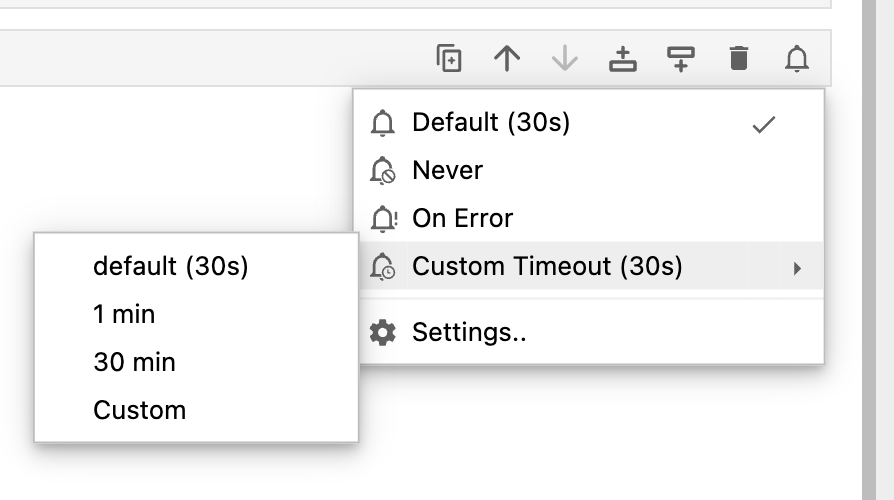
You can control when notifications are sent by setting a mode for each cell. Modes can be configured through the JupyterLab interface by clicking on the bell icon in the cell toolbar.
Supported modes include:
default: Notification is sent only if cell execution exceeds the threshold time (default: 30 seconds). No notification if execution time is below the threshold.never: Disables notifications for the cell.on-error: Sends a notification only if the cell execution fails with an error.custom-timeout: Sends a notification as soon as the cell-execution exceeds a timeout value specified for that cell. Users can either choose a pre-existing timeout value or set a custom one.
Default Threshold
Configure the default threshold value in JupyterLab’s settings:
- Go to Settings Editor.
- Select Execution Notifications.
- Set "Threshold for default notifications": 5 (in seconds) to apply to cells using the
defaultmode.
Desktop Notifications
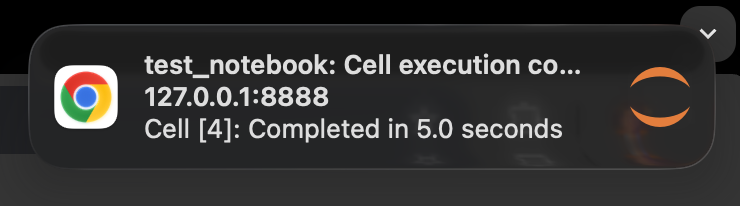
Desktop notifications are enabled by default and appear as pop-up alerts on your system.
Slack Notifications
Slack notifications are sent to the configured channel, requiring the setup described in the Configuration section.
Email Notifications
Email notifications are sent to the configured email address, also requiring the setup from the Configuration section.
Configuration warning
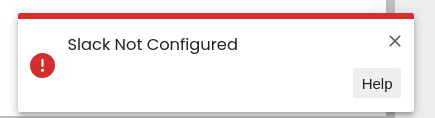
If your email or Slack notifications are not configured but you attempt to enable them through the settings editor, a warning will be displayed when you try to execute a cell in the JupyterLab interface.
Troubleshoot
If you notice that the desktop notifications are not showing up, check the below:
- Make sure JupyterLab is running in a secure context (i.e. either using HTTPS or localhost)
- If you've previously denied notification permissions for the site, update the browser settings accordingly. In Chrome, you can do so by navigating to
Setttings -> Privacy and security -> Site Settings -> Notificationsand updating the permissions against your JupyterLab URL. - Verify that notifications work for your browser. You may need to configure an OS setting first. You can test on this site.
Requirements
- JupyterLab >= 4.0
Install
To install this package with pip run
pip install jupyterlab_notify
To install with server-side execution dependencies run
pip install jupyterlab_notify[server-side-execution]
Contributing
Development install
Note: You will need NodeJS to build the extension package.
The jlpm command is JupyterLab's pinned version of
yarn that is installed with JupyterLab. You may use
yarn or npm in lieu of jlpm below.
# Clone the repo to your local environment
# Change directory to the jupyterlab_notify directory
# Install package in development mode
pip install -e .

# If you need server-side execution dependencies, install with:
pip install -e .[server-side-execution]

# If you want to install test dependencies as well, use:
pip install -e .[tests]

# Link your development version of the extension with JupyterLab
jupyter-labextension develop . --overwrite

# Rebuild extension Typescript source after making changes
jlpm run build
You can watch the source directory and run JupyterLab at the same time in different terminals to watch for changes in the extension's source and automatically rebuild the extension.
# Watch the source directory in one terminal, automatically rebuilding when needed
jlpm run watch
# Run JupyterLab in another terminal
jupyter lab
With the watch command running, every saved change will immediately be built locally and available in your running JupyterLab. Refresh JupyterLab to load the change in your browser (you may need to wait several seconds for the extension to be rebuilt).
By default, the jlpm run build command generates the source maps for this extension to make it easier to debug using the browser dev tools. To also generate source maps for the JupyterLab core extensions, you can run the following command:
jupyter lab build --minimize=False
Uninstall
pip uninstall jupyterlab_notify
Publishing
- Update the version in
package.jsonand update the release date inCHANGELOG.md - Commit the change in step 1
- For test release, manually trigger the
Build and publish to PyPIworkflow - you need to check theTest releasecheckbox - Draft a new GitHub release, creating an approriate version tag
- Publish the draft and verify that the
publishjob in the build workflow passed.
Uninstall
pip uninstall jupyterlab_notify
History
The initial version of this extension was inspired by the notebook version here.
This plugin was contributed back to the community by the D. E. Shaw group.

License
This project is released under a BSD-3-Clause license.
We love contributions! Before you can contribute, please sign and submit this Contributor License Agreement (CLA). This CLA is in place to protect all users of this project.
"Jupyter" is a trademark of the NumFOCUS foundation, of which Project Jupyter is a part.
1 maintainer

Metadata
1 maintainer
Release files for jupyterlab-notify 3.0.0
For a detailed explanation of source distributions (sdists) and built distributions (wheels), please see the package formats documentation.
Source distribution (sdist)
| File | Size | Uploaded | |
|---|---|---|---|
| jupyterlab_notify-3.0.0.tar.gz | 319.8 kB | Details |
Built distribution (wheel)
| File | Interpreter | ABI | Platform | Reset |
|---|---|---|---|---|
| jupyterlab_notify-3.0.0-py3-none-any.whl | Python 3 | none | any | Details |
Total release size: 366.3 kB
Release files / jupyterlab_notify-3.0.0.tar.gz
| Download URL | jupyterlab_notify-3.0.0.tar.gz |
|---|---|
| Size | 319.8 kB |
| Tags | Source |
|
SHA-256 checksum How to use checksums |
1b2d75d9d87b1eb0209605b6a4411ae1c64331fef0597868c82c31c8fe0791b0
|
|
BLAKE2b-256 checksum How to use checksums |
7cd4fe658d798c6aeda4c6c670206c3a68b321abbd0b0682a50626ce184a0231
|
| Upload date | |
|
Uploaded using Trusted Publishing? What is trusted publishing? |
Yes |
| Uploaded via |
twine/6.1.0 CPython/3.13.13
|
Provenance
Provenance describes where a file came from. On PyPI, provenance is shared via attestations, which provide a verifiable record of the build or publishing details. View details, limitations and caveats.


PyPI Publish Attestation
PyPI verified that this artifact, at this checksum, originated from the publisher listed below.
Signed by GitHub Actions, verified by PyPI on May 25, 2026.
Transparency logRelease files / jupyterlab_notify-3.0.0-py3-none-any.whl
| Download URL | jupyterlab_notify-3.0.0-py3-none-any.whl |
|---|---|
| Size | 46.5 kB |
| Tags | Python 3 |
|
SHA-256 checksum How to use checksums |
3598c011970c011a16508dec28acf8b2d93bd93a45b7339624669800f9007f95
|
|
BLAKE2b-256 checksum How to use checksums |
df3b3f1c593102f09e51b3302e1ef516cc63a34b31ddbada4bc9cfaa64c829ea
|
| Upload date | |
|
Uploaded using Trusted Publishing? What is trusted publishing? |
Yes |
| Uploaded via |
twine/6.1.0 CPython/3.13.13
|
Provenance
Provenance describes where a file came from. On PyPI, provenance is shared via attestations, which provide a verifiable record of the build or publishing details. View details, limitations and caveats.
PyPI Publish Attestation
PyPI verified that this artifact, at this checksum, originated from the publisher listed below.
Signed by GitHub Actions, verified by PyPI on May 25, 2026.
Transparency log













