
kMSR provides a selection of algorithms to solve the k-Min-Sum-Radii problem.


Project description



K-Min-Sum-Radii
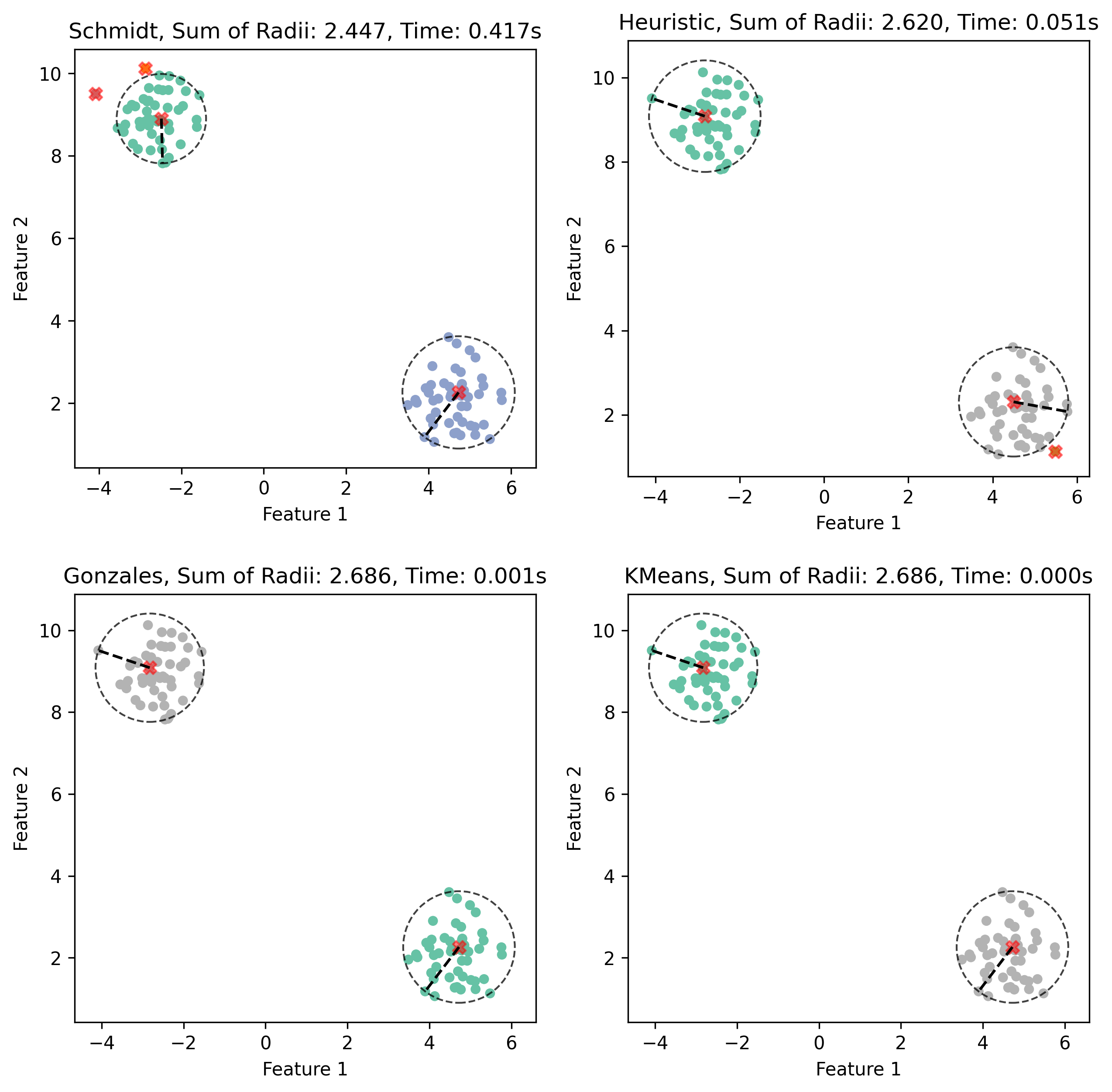
kMSR provides various implementations to solve the k-Min-Sum-Radii problem. The k-Min-Sum-Radii problem is a clustering problem that aims to minimize the sum of the radii of the clusters. Given a set of points, the aim is to find $k$ balls such that the the sum of the radii of the balls is minimized. The package provides the following algorithms:
fpt-heuristic: The algorithm is an heuristic version of what is described in this paper. In practice, this works well for clusters that are not too separated. The algorithm uses the parametersepsilon,n_u, andnum_test_radiito control the trade-off between the quality of the solution and the runtime. Increasen_ufor a more accurate solution, which will however require more computation time.heuristic: The algorithm is a simple heuristic that explores all possible combinations for the first cluster, and then selects the remaining centers as the points farthest from the radius of the first cluster. This algorithm works well in practice but it is not practical for large datasets.gonzalez: This is the standard Gonzalez algorithm for $k$-center.kmeans: This is the k-means++ algorithm for $k$-means.
Although the last two algorithms are not specifically designed for the k-Min-Sum-Radii problem, they serve as useful baselines for comparing the performance of other algorithms. Additionally, an optimization has been integrated into all algorithms: intersecting balls are merged at the end, resulting in a more cost-effective solution.
For computing the minimum enclosing circle of a set of points we use the miniball header for C++. Their code has not been changed.
You can try kMSR out on our Clustering Toolkit!
Installation
We highly recommend to install OpenMP. Parts of the code are parallelized and will be much faster. However, on Windows and MacOS the code also works without OpenMP. Nonetheless, the code was written for Linux and will achieve the best performance there.
On Linux, you can use the following command:
# Alpine
sudo apk add openmp-dev libgomp
# Ubuntu
sudo apt-get install libomp-dev libgomp1
# Debian
sudo apt-get install gcc libomp-dev libomp5 libgomp1
# ArchLinux
sudo pacman -S openmp
ln -s libomp.so libomp.so.5
We have tested this on docker, so it might be a little different on your system.
On MacOS, you can use the following command:
brew install llvm libomp
However, it might be that MacOS does not find the installed library. In build_extension.py, the paths are set manually. If it does not work for you, please clone the repository and run poetry build. You will see a message in red if your OpenMP is not found.
Then, you can install the package via pip:
pip install kmsr
Example
from kmsr import KMSR
from kmsr.plot import plot_multiple_results
from sklearn.datasets import make_blobs
from time import time

points, ground_truth = make_blobs(
    n_samples=100,
    n_features=2,
    centers=2,
    cluster_std=0.6,
    shuffle=True,
    random_state=42,
)

labels = []
centers = []
radii = []
titles = []
for algo in ["FPT-heuristic", "Heuristic", "Gonzalez", "KMeans"]:
    kmsr = KMSR(
        n_clusters=5,
        algorithm=algo,
        epsilon=0.5,
        n_u=10000,
        n_test_radii=10,
        random_state=42,
    )
    start = time()
    kmsr.fit(points)
    end = time() - start
    labels.append(kmsr.labels_)
    centers.append(kmsr.cluster_centers_)
    radii.append(kmsr.cluster_radii_)
    titles.append(f"{algo}: {sum(kmsr.cluster_radii_):.3f}, Time: {end:.3f}s")

plot_multiple_results(
    points,
    clusters=labels,
    centers=centers,
    radii=radii,
    title=titles,
)
Development
Install poetry
curl -sSL https://install.python-poetry.org | python3 -
Install clang
sudo apt-get install clang
Set clang variables
export CXX=/usr/bin/clang++
export CC=/usr/bin/clang
Install the package
poetry install
If the installation does not work and you do not see the C++ output, you can build the package to see the stack trace
poetry build
Run the tests
poetry run python -m unittest discover tests -v
Citation
If you use this code, please cite the following bachelor thesis:
N. Lenßen, "Experimentelle Analyse von Min-Sum-Radii Approximationsalgorithmen". Bachelorarbeit, Heinrich-Heine-Universität Düsseldorf, 2024.
Moreover, depending on the selection of the algorithm parameter, you should also cite the following paper for algorithm='fpt-heuristic':
L. Drexler, A. Hennes, A. Lahiri, M. Schmidt, and J. Wargalla, "Approximating Fair K-Min-Sum-Radii in Euclidean Space," in Lecture notes in computer science, 2023, pp. 119–133. doi: 10.1007/978-3-031-49815-2_9.
the following paper for algorithm='gonzalez':
T. F. Gonzalez, "Clustering to minimize the maximum intercluster distance," Theoretical Computer Science, vol. 38, pp. 293–306, Jan. 1985, doi: 10.1016/0304-3975(85)90224-5.
and the following paper for algorithm='kmeans':
D. Arthur and S. Vassilvitskii, "k-means++: the advantages of careful seeding," Symposium on Discrete Algorithms, pp. 1027–1035, Jan. 2007, doi: 10.5555/1283383.1283494.


Download files
Download the file for your platform. If you're not sure which to choose, learn more about installing packages.
Source Distribution
Built Distribution
Filter files by name, interpreter, ABI, and platform.
If you're not sure about the file name format, learn more about wheel file names.
Copy a direct link to the current filters
File details
Details for the file kmsr-0.1.3.tar.gz.
File metadata
- Download URL: kmsr-0.1.3.tar.gz
- Upload date:
- Size: 393.8 kB
- Tags: Source
- Uploaded using Trusted Publishing? No
- Uploaded via: poetry/1.8.2 CPython/3.10.18 Linux/6.11.0-1018-azure
File hashes
| Algorithm | Hash digest | |
|---|---|---|
| SHA256 |
607663f60c5c4b5259d41f5d5c62c9a14b7842c2252a9c9aa795f5ed763ca416
|
|
| MD5 |
2afdee76fcbd6196026668a48f5b0974
|
|
| BLAKE2b-256 |
149384aed3e27bec27bb47202d7d65d1ed07cec8b7ee464afb2f0e091fa7ab89
|
File details
Details for the file kmsr-0.1.3-cp310-cp310-manylinux_2_39_x86_64.whl.
File metadata
- Download URL: kmsr-0.1.3-cp310-cp310-manylinux_2_39_x86_64.whl
- Upload date:
- Size: 731.4 kB
- Tags: CPython 3.10, manylinux: glibc 2.39+ x86-64
- Uploaded using Trusted Publishing? No
- Uploaded via: poetry/1.8.2 CPython/3.10.18 Linux/6.11.0-1018-azure
File hashes
| Algorithm | Hash digest | |
|---|---|---|
| SHA256 |
fd214835ddddf3adef722aff90738784537a44e205531a80e71aca381fca214b
|
|
| MD5 |
f4e877010816870f2b273e5e9dfbfc75
|
|
| BLAKE2b-256 |
8716a7d94039113ab43cd3ad041485ee9b3b071903f1718fa138c79e62ac7c6d
|






