
Lighthouse Service Discovery Tool




Lighthouse is a service node discovery system written in python, built with resilience, flexibility and ease-of-use in mind and inspired by Airbnb’s SmartStack solution. Out of the box it supports discovery via Zookeeper with cluster load balancing handled by an automatically configured HAProxy.
Documentation
More detailed documentation can be found on Read the Docs.
Overview
A lighthouse setup consists of three parts running locally on each node: a load balancer, the lighthouse-writer script and (usually) the lighthouse-reporter script.
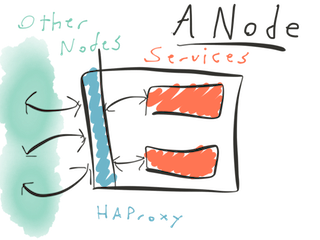
In a Lighthouse setup, no node’s application code is aware of the existence of other nodes, they talk to a local port handled by an instance of the load balancer which in turn routes traffice among the various known other nodes.
This local load balancer is automatically updated when nodes come and go via the lighthouse-writer script, which talks to the discovery method (e.g. Zookeeper) to keep track of which nodes on which clusters are up.
The lighthouse-reporter script likewise talks to the discovery method, it it is responsible for running health checks on any services on the local node and reports to the discovery method that the healthy services are up and the unhealthy ones are down.
Development
The code is hosted on GitHub
To file a bug or possible enhancement see the Issue Tracker, also found on GitHub.
License
(c) 2014-2016 William Glass
Lighthouse is licensed under the terms of the Apache license (2.0). See the LICENSE file for more details.
1 maintainer

Metadata
1 maintainer
Release files for lighthouse 1.0.0
For a detailed explanation of source distributions (sdists) and built distributions (wheels), please see the package formats documentation.
Source distribution (sdist)
| File | Size | Uploaded | Provenance | |
|---|---|---|---|---|
| lighthouse-1.0.0.tar.gz | 36.1 kB | Without provenance | Details |
Release files / lighthouse-1.0.0.tar.gz
| Download URL | lighthouse-1.0.0.tar.gz |
|---|---|
| Size | 36.1 kB |
| Tags | Source |
|
SHA-256 checksum How to use checksums |
f81ad515860bb92d986a1b0e3b157d5d4edc2566fc849ee8508c7341b18ceaf1
|
|
BLAKE2b-256 checksum How to use checksums |
abd40ce2b286c1e4bd29afeb258e860ac72eeff27ae8bf39d1d1b46a2a78c2d0
|
| Upload date | |
|
Uploaded using Trusted Publishing? What is trusted publishing? |
No |
Security for lighthouse 1.0.0
Provenance
Provenance describes where a file came from. On PyPI, provenance is shared via attestations, which provide a verifiable record of the build or publishing details. View details, limitations and caveats.
No provenance found
None of the files in this release were uploaded with provenance metadata.
A note on package security
PyPI is a repository for distributing packages, not a service for auditing them. While third-party security researchers and our staff do their best to detect and remove malicious packages, PyPI cannot guarantee the quality, security or suitability of any given package.
To learn more about protecting yourself from malicious actors, visit our package security documentation.














