
Locust odoorpc
Links
Locust: https://locust.io/
Locust docs: https://docs.locust.io/
OdooRPC: https://pythonhosted.org/OdooRPC/
Source code: https://github.com/camptocamp/locustodoorpc
Alternative: https://github.com/nseinlet/OdooLocust (using openerplib instead of odoorpc)
Description
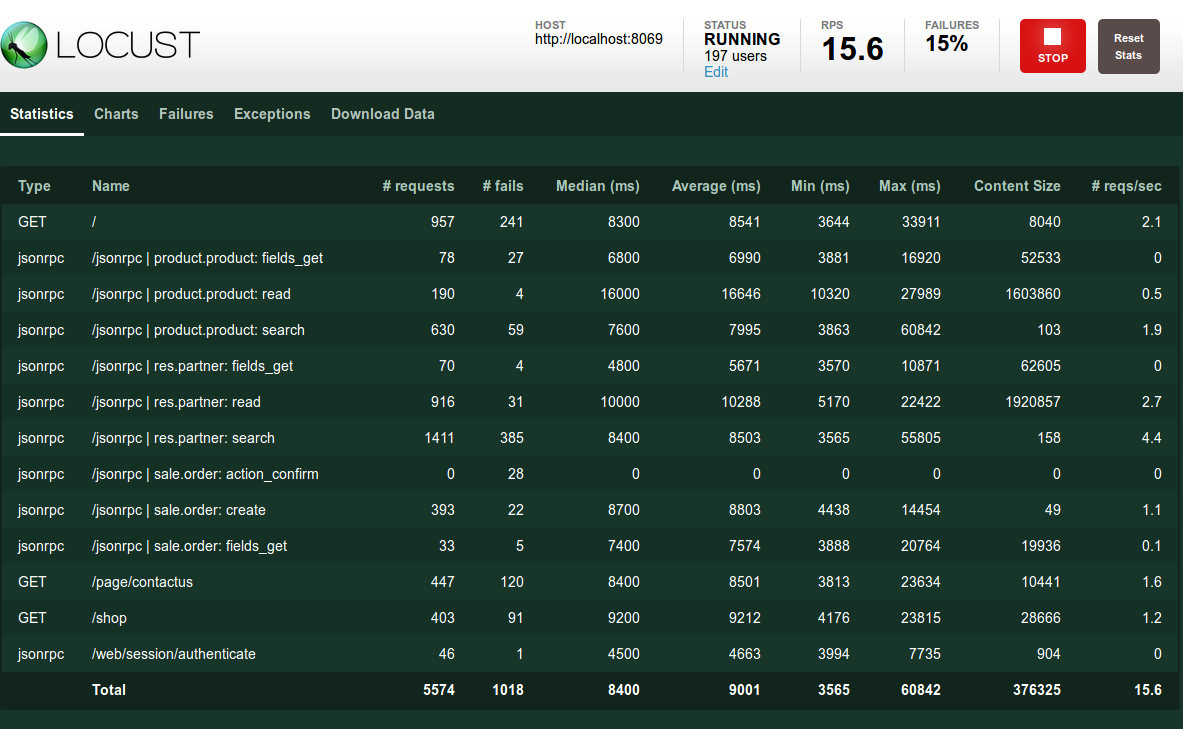
Locust custom client integrating the odoorpc library, so you can run load-testing on your odoo services. Have a look at the feature list of locust to see what you can do.
Installation
virtualenv .env
source .env/bin/activate
pip install locustodoorpc
Usage
For the general documentation on Locust, heads on https://docs.locust.io/en/latest/ A few options can be customized with environment variables or command line parameters. These can also be specified in the Locust Web UI now.
Name |
Option |
Usage |
ODOO_DB_NAME |
–odoo-db-name |
Configure the name of the database to load-test (default: odoo) |
ODOO_LOGIN |
–odoo-login |
Login to use for the actions (default: admin) |
ODOO_PASSWORD |
–odoo-password |
Password for the user (default: admin) |
ODOO_VERSION |
–odoo-version |
Force an Odoo version (e.g. 9.0, 10.0, 11.0), normally automatically recognized |
Example:
ODOO_DB_NAME=demo locust -f examples/locustfile.py --host http://localhost:8069
Also Valid:
locust -f examples/locustfile.py --host http://localhost:8069 --odoo-db-name=demo
Check the examples
Release History
0.0.4 (2023-02-17)
update locust version
allow Odoo Configuration from the Locust Web UI (#5 by @HP-bkeys)
0.0.3 (2022-08-25)
fix python3 support
update locust package name
adapt to new locust API
bump dependencies version of locust and odoorpc
update examples to work with Odoo 15.0 out of the box
0.0.2 (2017-11-03)
Fix support of jsonrpc-ssl
0.0.1 (2017-11-03)
Initial release.
4 maintainers


Metadata
4 maintainers
Release files for locustodoorpc 0.0.4
For a detailed explanation of source distributions (sdists) and built distributions (wheels), please see the package formats documentation.
Source distribution (sdist)
| File | Size | Uploaded | Provenance | |
|---|---|---|---|---|
| locustodoorpc-0.0.4.linux-x86_64.tar.gz | 5.7 kB | Without provenance | Details |
Built distribution (wheel)
| File | Interpreter | ABI | Platform | Reset |
|---|---|---|---|---|
| locustodoorpc-0.0.4-py3-none-any.whl | Python 3 | none | any | Details |
Total release size: 10.0 kB
Release files / locustodoorpc-0.0.4.linux-x86_64.tar.gz
| Download URL | locustodoorpc-0.0.4.linux-x86_64.tar.gz |
|---|---|
| Size | 5.7 kB |
| Tags | Source |
|
SHA-256 checksum How to use checksums |
e3a117c5d5b2004a1628246299edcfec0eadcff6a486afde030c50260b807e41
|
|
BLAKE2b-256 checksum How to use checksums |
a8be45033f8bd151d831021a7dc42abf9f863268b1cf39d134a9eda2527f8d56
|
| Upload date | |
|
Uploaded using Trusted Publishing? What is trusted publishing? |
No |
| Uploaded via |
twine/3.1.1 pkginfo/1.4.2 requests/2.22.0 setuptools/45.2.0 requests-toolbelt/0.8.0 tqdm/4.30.0 CPython/3.8.10
|
Release files / locustodoorpc-0.0.4-py3-none-any.whl
| Download URL | locustodoorpc-0.0.4-py3-none-any.whl |
|---|---|
| Size | 4.3 kB |
| Tags | Python 3 |
|
SHA-256 checksum How to use checksums |
065f60f7f9bece84a81549e803e86f7525a645539057bedfce5b9664fd1f0764
|
|
BLAKE2b-256 checksum How to use checksums |
ecfe7ef4532af262488dfa54eaa0c1aaf2cef6bba0f2b3b7fd7bff8478ccbac4
|
| Upload date | |
|
Uploaded using Trusted Publishing? What is trusted publishing? |
No |
| Uploaded via |
twine/3.1.1 pkginfo/1.4.2 requests/2.22.0 setuptools/45.2.0 requests-toolbelt/0.8.0 tqdm/4.30.0 CPython/3.8.10
|
Security for locustodoorpc 0.0.4
Provenance
Provenance describes where a file came from. On PyPI, provenance is shared via attestations, which provide a verifiable record of the build or publishing details. View details, limitations and caveats.
No provenance found
None of the files in this release were uploaded with provenance metadata.
A note on package security
PyPI is a repository for distributing packages, not a service for auditing them. While third-party security researchers and our staff do their best to detect and remove malicious packages, PyPI cannot guarantee the quality, security or suitability of any given package.
To learn more about protecting yourself from malicious actors, visit our package security documentation.














