
Multiple ADB logcat with colored output / csv export
Tested against Windows 10 / Python 3.11 / Anaconda
pip install logcatdevices
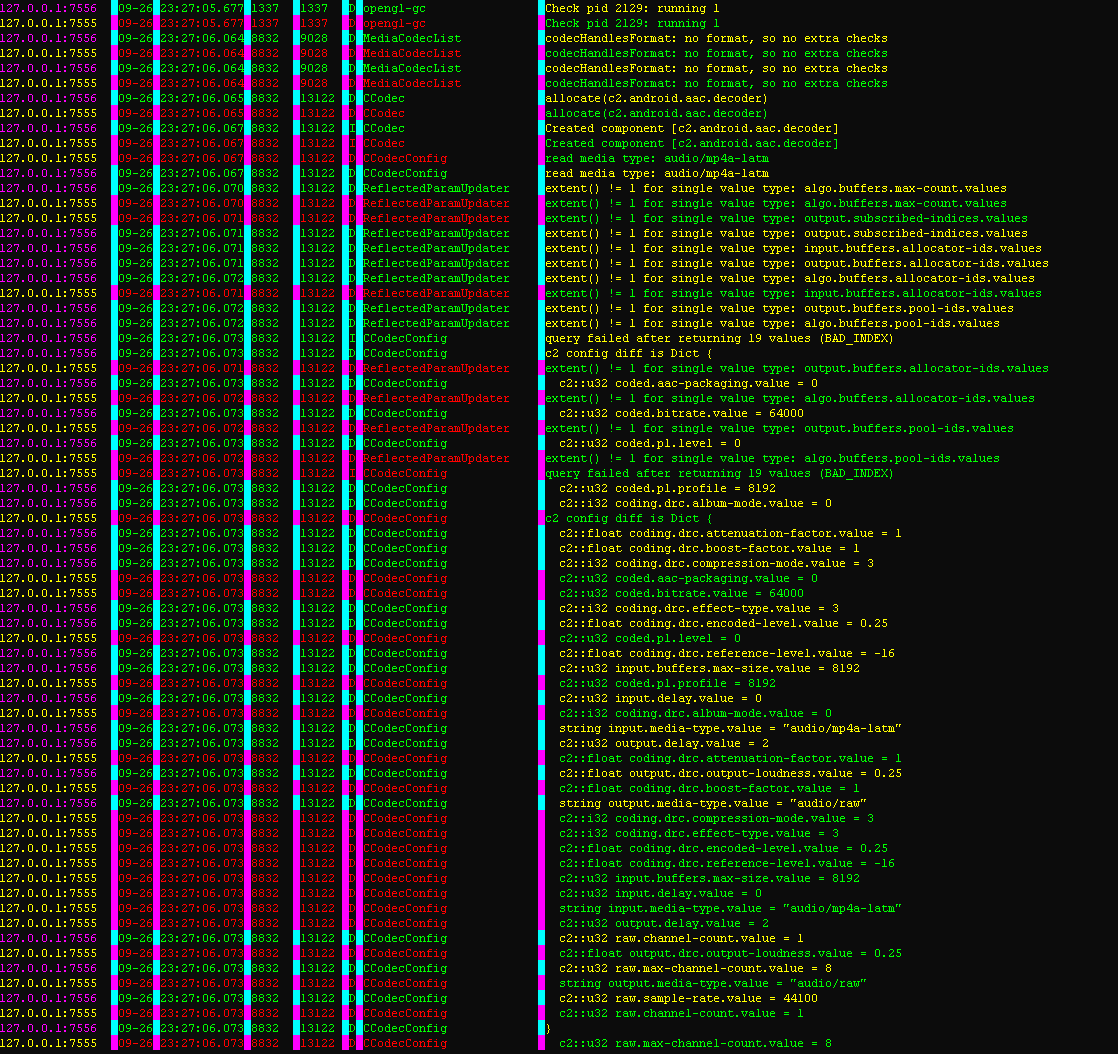
start_logcat (ctrl+c to stop)
Starts logging Android device logs using ADB.

This function initiates log capturing for specified Android devices using ADB (Android Debug Bridge).
Logs are saved to a CSV file for further analysis.

Args:
	adb_path (str): Path to the ADB executable.
	csv_output (str): Path to the CSV file where the logs will be saved.
	device_serials (str or list): A single device serial number as a string, or a list of serial numbers
								  for multiple devices. Serial numbers are used to identify connected devices.
	print_stdout (bool, optional): If True, prints log messages to the console. Default is True.
	clear_log (bool, optional): If True, clears the device log before capturing. Default is True.
	ljustserial (int, optional): Left-justifies the device serial number in the printed output. Default is 16.

Returns:
	None

Example:
	from logcatdevices import start_logcat

	androidcsv = "c:\\csvandroisad.csv"
	_ = start_logcat(
		adb_path=r"C:\Android\android-sdk\platform-tools\adb.exe",
		csv_output=androidcsv,
		device_serials=[
			"127.0.0.1:5565",
			"127.0.0.1:7555",
			"127.0.0.1:7556",
			"emulator-5554",
			"emulator-5564",
		],
		print_stdout=True,
		clear_log=True,
		ljustserial=16,
	)
csv2df
Converts a CSV log file to a pandas DataFrame.

This function reads a CSV file containing Android device log data and converts it into a structured
pandas DataFrame, enabling easy data manipulation and analysis.

Args:
	csvfile (str): Path to the CSV log file.

Returns:
	pandas.DataFrame: A DataFrame containing log data with the following columns:
		- aa_source (str): Source of the log message.
		- aa_date (datetime): Date and time of the log message.
		- aa_processID (int): Process ID associated with the log message.
		- aa_threadID (int): Thread ID associated with the log message.
		- aa_logType (str): Type of log message (e.g., 'V', 'D', 'I', 'W', 'E').
		- aa_tag (str): Tag associated with the log message.
		- aa_message (str): Log message content.

Example:
	from logcatdevices import csv2df
	androidcsv = "c:\\csvandroisad.csv"
	df = csv2df(androidcsv)
	print(df.to_string())
1 maintainer

Metadata
1 maintainer
Release files for logcatdevices 0.11
For a detailed explanation of source distributions (sdists) and built distributions (wheels), please see the package formats documentation.
Source distribution (sdist)
| File | Size | Uploaded | Provenance | Actions |
|---|---|---|---|---|
| logcatdevices-0.11.tar.gz | 8.1 kB | Without provenance | Details for logcatdevices-0.11.tar.gz |
Built distribution (wheel)
| File | Interpreter | ABI | Platform | Actions Reset |
|---|---|---|---|---|
| logcatdevices-0.11-py3-none-any.whl | Python 3 | none | any | Details for logcatdevices-0.11-py3-none-any.whl |
Total release size: 17.7 kB
Release files / logcatdevices-0.11.tar.gz
| Download URL | logcatdevices-0.11.tar.gz |
|---|---|
| Size | 8.1 kB |
| Tags | Source |
|
SHA-256 checksum How to use checksums |
0762b0edab2dc6f71b8abb3a604ef5c097353cba9b61836ca1d79a1f5e9ef5ee
|
|
BLAKE2b-256 checksum How to use checksums |
9d39374ed57441308c3878e6fb0a0385803d9bad70df2be0f1898731b845ae86
|
| Upload date | |
|
Uploaded using Trusted Publishing? What is trusted publishing? |
No |
| Uploaded via |
twine/4.0.2 CPython/3.11.5
|
Release files / logcatdevices-0.11-py3-none-any.whl
| Download URL | logcatdevices-0.11-py3-none-any.whl |
|---|---|
| Size | 9.5 kB |
| Tags | Python 3 |
|
SHA-256 checksum How to use checksums |
904661772319848c9d68607eba31d81673945f1eeafc1d38d3261512748d4221
|
|
BLAKE2b-256 checksum How to use checksums |
a11414a83bf9016a844a1f49f877c48acbf357c94975a2870c7a1c69a953f986
|
| Upload date | |
|
Uploaded using Trusted Publishing? What is trusted publishing? |
No |
| Uploaded via |
twine/4.0.2 CPython/3.11.5
|
Security for logcatdevices 0.11
Provenance
Provenance describes where a file came from. On PyPI, provenance is shared via attestations, which provide a verifiable record of the build or publishing details. View details, limitations and caveats.
No provenance found
None of the files in this release were uploaded with provenance metadata.
A note on package security
PyPI is a repository for distributing packages, not a service for auditing them. While third-party security researchers and our staff do their best to detect and remove malicious packages, PyPI cannot guarantee the quality, security or suitability of any given package.
To learn more about protecting yourself from malicious actors, visit our package security documentation.














