
Layer-Wise Relevance Propagation



PyTorch implementation of Layer-wise Relevance Propagation (LRP) algorithm together with quantitative evaluation metrics to compare heatmap explanations objectively.
Special thanks to Dr. Grégoire Montavon for his insights, which shaped the development of this project.
Features
Explainability:
- Layer-wise Relevance Propagation (LRP)
Quantitative Evaluation:
- Pixel Flipping (PF), also known as Region Perturbation (RP)
- Perturbation modes:
- inpainting
- random
- Sort objectives:
- most relevant first (MoRF), also known as activation curve
- least relevant first (LRF), also known as pruning curve
- random
- Perturbation modes:
- AUC (Area Under the Curve), also known as AUAC (Area Under the Activation Curve) or AU-MSE (Area Under the Mean Squared Error Curve) depending on the sort objective
Showcase
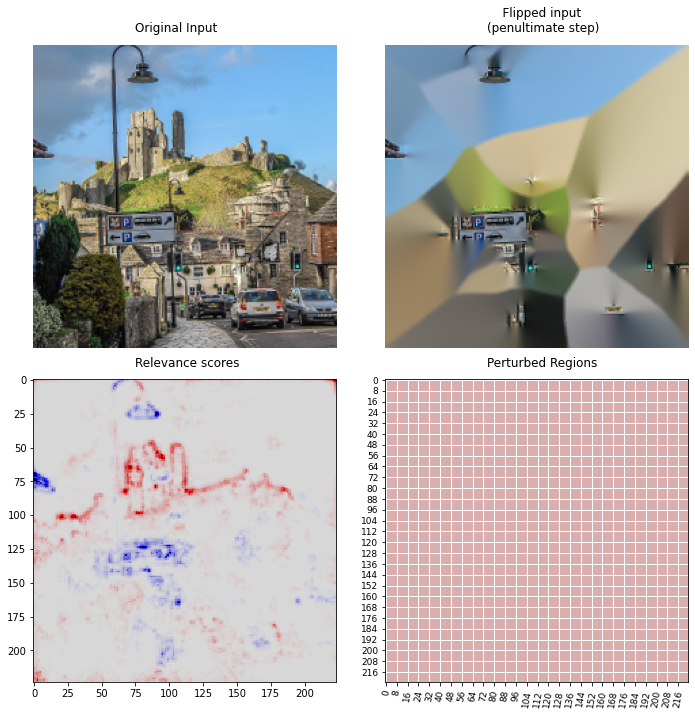
LRP (lrp-tutorial composite) and PF with inpainting perturbation mode and sort objective MoRF.
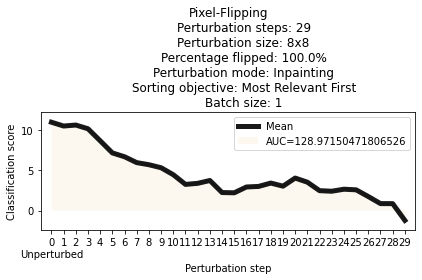
Classification scores of castle image with inpainting perturbation mode
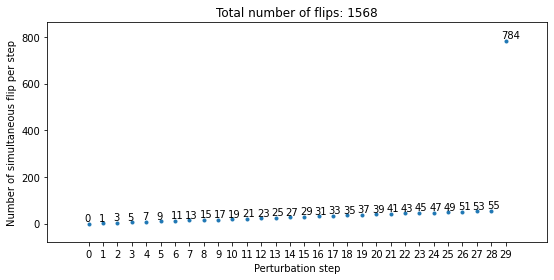
Number of simultaneous flips per perturbation step during Pixel-Flipping.
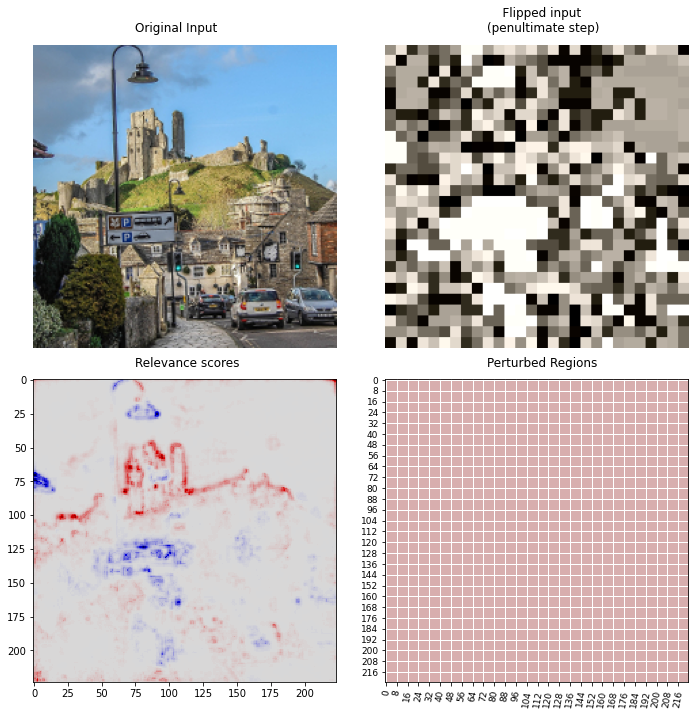
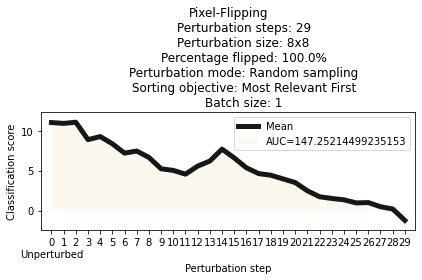
PF perturbation mode random
LRP (lrp-tutorial composite) and PF with random perturbation mode and sort objective MoRF.
Classification scores of castle image with random perturbation mode
Requirements
python3>= 3.9
Installation
python3 -m pip install lrp-pf-auc
The PyPI distribution lrp-pf-auc provides the following two packages: lrp and pf.
The name lrp-pf-auc stands for Layer-wise Relevance Propagation (LRP), Pixel Flipping (PF), and Area Under the Curve (AUC) respectively.
Usage
Refer to demo.ipynb for an example of Layer-wise Relevance Propagation (LRP), Pixel-Flipping (PF) and Area under the Curve (AUC).
Feel free to check out the Jupyter notebooks under experiments/notebooks for a chronological overview of the project.
Related Projects
- Sequential LRP implementation: gmontavon/lrp-tutorial
Tutorial on how to implement LRP
- Updated version of
gmontavon/lrp-tutorial: rodrigobdz/lrp-tutorial - Forward-hook LRP implementation: chr5tphr/zennit
Implementation of LRP-based methods in PyTorch
innvestigate-based LRP implementation: moboehle/Pytorch-LRP- Caffe-based LRP implementation:
lrp_toolbox - Pixel-Flipping and Region Perturbation implementation: understandable-machine-intelligence-lab/Quantus
Citation
Cite as:
-
Plaintext:
Rodrigo Bermúdez Schettino. (2022). rodrigobdz/lrp: v0.1.6 (v0.1.6). Zenodo. https://doi.org/10.5281/zenodo.6821295
-
BibTeX:
@software{rodrigo_bermudez_schettino_2022_6821295,
  author       = {Rodrigo Bermúdez Schettino},
  title        = {rodrigobdz/lrp: v0.1.6},
  month        = jul,
  year         = 2022,
  publisher    = {Zenodo},
  version      = {v0.1.6},
  doi          = {10.5281/zenodo.6821295},
  url          = {https://doi.org/10.5281/zenodo.6821295}
}
Credits
-
The structure of this readme is based on minimal-readme
-
Scripts follow Personal Shell Style Guide
-
The
lrppackage uses two customized files originally from chr5tphr/zennit. -
The syntax for defining custom composites is inspired by this discussion on
zennit's repo.
This implementation is based on insights from:
-
LRP overview paper
G. Montavon, A. Binder, S. Lapuschkin, W. Samek, K.-R. Müller Layer-wise Relevance Propagation: An Overview in Explainable AI: Interpreting, Explaining and Visualizing Deep Learning, Springer LNCS, vol. 11700, 2019
-
Original LRP paper
S. Bach, A. Binder, G. Montavon, F. Klauschen, K.-R. Müller, W. Samek On pixel-wise explanations for non-linear classifier decisions by layer-wise relevance propagation PloS ONE 10 (7), e0130140, 2015
-
ECML/PKDD 2020 Tutorial: Explainable AI for Deep Networks: Basics and Extensions (Part 3)
License
1 maintainer

Metadata
1 maintainer
Release files for lrp-pf-auc 0.1.6
For a detailed explanation of source distributions (sdists) and built distributions (wheels), please see the package formats documentation.
Source distribution (sdist)
| File | Size | Uploaded | Provenance | |
|---|---|---|---|---|
| lrp_pf_auc-0.1.6.tar.gz | 37.5 kB | Without provenance | Details |
Built distribution (wheel)
| File | Interpreter | ABI | Platform | Reset |
|---|---|---|---|---|
| lrp_pf_auc-0.1.6-py3-none-any.whl | Python 3 | none | any | Details |
Total release size: 82.4 kB
Release files / lrp_pf_auc-0.1.6.tar.gz
| Download URL | lrp_pf_auc-0.1.6.tar.gz |
|---|---|
| Size | 37.5 kB |
| Tags | Source |
|
SHA-256 checksum How to use checksums |
8dbd0c27f66a07005ee7fe0e91215718eb35b86892cf63c054363f5e0116087a
|
|
BLAKE2b-256 checksum How to use checksums |
cbe32bfd13f0b437db94e8a635377d66876004cdf32079f8d407bcab2c1c1384
|
| Upload date | |
|
Uploaded using Trusted Publishing? What is trusted publishing? |
No |
| Uploaded via |
twine/4.0.1 CPython/3.9.13
|
Release files / lrp_pf_auc-0.1.6-py3-none-any.whl
| Download URL | lrp_pf_auc-0.1.6-py3-none-any.whl |
|---|---|
| Size | 44.9 kB |
| Tags | Python 3 |
|
SHA-256 checksum How to use checksums |
d7b8458c32b4d1936f3638c60bab6bae77d48b6590ff88c565614d5485e0a139
|
|
BLAKE2b-256 checksum How to use checksums |
eda6d8ce885fb3364b3008d26678ef1b6fb66b9cb4865aa23982207645cef357
|
| Upload date | |
|
Uploaded using Trusted Publishing? What is trusted publishing? |
No |
| Uploaded via |
twine/4.0.1 CPython/3.9.13
|
Security for lrp-pf-auc 0.1.6
Provenance
Provenance describes where a file came from. On PyPI, provenance is shared via attestations, which provide a verifiable record of the build or publishing details. View details, limitations and caveats.
No provenance found
None of the files in this release were uploaded with provenance metadata.
A note on package security
PyPI is a repository for distributing packages, not a service for auditing them. While third-party security researchers and our staff do their best to detect and remove malicious packages, PyPI cannot guarantee the quality, security or suitability of any given package.














