
Luga
- A blazing fast language detection using fastText's language models.
Luga is a Swahili word for language. fastText provides blazing-fast language detection tool. Lamentably, fastText's API is beauty-less, and the documentation is a bit fuzzy. It is also funky that we have to manually download and load models.
Here is where luga comes in. We abstract unnecessary steps and allow you to do precisely one thing: detecting text language.
cover image
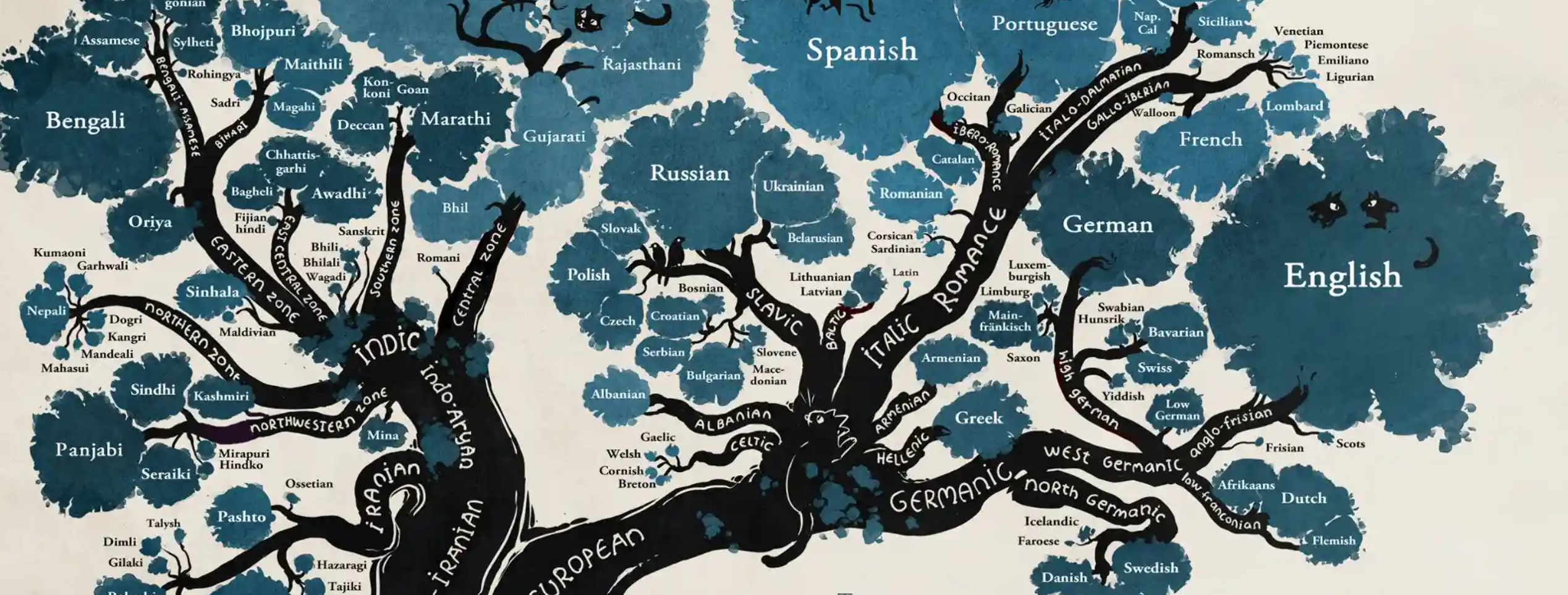
Stand Still. Stay Silent - The relationships between Indo-European and Uralic languages by Minna Sundberg.
Show, don't tell

Installation
python -m pip install -U luga
Usage:
⚠️ Note: The first usage downloads the model for you. It will take a bit longer to import depending on internet speed. It is done only once.
from luga import language

print(language("the world ended yesterday"))

# Language(name='en', score=0.9804665446281433)
With the list of texts, we can create a mask for a filtering pipeline, that can be used, for example, with DataFrames
from luga import language
import pandas as pd

examples = ["Jeg har ikke en rød reje", "Det blæser en halv pelican", "We are not robots yet"]
languages(texts=examples, only_language=True, to_array=True) == "en"
# output
# array([False, False, True])

dataf = pd.DataFrame({"text": examples})
dataf.loc[lambda d: languages(texts=d["text"].to_list(), only_language=True, to_array=True) == "en"]
# output
# 2    We are not robots yet
# Name: text, dtype: object
Without Luga:
Download the model
wget https://dl.fbaipublicfiles.com/fasttext/supervised-models/lid.176.bin -O /tmp/lid.176.bin
Load and use
import fasttext

PATH_TO_MODEL = '/tmp/lid.176.bin'
fmodel = fasttext.load_model(PATH_TO_MODEL)
fmodel.predict(["the world has ended yesterday"])

# ([['__label__en']], [array([0.98046654], dtype=float32)])
Dev:
poetry run pre-commit install
Release Flow
# assumes git push is completed
git tag -l #  lists tags
git tag v*.*.* # Major.Minor.Fix
git push origin tag v*.*.*

# to delete tag:
git tag -d v*.*.* && git push origin tag -d v*.*.*

# change project_toml and __init__.py to reflect new version
TODO:
- refactor artifacts.py
- auto checkers with pre-commit | invoke
- write more tests
- write github actions
- create an intelligent data checker (a fast List[str], what do with none strings)
- make it faster with Cython
- get NDArray typing correctly
- fix
artifacts.pyline 111 cast to List[str] that causes issues - remove nptyping when more packages move to numpy > 1.21
1 maintainer

Metadata
1 maintainer
Release files for luga 0.2.7
For a detailed explanation of source distributions (sdists) and built distributions (wheels), please see the package formats documentation.
Source distribution (sdist)
| File | Size | Uploaded | Provenance | Actions |
|---|---|---|---|---|
| luga-0.2.7.tar.gz | 5.5 kB | Without provenance | Details for luga-0.2.7.tar.gz |
Built distribution (wheel)
| File | Interpreter | ABI | Platform | Actions Reset |
|---|---|---|---|---|
| luga-0.2.7-py3-none-any.whl | Python 3 | none | any | Details for luga-0.2.7-py3-none-any.whl |
Total release size: 11.2 kB
Release files / luga-0.2.7.tar.gz
| Download URL | luga-0.2.7.tar.gz |
|---|---|
| Size | 5.5 kB |
| Tags | Source |
|
SHA-256 checksum How to use checksums |
f59a07dc9eaa6b72b8b88ddea69be292b9fbc4d1522cf3ed4a6f29fc5d7feaff
|
|
BLAKE2b-256 checksum How to use checksums |
12e77bcb3cee8e1fd07eff6b29c071c2ed78761c2308c14b006fc11cf5295eaa
|
| Upload date | |
|
Uploaded using Trusted Publishing? What is trusted publishing? |
No |
| Uploaded via |
poetry/1.3.1 CPython/3.10.6 Linux/5.15.0-1024-azure
|
Release files / luga-0.2.7-py3-none-any.whl
| Download URL | luga-0.2.7-py3-none-any.whl |
|---|---|
| Size | 5.7 kB |
| Tags | Python 3 |
|
SHA-256 checksum How to use checksums |
b4a6f39fb2e1d5dbec5fd1cc26646ac83ee0acfc6599732bbef1bd5ce4e35b94
|
|
BLAKE2b-256 checksum How to use checksums |
860b201e6de09986764cf4ae15b3a3b6165389c764f40f0866540a7b04bddcd2
|
| Upload date | |
|
Uploaded using Trusted Publishing? What is trusted publishing? |
No |
| Uploaded via |
poetry/1.3.1 CPython/3.10.6 Linux/5.15.0-1024-azure
|
Security for luga 0.2.7
Provenance
Provenance describes where a file came from. On PyPI, provenance is shared via attestations, which provide a verifiable record of the build or publishing details. View details, limitations and caveats.
No provenance found
None of the files in this release were uploaded with provenance metadata.
A note on package security
PyPI is a repository for distributing packages, not a service for auditing them. While third-party security researchers and our staff do their best to detect and remove malicious packages, PyPI cannot guarantee the quality, security or suitability of any given package.
To learn more about protecting yourself from malicious actors, visit our package security documentation.














