
 Maki Nage
Stream Processing Made Easy



Maki Nage is a Python stream processing library and framework. It provides expressive and extensible APIs. Maki Nage speeds up the development of stream applications. It can be used to process stream and batch data. More than that, it allows to develop an application with batch data, and deploy it as a Kafka micro-service.
Read the doc to learn more.
Main Features
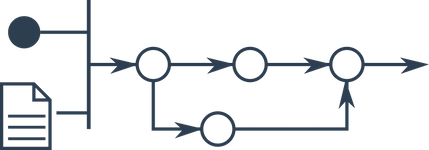
Expressive and Extensible APIs: Maki-Nage is based on ReactiveX.
Deployment Ready: Maki-Nage uses Kafka to scale the workload, and be resilient to errors.
Unifies Batch and Stream processing: The same APIs work on both sources of data.
Flexible: Start working on your laptop, continue on a server, deploy on a cluster.
ML Streaming Serving: Serve your machine learning model as a Kafka micro-service.
Installation
Maki Nage is available on PyPI:
pip install makinageGetting started
Write your data transforms
import rx
import rxsci as rs

def rolling_mean():
    return rx.pipe(
        rs.data.roll(window=3, stride=3, pipeline=rx.pipe(
            rs.math.mean(reduce=True),
        )),
    )
Test your code on batch data
You can test your code from any python data or CSV file.
data = [1, 2, 3, 4, 5, 6, 7]

rx.from_(data).pipe(
    rs.state.with_memory_store(rx.pipe(
        rolling_mean(),
    )),
).subscribe(
    on_next=print
)
2.0
5.0Deploy your code as a Kafka micro-service
To deploy the code, package it as a function:
def my_app(config, data):
    roll_mean = rx.from_(data).pipe(
        rs.state.with_memory_store(rx.pipe(
            rolling_mean(),
        )),
    )

    return roll_mean,
Create a configuration file:
application:
    name: my_app
kafka:
    endpoint: "localhost"
topics:
    - name: data
    - name: features
operators:
    compute_features:
        factory: my_app:my_app
        sources:
            - data
        sinks:
            - features
And start it!
makinage --config myconfig.yamlServe Machine Learning Models
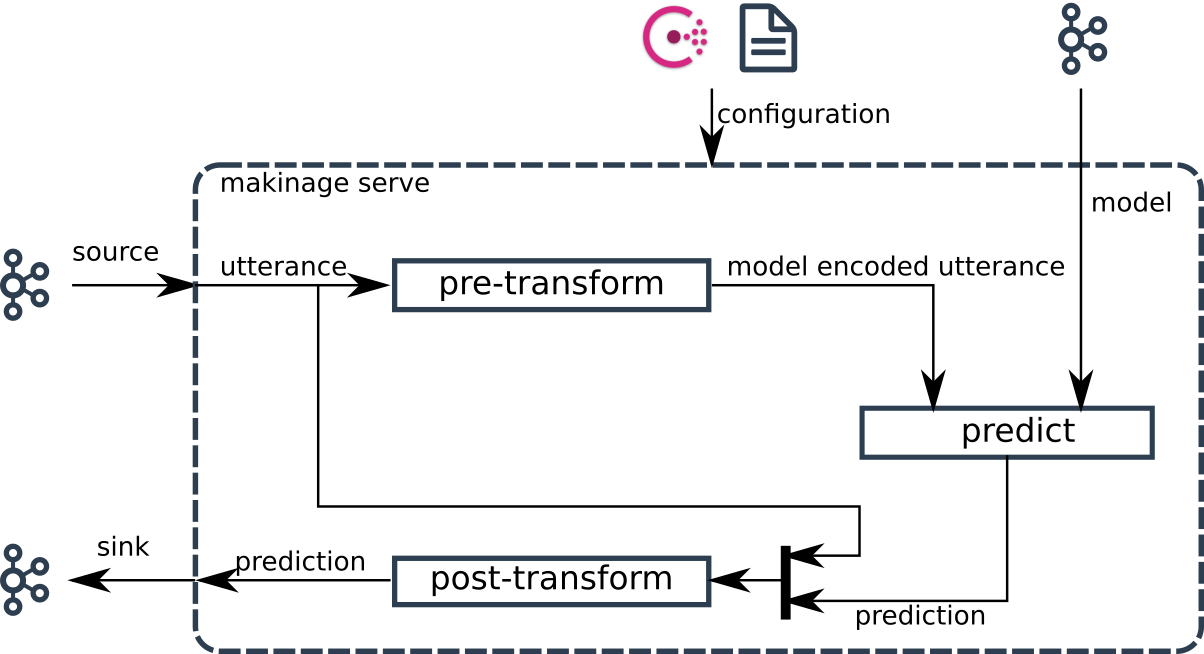
Maki Nage contains a model serving tool. With it, serving a machine learning model in streaming mode just requires a configuration file:
application:
    name: my_model_serving
Kafka:
    endpoint: "localhost"
topics:
- name: data
  encoder: makinage.encoding.json
- name: model
  encoder: makinage.encoding.none
  start_from: last
- name: predict
  encoder: makinage.encoding.json
operators:
  serve:
    factory: makinage.serve:serve
    sources:
      - model
      - data
    sinks:
      - predict
config:
  serve: {}
And then serving the model it done the same way than any makinage application:
makinage --config config.serve.yamlSome pre and post processing steps are possible if input features or predictions must be modified before/after the inference:
Read the book to learn more.
Publications
Toward Data Science: Stream Processing Made Easy
KDnuggets: Real-Time Histogram Plots on Unbounded Data
License
Maki Nage is publised under the MIT License.
1 maintainer

Metadata
1 maintainer
Release files for makinage 0.8.0
For a detailed explanation of source distributions (sdists) and built distributions (wheels), please see the package formats documentation.
Source distribution (sdist)
| File | Size | Uploaded | Provenance | |
|---|---|---|---|---|
| makinage-0.8.0.tar.gz | 19.1 kB | Without provenance | Details |
Release files / makinage-0.8.0.tar.gz
| Download URL | makinage-0.8.0.tar.gz |
|---|---|
| Size | 19.1 kB |
| Tags | Source |
|
SHA-256 checksum How to use checksums |
392229ea08090a18dcb582ae5615672f3bc11fe748c5653421c3acc24d7b53a2
|
|
BLAKE2b-256 checksum How to use checksums |
b51dff9fbe443ea98047cba38f932b6b58a5c75b65cebd06e822ffa6f0405292
|
| Upload date | |
|
Uploaded using Trusted Publishing? What is trusted publishing? |
No |
| Uploaded via |
twine/3.4.2 importlib_metadata/4.8.1 pkginfo/1.7.1 requests/2.26.0 requests-toolbelt/0.9.1 tqdm/4.62.3 CPython/3.9.7
|
Security for makinage 0.8.0
Provenance
Provenance describes where a file came from. On PyPI, provenance is shared via attestations, which provide a verifiable record of the build or publishing details. View details, limitations and caveats.
No provenance found
None of the files in this release were uploaded with provenance metadata.
A note on package security
PyPI is a repository for distributing packages, not a service for auditing them. While third-party security researchers and our staff do their best to detect and remove malicious packages, PyPI cannot guarantee the quality, security or suitability of any given package.














