
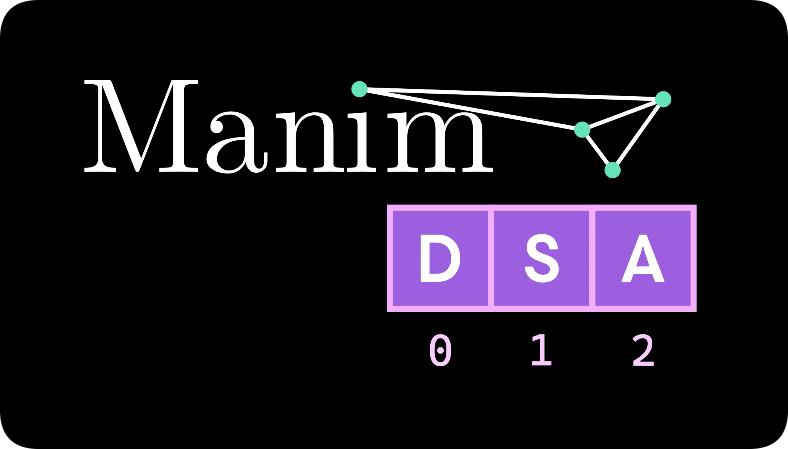




A Manim plugin designed to animate common data structures and algorithms
Manim DSA, short for Manim Data Structures & Algorithms, is a Manim plugin designed to animate common data structures and algorithms. Whether you are an educator looking to enhance your lectures, a student seeking to better understand these concepts, or a content creator making educational videos, Manim DSA provides a robust toolkit to bring abstract concepts to life.
Table of Contents:
Installation
To install Manim DSA, you can use pip:
pip install manim-dsa
If you don't have Manim installed, please refer to the official Manim documentation for installation instructions.
Importing
Simply use the following line of code to import the package:
from manim_dsa import *
Usage
The following is an example Scene where an array, a stack and a graph are created.
from manim import *
from manim_dsa import *

class Example(Scene):
    def construct(self):
        graph = {
            'A': [('C', 11), ('D', 7)],
            'B': [('A', 5),  ('C', 3)],
            'C': [('A', 11), ('B', 3)],
            'D': [('A', 7),  ('C', 4)],
        }
        nodes_and_positions = {
            'A': LEFT * 1.5,
            'B': UP * 2,
            'C': RIGHT * 1.5,
            'D': DOWN * 2,
        }

        mArray = (
            MArray([1, 2, 3], style=MArrayStyle.BLUE)
            .add_indexes()
            .scale(0.9)
            .add_label(Text("Array", font="Cascadia Code"))
            .to_edge(LEFT, 1)
        )

        mStack = (
            MStack([3, 7, 98, 1], style=MStackStyle.GREEN)
            .scale(0.8)
            .add_label(Text("Stack", font="Cascadia Code"))
            .move_to(ORIGIN)
        )

        mGraph = (
            MGraph(graph, nodes_and_positions, MGraphStyle.PURPLE)
            .add_label(Text("Graph", font="Cascadia Code"))
            .to_edge(RIGHT, 1)
        )

        self.play(Create(mArray))
        self.play(Create(mStack))
        self.play(Create(mGraph))
        self.wait()
The result is as follows:
https://github.com/user-attachments/assets/05307dc9-65d9-4262-ae32-3fb53068c8e4
Documentation
Documentation is in progress at ReadtheDocs.
Help with Manim DSA
If you need help installing or using Manim DSA, or you need to submit a bug report or feature request, please open an issue.
Contributing
Contributions are welcome! Whether it’s reporting a bug, suggesting new features, or submitting pull requests, any help is greatly appreciated.
How to Cite Manim DSA
To demonstrate the value of Manim DSA, we ask that you cite Manim DSA in your work. Currently, the best way to cite Manim DSA is to go to the repository page (if you aren't already) and click the "cite this repository" button on the right sidebar. This will generate a citation in your preferred format, and will also integrate well with citation managers. For guidance on how to properly cite Manim, please refer to the Manim GitHub page.
License
Manim DSA is licensed under the MIT License. You are free to use, modify, and distribute this software as long as you include the original license.
Acknowledgements
- Manim Community: For creating and maintaining the amazing Manim library.
- drageelr: For the inspiration behind the array implementation.
- Verdiana Pasqualini: For the inspiration behind the graph implementation.
1 maintainer

Metadata
1 maintainer
Release files for manim-dsa 0.4.0
For a detailed explanation of source distributions (sdists) and built distributions (wheels), please see the package formats documentation.
Source distribution (sdist)
| File | Size | Uploaded | Provenance | Actions |
|---|---|---|---|---|
| manim_dsa-0.4.0.tar.gz | 477.2 kB | With provenance | Details for manim_dsa-0.4.0.tar.gz |
Built distribution (wheel)
| File | Interpreter | ABI | Platform | Actions Reset |
|---|---|---|---|---|
| manim_dsa-0.4.0-py3-none-any.whl | Python 3 | none | any | Details for manim_dsa-0.4.0-py3-none-any.whl |
Total release size: 812.5 kB
Release files / manim_dsa-0.4.0.tar.gz
| Download URL | manim_dsa-0.4.0.tar.gz |
|---|---|
| Size | 477.2 kB |
| Tags | Source |
|
SHA-256 checksum How to use checksums |
6f1c953086c3e7d167a8071e8bb664170f19a74f981d9dc16da9e39777def040
|
|
BLAKE2b-256 checksum How to use checksums |
71af8706fc24f47810f8e3c6f4a40ca0700a3b36690a6a0d16bb6087ba22e714
|
| Upload date | |
|
Uploaded using Trusted Publishing? What is trusted publishing? |
Yes |
| Uploaded via |
twine/6.1.0 CPython/3.12.9
|
Provenance
Provenance describes where a file came from. On PyPI, provenance is shared via attestations, which provide a verifiable record of the build or publishing details. View details, limitations and caveats.


PyPI Publish Attestation
PyPI verified that this artifact, at this checksum, originated from the publisher listed below.
Signed by GitHub Actions, verified by PyPI on Aug 12, 2025.
Transparency logRelease files / manim_dsa-0.4.0-py3-none-any.whl
| Download URL | manim_dsa-0.4.0-py3-none-any.whl |
|---|---|
| Size | 335.3 kB |
| Tags | Python 3 |
|
SHA-256 checksum How to use checksums |
d867ea3fd1c63789538e11d9dc79943995389e564a8e387edaf63299bd106c18
|
|
BLAKE2b-256 checksum How to use checksums |
8a3dc888c525ac41faa2bfed1827e5a074800ac4c55cde8d3f1d4f7ebab97e6f
|
| Upload date | |
|
Uploaded using Trusted Publishing? What is trusted publishing? |
Yes |
| Uploaded via |
twine/6.1.0 CPython/3.12.9
|
Provenance
Provenance describes where a file came from. On PyPI, provenance is shared via attestations, which provide a verifiable record of the build or publishing details. View details, limitations and caveats.
PyPI Publish Attestation
PyPI verified that this artifact, at this checksum, originated from the publisher listed below.
Signed by GitHub Actions, verified by PyPI on Aug 12, 2025.
Transparency logSecurity for manim-dsa 0.4.0
Provenance
Provenance describes where a file came from. On PyPI, provenance is shared via attestations, which provide a verifiable record of the build or publishing details. View details, limitations and caveats.
Full provenance
All 2 files in this release have been uploaded with provenance metadata.
Attestation for manim_dsa-0.4.0.tar.gz
PyPI Publish Attestation
PyPI verified that this artifact, at this checksum, originated from the publisher listed below.
Signed by GitHub Actions, verified by PyPI on Aug 12, 2025.
Transparency logA note on package security
PyPI is a repository for distributing packages, not a service for auditing them. While third-party security researchers and our staff do their best to detect and remove malicious packages, PyPI cannot guarantee the quality, security or suitability of any given package.
To learn more about protecting yourself from malicious actors, visit our package security documentation.














