
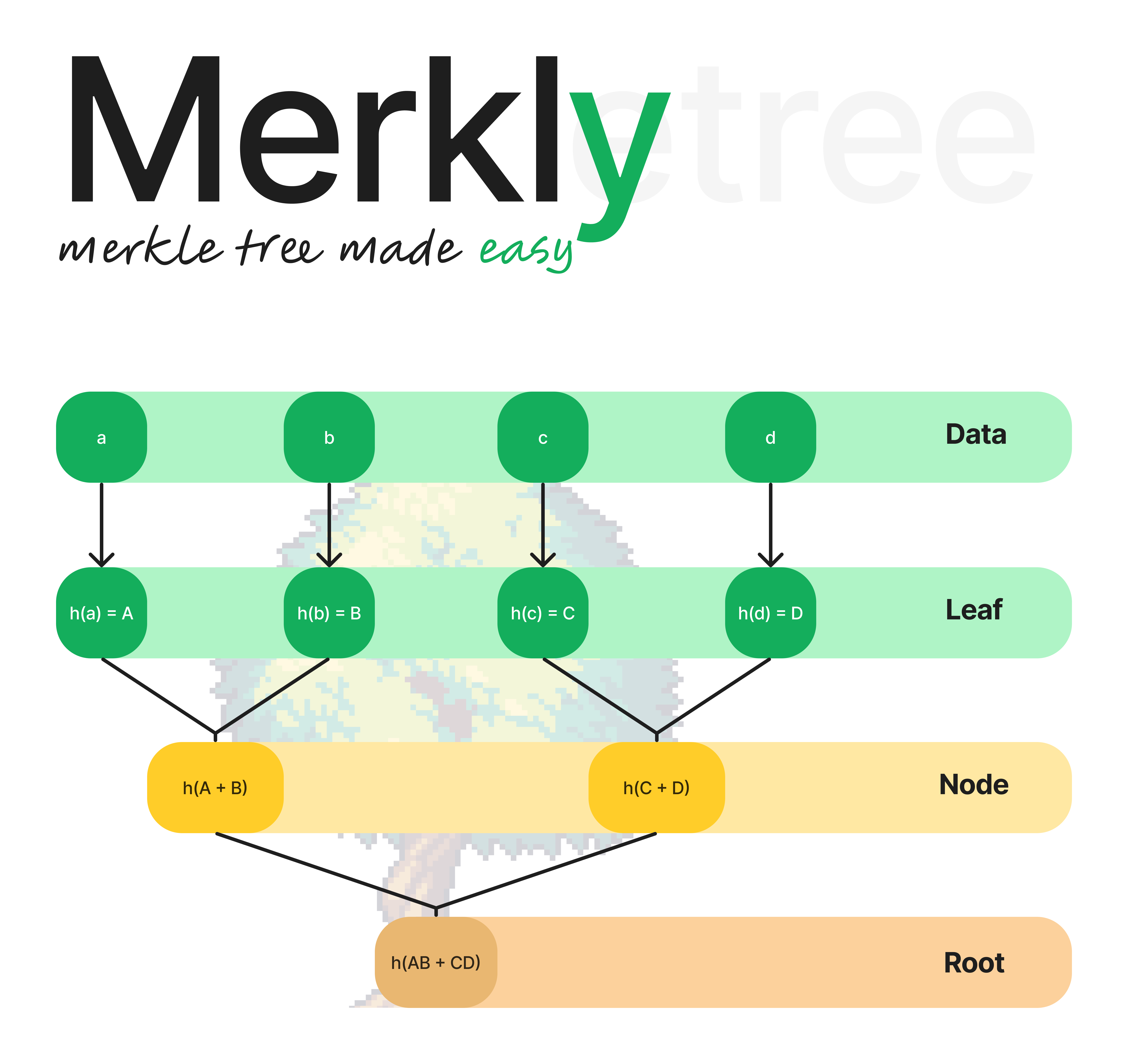
The simple and easy implementation of Python Merkle Tree.






Table of Contents
Credits

Documentation
HOW TO INSTALL
poetry add merkly
pip install merkly
HOW TO WORKS
WARNING: We use keccak-256 under-the-hood if you dont pass your hash function
This library provides a clean and easy to use implementation of the Merkle Tree with the following features:
- Create Leaf
- Create Root
- Create Proof
- Verify Proof
HOW TO USE
Creating a Merkle Tree
from merkly.mtree import MerkleTree
from typing import Callable

# choose any hash function that is of type (bytes, bytes) -> bytes
my_hash_function: Callable[[bytes, bytes], bytes] = lambda x, y: x + y

# create a Merkle Tree
mtree = MerkleTree(['a', 'b', 'c', 'd'], my_hash_function)

# show original input
assert mtree.raw_leaves == ['a', 'b', 'c', 'd']

# hashed leaves
assert mtree.leaves == [b'a', b'b', b'c', b'd']

# shorted hashed leaves
assert mtree.short_leaves == [b'a', b'b', b'c', b'd']
Creating a Default Merkle Tree (with Keccak256)
from merkly.mtree import MerkleTree

# create a Merkle Tree with keccak256
mtree = MerkleTree(['a', 'b', 'c', 'd'])

# show original input
assert mtree.raw_leaves == ['a', 'b', 'c', 'd']

# hashed leaves (just bytes)
assert mtree.leaves == [
    b':\xc2%\x16\x8d\xf5B\x12\xa2\\\x1c\x01\xfd5\xbe\xbf\xea@\x8f\xda\xc2\xe3\x1d\xddo\x80\xa4\xbb\xf9\xa5\xf1\xcb', b'\xb5U=\xe3\x15\xe0\xed\xf5\x04\xd9\x15\n\xf8-\xaf\xa5\xc4f\x7f\xa6\x18\xed\no\x19\xc6\x9bA\x16lU\x10', b'\x0bB\xb69<\x1fS\x06\x0f\xe3\xdd\xbf\xcdz\xad\xcc\xa8\x94FZZC\x8fi\xc8}y\x0b"\x99\xb9\xb2', b'\xf1\x91\x8e\x85b#n\xb1z\xdc\x85\x023/L\x9c\x82\xbc\x14\xe1\x9b\xfc\n\xa1\n\xb6t\xffu\xb3\xd2\xf3'
]

# shorted hashed leaves
assert mtree.short_leaves == [b':\xc2', b'\xb5U', b'\x0bB', b'\xf1\x91']


######## comming soon!

# human leaves
assert mtree.human_leaves == [
    "3ac225168df54212a25c1c01fd35bebfea408fdac2e31ddd6f80a4bbf9a5f1cb",
    "b5553de315e0edf504d9150af82dafa5c4667fa618ed0a6f19c69b41166c5510",
    "0b42b6393c1f53060fe3ddbfcd7aadcca894465a5a438f69c87d790b2299b9b2",
    "f1918e8562236eb17adc8502332f4c9c82bc14e19bfc0aa10ab674ff75b3d2f3",
]
# shorted human hashed leaves
assert mtree.human_short_leaves = ["3ac2", "b555", "0b42", "f191"]
Creating a Root
from merkly.mtree import MerkleTree

# create a Merkle Tree
mtree = MerkleTree(['a', 'b', 'c', 'd'])

# get root of tree (This is compatible with MerkleTreeJS)
assert mtree.root.hex() == '68203f90e9d07dc5859259d7536e87a6ba9d345f2552b5b9de2999ddce9ce1bf'
Creating Proof of a leaf
from merkly.mtree import MerkleTree
from merkly.node import Node, Side

# create a Merkle Tree
mtree = MerkleTree(['a', 'b', 'c', 'd'])

# get proof of a `raw` leaf
assert mtree.proof('b') == [
    Node(data=b"3ac225168df54212a25c1c01fd35bebfea408fdac2e31ddd6f80a4bbf9a5f1cb", side=Side.LEFT),
    Node(data=b"d253a52d4cb00de2895e85f2529e2976e6aaaa5c18106b68ab66813e14415669", side=Side.RIGHT)
]
Checking the proof of a sheet
from merkly.mtree import MerkleTree
from merkly.node import Node, Side


# create a Merkle Tree
mtree = MerkleTree(['a', 'b', 'c', 'd'])

# get proof of a raw leaf
p = [
    Node(
        data=b"3ac225168df54212a25c1c01fd35bebfea408fdac2e31ddd6f80a4bbf9a5f1cb",
        side=Side.LEFT
    ),
    Node(
        data=b"d253a52d4cb00de2895e85f2529e2976e6aaaa5c18106b68ab66813e14415669",
        side=Side.RIGHT
    )
]

# verify your proof of raw leaf
assert mtree.verify(p, 'b') == True
Roadmap
| Feature | Status | Version |
|---|---|---|
| Auto deploy PyPi | ✅ Deployed | 0.2.0 |
| Create Root | ✅ Deployed | 0.4.0 |
| Create Proof | ✅ Deployed | 0.5.0 |
| Verify Proof | ✅ Deployed | 0.6.0 |
| Use any Hash function | ✅ Deployed | 0.7.0 |
| Leafs of any size | ✅ Deployed | 0.8.0 |
| Security deprecation pysha3 | ✅ Deployed | 0.8.1 |
| Compatible with MerkleTreeJs | ✅ Deployed | 1.0.0 |
| First Issue solved by community | ✅ Deployed | 1.0.0 |
| Accelerator code with Rust | 🏗️ Alpha | 1.1.0 |
| Tutorial how to use with solidity | 🖊️ Design | x.x.x |
| Tutorial how to use with MerkleTreeJS | 🖊️ Design | x.x.x |
Contributing
- Before read a code of conduct: CODE_OF_CONDUCT
- Follow the guide of development: CONTRIBUTING
License
1 maintainer

Metadata
1 maintainer
Release files for merkly 1.0.2
For a detailed explanation of source distributions (sdists) and built distributions (wheels), please see the package formats documentation.
Source distribution (sdist)
| File | Size | Uploaded | Provenance | |
|---|---|---|---|---|
| merkly-1.0.2.tar.gz | 6.8 kB | Without provenance | Details |
Built distribution (wheel)
| File | Interpreter | ABI | Platform | Reset |
|---|---|---|---|---|
| merkly-1.0.2-py3-none-any.whl | Python 3 | none | any | Details |
Total release size: 14.8 kB
Release files / merkly-1.0.2.tar.gz
| Download URL | merkly-1.0.2.tar.gz |
|---|---|
| Size | 6.8 kB |
| Tags | Source |
|
SHA-256 checksum How to use checksums |
d5711023141aa45ba6689430984686567a68ed04acd9e1cc7c602d0f37381817
|
|
BLAKE2b-256 checksum How to use checksums |
b88479fcc88c46eda5b922da7d685eb1e26d2c1c8a6f7977c790899d55f12155
|
| Upload date | |
|
Uploaded using Trusted Publishing? What is trusted publishing? |
No |
| Uploaded via |
poetry/1.7.1 CPython/3.10.2 Linux/6.2.0-1018-azure
|
Release files / merkly-1.0.2-py3-none-any.whl
| Download URL | merkly-1.0.2-py3-none-any.whl |
|---|---|
| Size | 8.0 kB |
| Tags | Python 3 |
|
SHA-256 checksum How to use checksums |
b6acae8a8d31f9ad1647c8b9cdaf73621151106d1dc3e0856423f23cbe386023
|
|
BLAKE2b-256 checksum How to use checksums |
241dcb185f22e25473fe69630e500616fe92185a95823b5229bfad961e8210a1
|
| Upload date | |
|
Uploaded using Trusted Publishing? What is trusted publishing? |
No |
| Uploaded via |
poetry/1.7.1 CPython/3.10.2 Linux/6.2.0-1018-azure
|
Security for merkly 1.0.2
Provenance
Provenance describes where a file came from. On PyPI, provenance is shared via attestations, which provide a verifiable record of the build or publishing details. View details, limitations and caveats.
No provenance found
None of the files in this release were uploaded with provenance metadata.
A note on package security
PyPI is a repository for distributing packages, not a service for auditing them. While third-party security researchers and our staff do their best to detect and remove malicious packages, PyPI cannot guarantee the quality, security or suitability of any given package.
To learn more about protecting yourself from malicious actors, visit our package security documentation.














