
mkdocs-click



An MkDocs extension to generate documentation for Click command line applications.
Originally developed by Datadog.
Installation
Install from PyPI:
pip install mkdocs-click
Quickstart
Add mkdocs-click to Markdown extensions in your mkdocs.yml configuration:
site_name: Example
theme: readthedocs

markdown_extensions:
    - mkdocs-click
Add a CLI application, e.g.:
# app/cli.py
import click

@click.group()
def cli():
    """Main entrypoint."""

@cli.command()
@click.option("-d", "--debug", help="Include debug output.")
def build(debug):
    """Build production assets."""
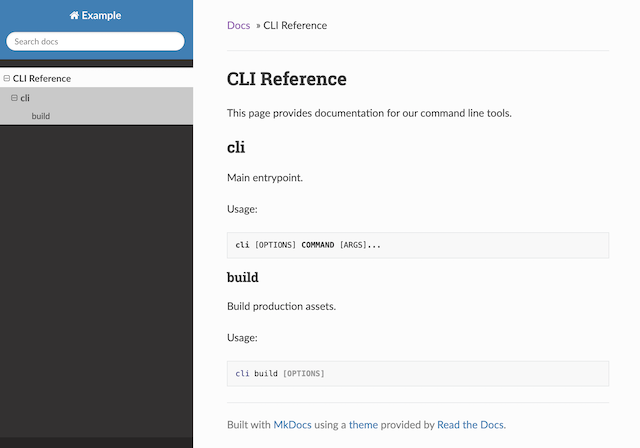
Add a mkdocs-click block in your Markdown:
# CLI Reference

This page provides documentation for our command line tools.

::: mkdocs-click
    :module: app.cli
    :command: cli
Start the docs server:
mkdocs serve
Tada! 💫
Usage
Documenting commands
To add documentation for a command, add a mkdocs-click block where the documentation should be inserted.
Example:
::: mkdocs-click
    :module: app.cli
    :command: main
For all available options, see the Block syntax.
Multi-command support
When pointed at a group (or any other multi-command), mkdocs-click will also generate documentation for sub-commands.
This allows you to generate documentation for an entire CLI application by pointing mkdocs-click at the root command.
Tweaking header levels
By default, mkdocs-click generates Markdown headers starting at <h1> for the root command section. This is generally what you want when the documentation should fill the entire page.
If you are inserting documentation within other Markdown content, you can set the :depth: option to tweak the initial header level. Note that this applies even if you are just adding a heading.
By default it is set to 0, i.e. headers start at <h1>. If set to 1, headers will start at <h2>, and so on. Note that if you insert your own first level heading and leave depth at its default value of 0, the page will have multiple <h1> tags, which is not compatible with themes that generate page-internal menus such as the ReadTheDocs and mkdocs-material themes.
Full command path headers
By default, mkdocs-click outputs headers that contain the command name. For nested commands such as $ cli build all, this also means the heading would be ## all. This might be surprising, and may be harder to navigate at a glance for highly nested CLI apps.
If you'd like to show the full command path instead, turn on the Attribute Lists extension:
# mkdocs.yaml

markdown_extensions:
    - attr_list
    - mkdocs-click
mkdocs-click will then output the full command path in headers (e.g. ## cli build all) and permalinks (e.g. #cli-build-all).
Note that the table of content (TOC) will still use the command name: the TOC is naturally hierarchal, so full command paths would be redundant. (This exception is why the attr_list extension is required.)
Reference
Block syntax
The syntax for mkdocs-click blocks is the following:
::: mkdocs-click
    :module: <MODULE>
    :command: <COMMAND>
    :prog_name: <PROG_NAME>
    :depth: <DEPTH>
    :style: <STYLE>
Options:
module: Path to the module where the command object is located.command: Name of the command object.prog_name: (Optional, default: same ascommand) The name to display for the command.depth: (Optional, default:0) Offset to add when generating headers.style: (Optional, default:plain) Style for the options section. The possible choices areplainandtable.remove_ascii_art: (Optional, default:False) When docstrings begin with the escape character\b, all text will be ignored until the next blank line is encountered.show_hidden: (Optional, default:False) Show commands and options that are marked as hidden.list_subcommands: (Optional, default:False) List subcommands of a given command. If attr_list is installed, add links to subcommands also.


Release files for mkdocs-click 0.9.0
For a detailed explanation of source distributions (sdists) and built distributions (wheels), please see the package formats documentation.
Source distribution (sdist)
| File | Size | Uploaded | |
|---|---|---|---|
| mkdocs_click-0.9.0.tar.gz | 18.7 kB | Details |
Built distribution (wheel)
| File | Interpreter | ABI | Platform | Reset |
|---|---|---|---|---|
| mkdocs_click-0.9.0-py3-none-any.whl | Python 3 | none | any | Details |
Total release size: 33.8 kB
Release files / mkdocs_click-0.9.0.tar.gz
| Download URL | mkdocs_click-0.9.0.tar.gz |
|---|---|
| Size | 18.7 kB |
| Tags | Source |
|
SHA-256 checksum How to use checksums |
6050917628d4740517541422b607404d044117bc31b770c4f9e9e1939a50c908
|
|
BLAKE2b-256 checksum How to use checksums |
a1c78c25f3a3b379def41e6d0bb5c4beeab7aa8a394b17e749f498504102cfa5
|
| Upload date | |
|
Uploaded using Trusted Publishing? What is trusted publishing? |
Yes |
| Uploaded via |
twine/6.1.0 CPython/3.12.9
|
Provenance
Provenance describes where a file came from. On PyPI, provenance is shared via attestations, which provide a verifiable record of the build or publishing details. View details, limitations and caveats.


PyPI Publish Attestation
PyPI verified that this artifact, at this checksum, originated from the publisher listed below.
Signed by GitHub Actions, verified by PyPI on Apr 7, 2025.
Transparency logRelease files / mkdocs_click-0.9.0-py3-none-any.whl
| Download URL | mkdocs_click-0.9.0-py3-none-any.whl |
|---|---|
| Size | 15.1 kB |
| Tags | Python 3 |
|
SHA-256 checksum How to use checksums |
5208e828f4f68f63c847c1ef7be48edee9964090390afc8f5b3d4cbe5ea9bbed
|
|
BLAKE2b-256 checksum How to use checksums |
e9fc9124ab36e2341e78d8d9c669511bd70f52ea0de8105760c31fabec1f9396
|
| Upload date | |
|
Uploaded using Trusted Publishing? What is trusted publishing? |
Yes |
| Uploaded via |
twine/6.1.0 CPython/3.12.9
|
Provenance
Provenance describes where a file came from. On PyPI, provenance is shared via attestations, which provide a verifiable record of the build or publishing details. View details, limitations and caveats.
PyPI Publish Attestation
PyPI verified that this artifact, at this checksum, originated from the publisher listed below.
Signed by GitHub Actions, verified by PyPI on Apr 7, 2025.
Transparency log













