
Python Monthly Returns Heatmap


monthly-returns-heatmap is a simple Python library for creating Monthly Returns Heatmap from Pandas series with ease.
Quick Start
Let’s create a returns heatmap for SPY (S&P 500 Spider ETF).
First, let’s download SPY’s daily close prices from Google finance.
from pandas_datareader import data
prices = data.get_data_google("SPY")['Close']
returns = prices.pct_change()
Next, we’ll import monthly_returns_heatmap and plot the monthly return heatmap:
import monthly_returns_heatmap as mrh

returns.plot_monthly_returns_heatmap()
# mrh.plot(returns) # <== or using direct call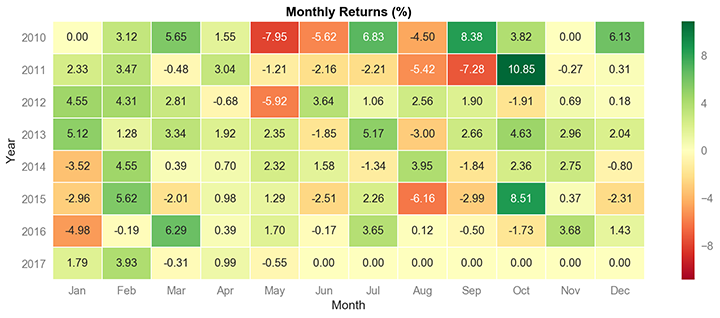
Getting heatmap data only (no plotting)
heatmap = prices.get_monthly_returns_heatmap()
# heatmap = mrh.get(returns) # <== or using direct call

print(heatmap)

# prints:

Month       Jan        Feb        Mar        Apr  ...        Dec
Year
2010   0.000000   0.031195   0.056529   0.015470  ...   0.061271
2011   0.023300   0.034737  -0.004807   0.030413  ...   0.003117
2012   0.045498   0.043137   0.028129  -0.006751  ...   0.001759
2013   0.051190   0.012759   0.033375   0.019212  ...   0.020387
2014  -0.035248   0.045516   0.003865   0.006951  ...  -0.008012
2015  -0.029629   0.056205  -0.020080   0.009834  ...  -0.023096
2016  -0.049787  -0.001910   0.062943   0.003941  ...   0.014293
2017   0.017895   0.039292  -0.003087   0.009926  ...   0.000000
Get Parameters (optional)
is_prices - set to True if the data used is price data instead of returns data
compounded - set to False if the you don’t want the calculation to use compounded returns
eoy - set to True to add a End Of Year column with total yearly returns
Plot Parameters (optional)
title - Heatmap title (defaults to "Monthly Returns (%)")
title_color - Heatmap title color (defaults to "black")
title_size - Heatmap title font size (defaults to 12)
annot_size - Returns boxes font size (defaults to 10)
figsize - Heatmap figure size (defaults to None)
cmap - Color map (defaults to "RdYlGn")
cbar - Show color bar? (defaults to True)
square - Force squere returns boxes? (defaults to False)
is_prices - set to True if the data used is price data instead of returns data
compounded - set to False if the you don’t want the calculation to use compounded returns
eoy - set to True to add a End Of Year column with total yearly returns
Installation
Install monthly_returns_heatmap using pip:
$ pip install monthly_returns_heatmap --upgrade --no-cache-dirRequirements
Python >=3.4
Pandas (tested to work with >=0.18.1)
Matplotlib (tested to work with >=1.5.3)
Seaborn (tested to work with >=0.7)
Legal Stuff
monthly-returns-heatmap is distributed under the GNU Lesser General Public License v3.0. See the LICENSE.txt file in the release for details.
P.S.
Please drop me an note with any feedback you have.
Ran Aroussi
1 maintainer

Metadata
1 maintainer
Release files for monthly-returns-heatmap 0.0.11
For a detailed explanation of source distributions (sdists) and built distributions (wheels), please see the package formats documentation.
Source distribution (sdist)
| File | Size | Uploaded | Provenance | |
|---|---|---|---|---|
| monthly-returns-heatmap-0.0.11.tar.gz | 7.8 kB | Without provenance | Details |
Release files / monthly-returns-heatmap-0.0.11.tar.gz
| Download URL | monthly-returns-heatmap-0.0.11.tar.gz |
|---|---|
| Size | 7.8 kB |
| Tags | Source |
|
SHA-256 checksum How to use checksums |
33dda6beb05ee963083c16a1ebc47c315e94159555cb8ef8bd5c98d89345dd20
|
|
BLAKE2b-256 checksum How to use checksums |
0dbc07ec53971c10880cec8904cbf2adff0f372dddab8c24bb6ed331b3b2afce
|
| Upload date | |
|
Uploaded using Trusted Publishing? What is trusted publishing? |
No |
| Uploaded via |
Python-urllib/3.6
|
Security for monthly-returns-heatmap 0.0.11
Provenance
Provenance describes where a file came from. On PyPI, provenance is shared via attestations, which provide a verifiable record of the build or publishing details. View details, limitations and caveats.
No provenance found
None of the files in this release were uploaded with provenance metadata.
A note on package security
PyPI is a repository for distributing packages, not a service for auditing them. While third-party security researchers and our staff do their best to detect and remove malicious packages, PyPI cannot guarantee the quality, security or suitability of any given package.
To learn more about protecting yourself from malicious actors, visit our package security documentation.














