
MuNG
The mung (Music Notation Graph) package implements a graph representation
of music notation that is especially amenable to Optical Music Recognition (OMR).
It was used for instance in the MUSCIMA++ dataset of music notation.





Requires Python >= 3.6 and was tested with Python 3.11.
Getting started
- Install this package:
pip install mung - Download the MUSCIMA++ dataset.
- Run through the tutorial.
Fundamentally, the Music Notatation Graph is a very simple construct:

It stores the primitives that can be detected by a Music Object Detector as nodes and then store the relations between those nodes. But the devil is in the details. To better understand what kind of relations are useful and which kind of relations are stored for common western music notation, check out the annotator instruction from MUSCIMarker.
Dataset
The dataset itself is available for download here and due to its derived nature, licensed differently:


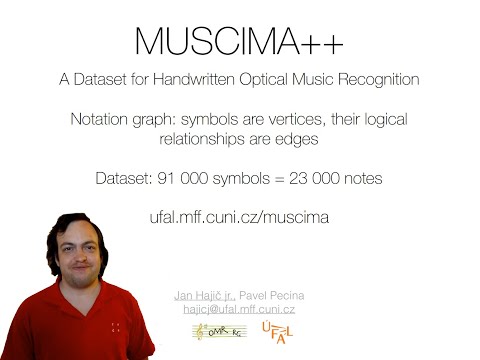
Introduction to MUSCIMA++ Video
Watch Jan give a 30 minute introduction into this dataset on YouTube, which explains many design decisions and thoughts that directly affected the creation of the MuNG format:
Changelog
This changelog does not refer to the older muscima package.
1.2.1
New release with adapted Mung Parser to support other dataset too (Musigraph and DoReMi).
1.2
New release with updated libraries and executed tests with Python 3.11
1.1
Performance improvements for loading image masks from RLE string.
1.0
First public release of mung package, which is equivalent to the muscima-package, but updated
to comply with the version 2.0 of the MUSCIMA++ dataset.
1 maintainer

Metadata
1 maintainer
Release files for mung 1.2.1
For a detailed explanation of source distributions (sdists) and built distributions (wheels), please see the package formats documentation.
Source distribution (sdist)
| File | Size | Uploaded | Provenance | Actions |
|---|---|---|---|---|
| mung-1.2.1.tar.gz | 117.1 kB | Without provenance | Details for mung-1.2.1.tar.gz |
Release files / mung-1.2.1.tar.gz
| Download URL | mung-1.2.1.tar.gz |
|---|---|
| Size | 117.1 kB |
| Tags | Source |
|
SHA-256 checksum How to use checksums |
2ba56ec7d014ca27c5710184651f7fc494b644078bf58cf3695fcceaa997540b
|
|
BLAKE2b-256 checksum How to use checksums |
4acbcfc739951365095327fb31189df812caef26b0e56385dfe67db4f6c8ec92
|
| Upload date | |
|
Uploaded using Trusted Publishing? What is trusted publishing? |
No |
| Uploaded via |
twine/5.1.0 CPython/3.9.6
|
Security for mung 1.2.1
Provenance
Provenance describes where a file came from. On PyPI, provenance is shared via attestations, which provide a verifiable record of the build or publishing details. View details, limitations and caveats.
No provenance found
None of the files in this release were uploaded with provenance metadata.
A note on package security
PyPI is a repository for distributing packages, not a service for auditing them. While third-party security researchers and our staff do their best to detect and remove malicious packages, PyPI cannot guarantee the quality, security or suitability of any given package.
To learn more about protecting yourself from malicious actors, visit our package security documentation.














