
MuscledAgents
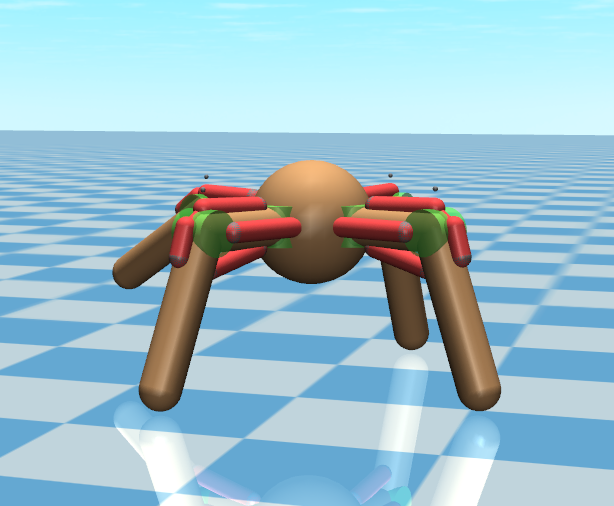
OpenAI Gym MuJoCo environments rigged with muscles which can be used with PyMuscle fatigable muscle models.
Prerequisites
- MuJoCo 1.5
- mujoco-py
- gym
Setup
python setup.py develop
Usage
import gym
import muscledagents
import math


def main():

    # Load a muscled ant
    env = gym.make("MuscledAnt-v0")  # Only functional env at the moment
    env.reset()

    print("Observation Space Dims", env.observation_space.shape)
    print("Action Space Dims", env.action_space.shape)

    action_size = env.action_space.shape[0]

    action = [0.0] * action_size
    total_steps = 60 * 10
    for i in range(total_steps):
        action[1] = ((math.sin(i / 25) + 1) / 2)
        action[5] = ((math.sin(i / 35) + 1) / 2)
        action[9] = ((math.sin(i / 45) + 1) / 2)
        action[13] = ((math.sin(i / 55) + 1) / 2)
        env.step(action)
        env.render()


if __name__ == '__main__':
    main()
To explore these environments and models further you will need to understand how input values get translated into final simulated movements.
Control Signals
The action space for an ant is continuous control over 16 muscles. For each of four legs there are four muscles. One leg extensor, one leg flexor, and two hip muscles which move the leg left and right (or forward and back depending on your perspective.)
Gym Environment
The step method takes an array of 16 values which represent the input to
the fatigable muscle model for each muscle. Inputs should be in the range [0-1].
PyMuscle Fatigue
After use muscles produce less force for the same level of input. So if you were to send an input signal which recruited all motor units in a muscle constantly for several seconds the output the model will return will rapidly decrease. A period of light or no use is required for the muscle to recover.
MuJoCo Model
Each tendon actuator is control limited to the range [-1.0, 0.0]. When a General actuator is tied to a Tendon in MuJoCo negative values are the equivalent of contractions. Muscles cannot produce force in extension so no positive non-zero values are allowed.
Actuators have a gainprm which scales this input value. This is tuned to
a value of 100 to work with the mass of the ant and the resistances of opposing
tendons.
Altering the Models
Due to frustration editing XML files the ant model is generated by a python
script that uses the mjcf library which
I wrote to wrap MuJoCo xml elements in python classes. Note: This may
be replaced with the mjcf library from dm_control in the future.
You can view and modify that script in scripts/gen_ant.py.
1 maintainer

Metadata
1 maintainer
Release files for muscledagents 0.0.2
For a detailed explanation of source distributions (sdists) and built distributions (wheels), please see the package formats documentation.
Source distribution (sdist)
| File | Size | Uploaded | Provenance | Actions |
|---|---|---|---|---|
| muscledagents-0.0.2.tar.gz | 9.6 kB | Without provenance | Details for muscledagents-0.0.2.tar.gz |
Built distribution (wheel)
| File | Interpreter | ABI | Platform | Actions Reset |
|---|---|---|---|---|
| muscledagents-0.0.2-py2.py3-none-any.whl | Python 3, Python 2 | none | any | Details for muscledagents-0.0.2-py2.py3-none-any.whl |
Total release size: 21.2 kB
Release files / muscledagents-0.0.2.tar.gz
| Download URL | muscledagents-0.0.2.tar.gz |
|---|---|
| Size | 9.6 kB |
| Tags | Source |
|
SHA-256 checksum How to use checksums |
751a2c761e9116851e5e41e18a4ae4874714f7eafc53daa7b0794540bacc7882
|
|
BLAKE2b-256 checksum How to use checksums |
e3e59d86ab638449ed13f6d628c536095702a89a4dab6d9a30214561b75e06db
|
| Upload date | |
|
Uploaded using Trusted Publishing? What is trusted publishing? |
No |
| Uploaded via |
twine/1.12.1 pkginfo/1.5.0.1 requests/2.19.1 setuptools/40.0.0 requests-toolbelt/0.8.0 tqdm/4.29.0 CPython/3.6.5
|
Release files / muscledagents-0.0.2-py2.py3-none-any.whl
| Download URL | muscledagents-0.0.2-py2.py3-none-any.whl |
|---|---|
| Size | 11.6 kB |
| Tags | Python 2 Python 3 |
|
SHA-256 checksum How to use checksums |
fe54b7dbe8cc5b0795e1d204efb09e59e92719ded387bf6db00ce9b2ce9fb880
|
|
BLAKE2b-256 checksum How to use checksums |
20af06ec09e21a5f79ab4d1eedc8eff35bb508723b536472e2a7f2e88db700ed
|
| Upload date | |
|
Uploaded using Trusted Publishing? What is trusted publishing? |
No |
| Uploaded via |
twine/1.12.1 pkginfo/1.5.0.1 requests/2.19.1 setuptools/40.0.0 requests-toolbelt/0.8.0 tqdm/4.29.0 CPython/3.6.5
|
Security for muscledagents 0.0.2
Provenance
Provenance describes where a file came from. On PyPI, provenance is shared via attestations, which provide a verifiable record of the build or publishing details. View details, limitations and caveats.
No provenance found
None of the files in this release were uploaded with provenance metadata.
A note on package security
PyPI is a repository for distributing packages, not a service for auditing them. While third-party security researchers and our staff do their best to detect and remove malicious packages, PyPI cannot guarantee the quality, security or suitability of any given package.
To learn more about protecting yourself from malicious actors, visit our package security documentation.













