
nerblackbox
A High-level Library for Named Entity Recognition in Python.






Resources
Source Code: https://github.com/flxst/nerblackbox
Documentation: https://flxst.github.io/nerblackbox
Installation
pip install nerblackbox
About
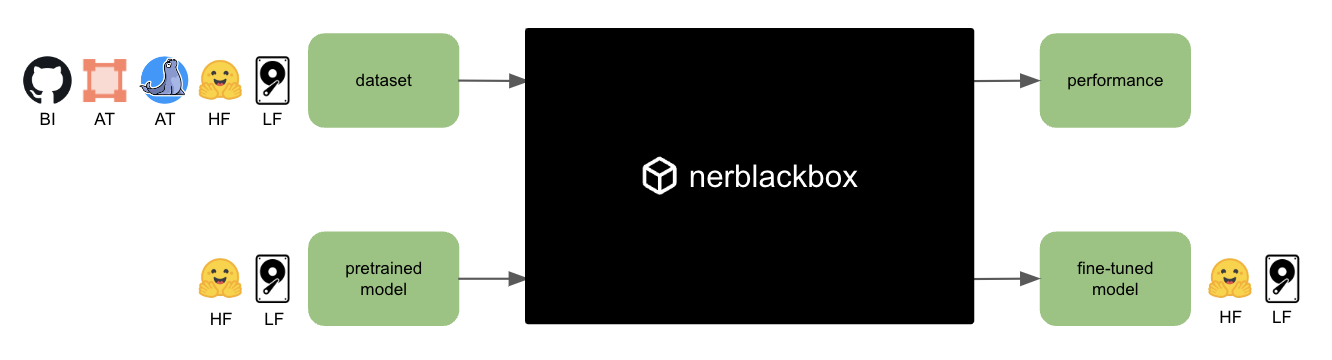
Take a dataset from one of many available sources. Then train, evaluate and apply a language model in a few simple steps.
1. Data
Choose a dataset from HuggingFace (HF), the Local Filesystem (LF), an Annotation Tool (AT) server, or a Built-in (BI) dataset
dataset = Dataset("conll2003",  source="HF")  # HuggingFace
dataset = Dataset("my_dataset", source="LF")  # Local Filesystem
dataset = Dataset("swe_nerc",   source="BI")  # Built-in
Set up the dataset
dataset.set_up()
2. Training
Define the training by choosing a pretrained model and a dataset
training = Training("my_training", model="bert-base-cased", dataset="conll2003")
Run the training and get the performance of the fine-tuned model
training.run()
training.get_result(metric="f1", level="entity", phase="test")
# 0.9045
3. Evaluation
Load the model
model = Model.from_training("my_training")
Evaluate the model
results = model.evaluate_on_dataset("ehealth_kd", phase="test")
results["micro"]["entity"]["f1"]
# 0.9045
4. Inference
Load the model
model = Model.from_training("my_training")
Let the model predict
model.predict("The United Nations has never recognised Jakarta's move.")
# [[
#  {'char_start': '4', 'char_end': '18', 'token': 'United Nations', 'tag': 'ORG'},
#  {'char_start': '40', 'char_end': '47', 'token': 'Jakarta', 'tag': 'LOC'}
# ]]
There is much more to it than that! See the documentation to get started.
Features
Data
Integration of Datasets from Multiple Sources (HuggingFace, Annotation Tools, ..)
Support for Multiple Dataset Types (Standard, Pretokenized)
Support for Multiple Annotation Schemes (IO, BIO, BILOU)
Text Encoding
Training
Adaptive Fine-tuning
Hyperparameter Search
Multiple Runs with Different Random Seeds
Detailed Analysis of Training Results
Evaluation
Evaluation of Any Model on Any Dataset
Inference
Versatile Model Inference (Entity/Word Level, Probabilities, ..)
Other
Full Compatibility with HuggingFace
GPU Support
Language Agnosticism
See the documentation for details.
Citation
@misc{nerblackbox,
  author = {Stollenwerk, Felix},
  title  = {nerblackbox: a high-level library for named entity recognition in python},
  year   = {2021},
  url    = {https://github.com/flxst/nerblackbox},
}
1 maintainer

Metadata
1 maintainer
Release files for nerblackbox 1.0.0
For a detailed explanation of source distributions (sdists) and built distributions (wheels), please see the package formats documentation.
Source distribution (sdist)
| File | Size | Uploaded | Provenance | Actions |
|---|---|---|---|---|
| nerblackbox-1.0.0.tar.gz | 127.0 kB | Without provenance | Details for nerblackbox-1.0.0.tar.gz |
Built distribution (wheel)
| File | Interpreter | ABI | Platform | Actions Reset |
|---|---|---|---|---|
| nerblackbox-1.0.0-py3-none-any.whl | Python 3 | none | any | Details for nerblackbox-1.0.0-py3-none-any.whl |
Total release size: 302.1 kB
Release files / nerblackbox-1.0.0.tar.gz
| Download URL | nerblackbox-1.0.0.tar.gz |
|---|---|
| Size | 127.0 kB |
| Tags | Source |
|
SHA-256 checksum How to use checksums |
f978f5a6fadb1a832b6ebab75ba640fe18f1445a5543cf67bbcd6c551df04cc4
|
|
BLAKE2b-256 checksum How to use checksums |
8e7db5d10381102a98b2c75488afe9015fe469e755be8f091e8abae963d50f0e
|
| Upload date | |
|
Uploaded using Trusted Publishing? What is trusted publishing? |
No |
| Uploaded via |
twine/4.0.2 CPython/3.8.10
|
Release files / nerblackbox-1.0.0-py3-none-any.whl
| Download URL | nerblackbox-1.0.0-py3-none-any.whl |
|---|---|
| Size | 175.2 kB |
| Tags | Python 3 |
|
SHA-256 checksum How to use checksums |
64eea60cc76f614fe1e8ca808d7f77445c1934a79d102ab0c028775f2861ceae
|
|
BLAKE2b-256 checksum How to use checksums |
46887eb532ef4657a7d4e601fe9290b2ed8a441602b596fca9b3c49a2f6d1ba2
|
| Upload date | |
|
Uploaded using Trusted Publishing? What is trusted publishing? |
No |
| Uploaded via |
twine/4.0.2 CPython/3.8.10
|
Security for nerblackbox 1.0.0
Provenance
Provenance describes where a file came from. On PyPI, provenance is shared via attestations, which provide a verifiable record of the build or publishing details. View details, limitations and caveats.
No provenance found
None of the files in this release were uploaded with provenance metadata.
A note on package security
PyPI is a repository for distributing packages, not a service for auditing them. While third-party security researchers and our staff do their best to detect and remove malicious packages, PyPI cannot guarantee the quality, security or suitability of any given package.
To learn more about protecting yourself from malicious actors, visit our package security documentation.














