

netclop
NETwork CLustering OPerations (for geophysical fluid transport).
netclop is a command-line interface for constructing network models of geophysical fluid transport and performing associated clustering operations (e.g., community detection and significance clustering).
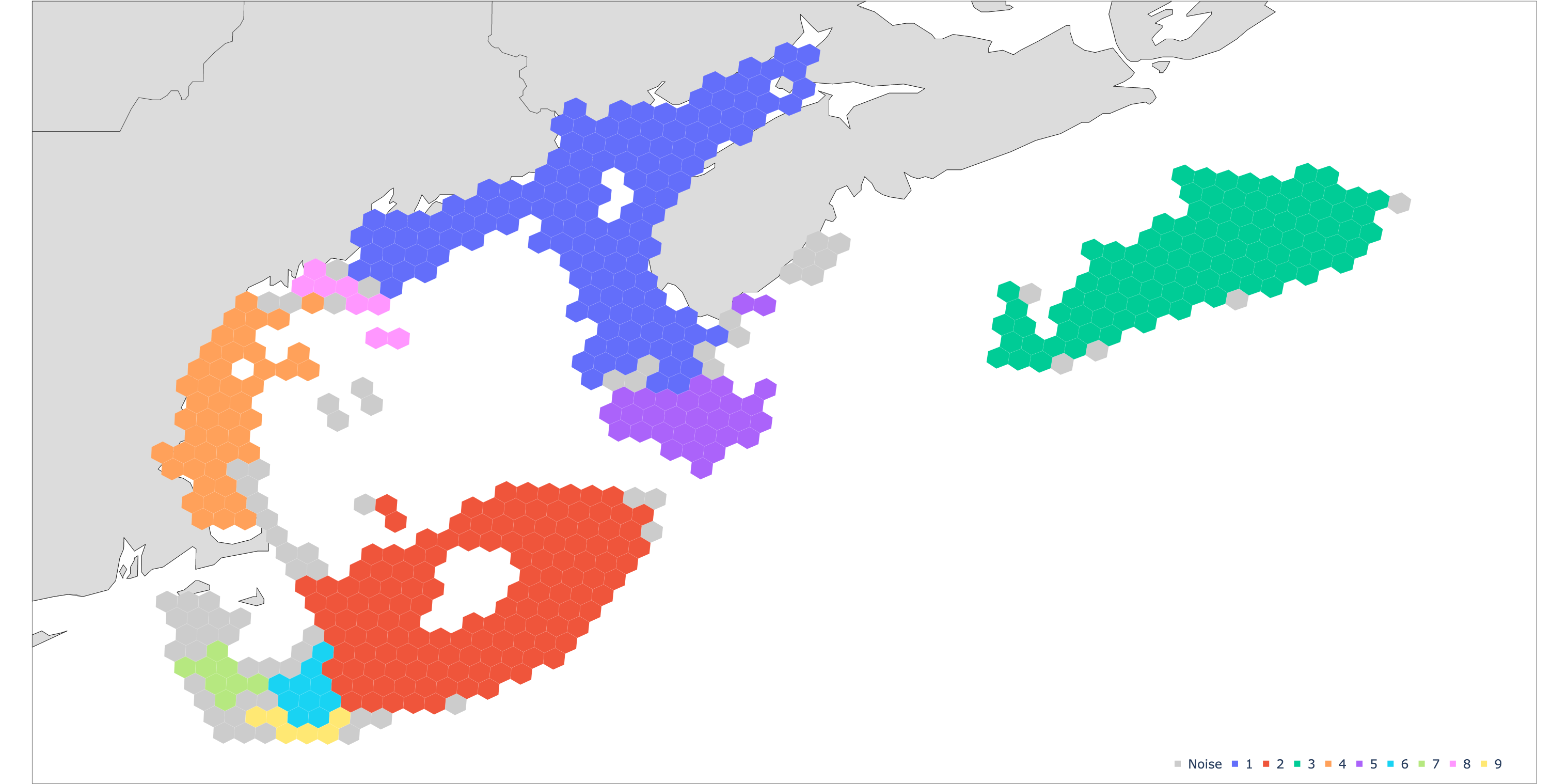
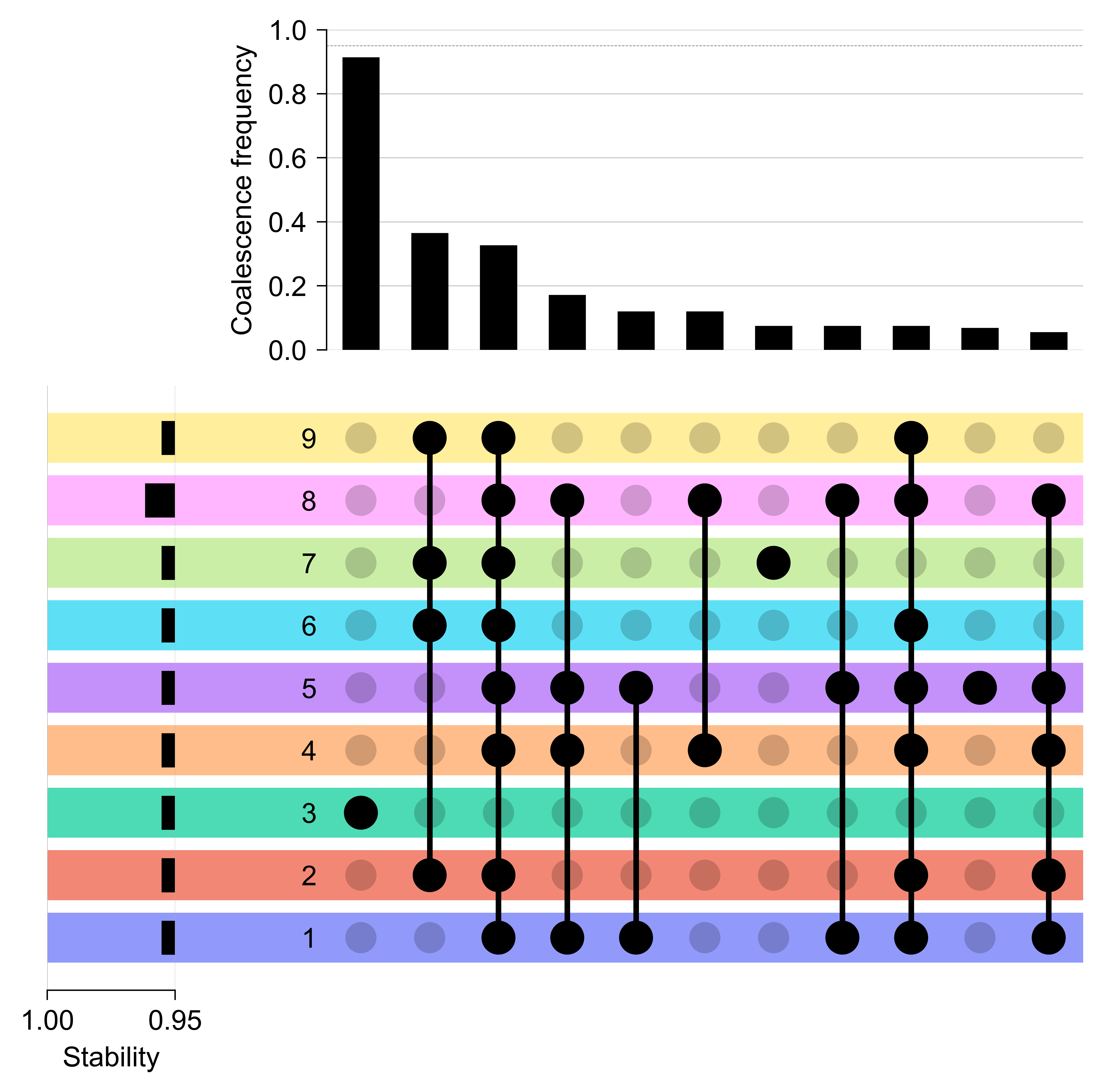
Features
- Binning of Lagrangian particle simulations using H3
- Network construction of LPT connectivity
- Community detection using Infomap
- Network resampling and recursive significance clustering
- Node centrality calculation
- Spatially-embedded network visualization
About
netclop was created as a CLI to facilitate network-theoretic analysis of marine connectivity in support of larval ecology.
It functions as a library to computations on network ensembles.
Developed at the Department of Engineering Mathematics and Internetworking, Dalhousie University by Karsten N. Economou.
Papers
- 2024 - Characterizing variability in complex network community structure with a recursive significance clustering scheme (Karsten N. Economou, Cassie R. Norman, Wendy C. Gentleman)
Usage
CLI
netclop accepts Lagrangian particle tracking (LPT) simulations decomposed into initial and final positions in as .csv structured as
initial_latitude,initial_longitude,final_latitude,final_longitude
as an input. Recursive significance clustering is run on all provided filepaths of LPT position files and stores all produced content in the specified output directory
netclop rsc [OPTIONS] [PATHS] -o [DIRECTORY]
If one LPT position file is given, it will be bootstrapped; otherwise, each LPT position file is treated as an observation.
Significance clustering
Significance clustering can be run on a networkx.Graph object directly, which will partition and bootstrap
from netclop import NetworkEnsemble
ne = NetworkEnsemble(net, **ne_config)
ne.sigclu(**sc_config)
cores = ne.cores
or on an ensemble of partitions
from netclop import SigClu
sc = SigClu(partitions, **sc_config)
sc.run()
cores = sc.cores
1 maintainer

Metadata
1 maintainer
Release files for netclop 2.2.1
For a detailed explanation of source distributions (sdists) and built distributions (wheels), please see the package formats documentation.
Source distribution (sdist)
| File | Size | Uploaded | Provenance | Actions |
|---|---|---|---|---|
| netclop-2.2.1.tar.gz | 18.0 kB | Without provenance | Details for netclop-2.2.1.tar.gz |
Built distribution (wheel)
| File | Interpreter | ABI | Platform | Actions Reset |
|---|---|---|---|---|
| netclop-2.2.1-py3-none-any.whl | Python 3 | none | any | Details for netclop-2.2.1-py3-none-any.whl |
Total release size: 40.9 kB
Release files / netclop-2.2.1.tar.gz
| Download URL | netclop-2.2.1.tar.gz |
|---|---|
| Size | 18.0 kB |
| Tags | Source |
|
SHA-256 checksum How to use checksums |
4c523c97e312593ca9eedff355e3efb89d9fad4e404ac83dd56e478dc7d4061b
|
|
BLAKE2b-256 checksum How to use checksums |
5b7f92cd7dd87955c519585e58a1589d3b99fc4032d6ca0761c01d29c87ba726
|
| Upload date | |
|
Uploaded using Trusted Publishing? What is trusted publishing? |
No |
| Uploaded via |
poetry/1.8.4 CPython/3.13.0 Darwin/24.0.0
|
Release files / netclop-2.2.1-py3-none-any.whl
| Download URL | netclop-2.2.1-py3-none-any.whl |
|---|---|
| Size | 22.9 kB |
| Tags | Python 3 |
|
SHA-256 checksum How to use checksums |
6af54a19303ced1882828cd0e54dd8661d4e94476af5c402ee7e28ca763fbc00
|
|
BLAKE2b-256 checksum How to use checksums |
7934eef2b67a1b98ef5b90bfc99726d8d052e40fbbf8d484419742ab1e4d0a04
|
| Upload date | |
|
Uploaded using Trusted Publishing? What is trusted publishing? |
No |
| Uploaded via |
poetry/1.8.4 CPython/3.13.0 Darwin/24.0.0
|
Security for netclop 2.2.1
Provenance
Provenance describes where a file came from. On PyPI, provenance is shared via attestations, which provide a verifiable record of the build or publishing details. View details, limitations and caveats.
No provenance found
None of the files in this release were uploaded with provenance metadata.
A note on package security
PyPI is a repository for distributing packages, not a service for auditing them. While third-party security researchers and our staff do their best to detect and remove malicious packages, PyPI cannot guarantee the quality, security or suitability of any given package.
To learn more about protecting yourself from malicious actors, visit our package security documentation.














