
This project has been archived by its maintainers, and is no longer receiving any updates.
Nexus


Nexus is a pluggable admin application in Django. It’s designed to give you a simple design and architecture for building admin applications.
It was originally created by Disqus, but due to the inactivity we at YPlan have taken over maintenance on this fork.
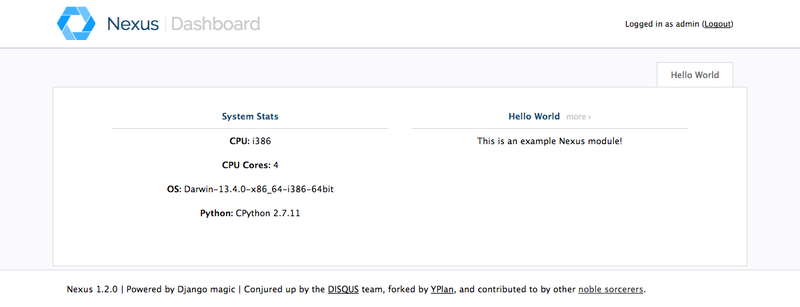
Screenshot
Requirements
Tested with all combinations of:
Python: 2.7, 3.6
Django: 1.8, 1.9, 1.10, 1.11, 2.0
Installation
Install it with pip:
pip install nexus-yplanMake sure you pip uninstall nexus first if you’re upgrading from the original to this fork - the packages clash.
You’ll need to enable it much like you would django.contrib.admin.
First, add it to your INSTALLED_APPS setting:
INSTALLED_APPS = (
    ...
    'nexus',
)
nexus has three dependencies from core Django - django.contrib.admin, django.contrib.auth, and django.contrib.sessions. If these applications are not in your INSTALLED_APPS, add them; or if you are using a custom auth system you can skip these requirements by adding the line NEXUS_SKIP_INSTALLED_APPS_REQUIREMENTS = True to your settings.
Second, include nexus at some url in your urls.py:
import nexus

# urls.py
urlpatterns = patterns('',
    ('^nexus/', include(nexus.site.urls)),
)
Nexus has autodiscovery similar to Django Admin - it will look in each of your INSTALLED_APPS for a nexus_modules submodule, and import that. This is where the app should declare a NexusModule subclass and use nexus.site.register to add it to the main Nexus site. Thus to add functionality you should install some packages with modules, or write your own.
Available Modules
The following modules are tested against nexus-yplan:
There are also some older applications that provide Nexus modules, however these were only developed against Disqus’ Nexus and not this fork; your mileage may vary:
If you want to write a module, there are a couple of example modules in tests/testapp/nexus_modules.py, with templates in tests/testapp/templates/nexus/example. Also the source code shouldn’t be too hard to understand.
A Note on Login
Until Version 1.1, Nexus included a login/logout functionality. Unfortunately these were copied and adapted from an old version of the code in Django Admin, and were thus not up to date with security changes in newer Django versions. Since keeping them up to date would be a burden, and most sites use Django Admin for adminstrator login, the login/logout functions have been removed.
Nexus now relies on Django Admin login, or for users to visit it having logged in through another route.
Settings
Nexus’ behaviour can be customized by adding some values to your Django settings.
Media
By default Nexus serves its media files itself through Python, avoiding any configuration to integrate with your project. This is convenient but can be slow. You can control where the media files are served from with the setting NEXUS_MEDIA_PREFIX, for example:
NEXUS_MEDIA_PREFIX = '/served/here/'This will make Nexus write its media URLs using this prefix, where it assumes you have set up serving its files.
History
Pending Release
Nothing pending
1.6.1 (2018-10-17)
Fix Django deprecation warnings
1.6.0 (2017-10-28)
Added Django 2.0b1 support
Tested on Django 1.11 (no changes were necessary)
1.5.0 (2017-01-19)
Added CSRF token on the base template to make AJAX requests work when Django’s CSRF_COOKIE_HTTPONLY setting is set
Removed the now obsolete template tag nexus_csrf_cookie_name
1.4.0 (2016-05-24)
Fixed footer appearance on long pages
Fixed the tab highlighting and removed NexusModule.get_request which existed only to support the old broken code.
‘jQuery Templates’ is no longer included in Nexus - this was done for Gargoyle, which now uses its own bundled templating code instead.
1.3.1 (2016-02-25)
Theme updated a bit more to make buttons look nice
1.3.0 (2016-02-24)
New Logo and theme, thanks @emache.
The login logic no longer sends users without permission to see Nexus through a redirect loop, thanks @ChunYin for the report.
1.2.0 (2016-02-12)
Removed support for Django 1.7
Removed the need to add a call to nexus.autodiscover() in your URLConf by using the AppConfig, similar to Django Admin from Django 1.7+
Upgraded jQuery to 1.6.4
Upgraded Facebox to its master version
1.1.0 (2016-01-13)
Removed support for old Django versions
Fixed all deprecation warnings on Django 1.7 and 1.8
Added Django 1.9 support
Added Python 3.4 and 3.5 support
Historically Nexus had a module that embedded Django Admin; this has not worked since Django 1.3 due to removal of the adminmedia template tag that the templates were still using. Because it seems that no one has been using it, it has been removed. Users are encourage to just use the normal Django Admin instead. Nexus thus ships with no modules included.
Removed the login/logout pages, which were copied and adapted from an old version of Django Admin, and likely no longer secure. If you are not logged in Nexus will now redirect you to Django Admin - thus Django Admin is now required by Nexus.
Fixed Nexus CSRF protection to work if you have changed the CSRF cookie name, thanks to a PR on the original Nexus from Github users @karech and @graingert.
Removed all inline javascript, thanks @graingert.
1.0.0 (2015-12-09)
First publication on PyPI as nexus-yplan
Django 1.8 compatibility
0.3.1 (2015-01-22)
Better support for Django 1.7 and Python 3
0.2.3 (2011-12-19)
Ensure on exempt views we still send .
Downgrade CSRF ajax to work with older versions of jQuery.
0.2.2 (2011-12-19)
Update AJAX CSRF set to work against correct origins.
0.2.1 (2011-12-19)
Added version to Nexus footer.
2 maintainers


Metadata
2 maintainers
Release files for nexus-yplan 1.6.1
For a detailed explanation of source distributions (sdists) and built distributions (wheels), please see the package formats documentation.
Source distribution (sdist)
| File | Size | Uploaded | Provenance | Actions |
|---|---|---|---|---|
| nexus-yplan-1.6.1.tar.gz | 64.0 kB | Without provenance | Details for nexus-yplan-1.6.1.tar.gz |
Built distribution (wheel)
| File | Interpreter | ABI | Platform | Actions Reset |
|---|---|---|---|---|
| nexus_yplan-1.6.1-py2.py3-none-any.whl | Python 3, Python 2 | none | any | Details for nexus_yplan-1.6.1-py2.py3-none-any.whl |
Total release size: 129.0 kB
Release files / nexus-yplan-1.6.1.tar.gz
| Download URL | nexus-yplan-1.6.1.tar.gz |
|---|---|
| Size | 64.0 kB |
| Tags | Source |
|
SHA-256 checksum How to use checksums |
726db3f00506708b6c62974b5965247efc03a3429212eb1a133ff8a7d455d065
|
|
BLAKE2b-256 checksum How to use checksums |
67826fd19e5391de89e515d946732d66ef1beea85d73bfcdd44a662ed0852f11
|
| Upload date | |
|
Uploaded using Trusted Publishing? What is trusted publishing? |
No |
| Uploaded via |
Python-urllib/2.7
|
Release files / nexus_yplan-1.6.1-py2.py3-none-any.whl
| Download URL | nexus_yplan-1.6.1-py2.py3-none-any.whl |
|---|---|
| Size | 65.1 kB |
| Tags | Python 2 Python 3 |
|
SHA-256 checksum How to use checksums |
456419248c4d05c874d22f4048650387af5ea58258c72b5e1ceec8c8b465d5f6
|
|
BLAKE2b-256 checksum How to use checksums |
3c5a26b5fe92fd49550f84dbb0512b73a6bd40999c9bdd100a51c985ab33f73e
|
| Upload date | |
|
Uploaded using Trusted Publishing? What is trusted publishing? |
No |
| Uploaded via |
Python-urllib/2.7
|
Security for nexus-yplan 1.6.1
Provenance
Provenance describes where a file came from. On PyPI, provenance is shared via attestations, which provide a verifiable record of the build or publishing details. View details, limitations and caveats.
No provenance found
None of the files in this release were uploaded with provenance metadata.
A note on package security
PyPI is a repository for distributing packages, not a service for auditing them. While third-party security researchers and our staff do their best to detect and remove malicious packages, PyPI cannot guarantee the quality, security or suitability of any given package.
To learn more about protecting yourself from malicious actors, visit our package security documentation.














