
Niquests
Niquests is a simple, yet elegant, HTTP library. It is a drop-in replacement for Requests that is no longer under feature freeze. We will support and maintain v2.x.y that only ships with possible minor breaking changes. All breaking changes are issued in the v3.x that should be available as a pre-release on PyPI.
Why did we pursue this? We don't have to reinvent the wheel all over again, HTTP client Requests is well established and really plaisant in its usage. We believe that Requests have the most inclusive, and developer friendly interfaces. We intend to keep it that way.
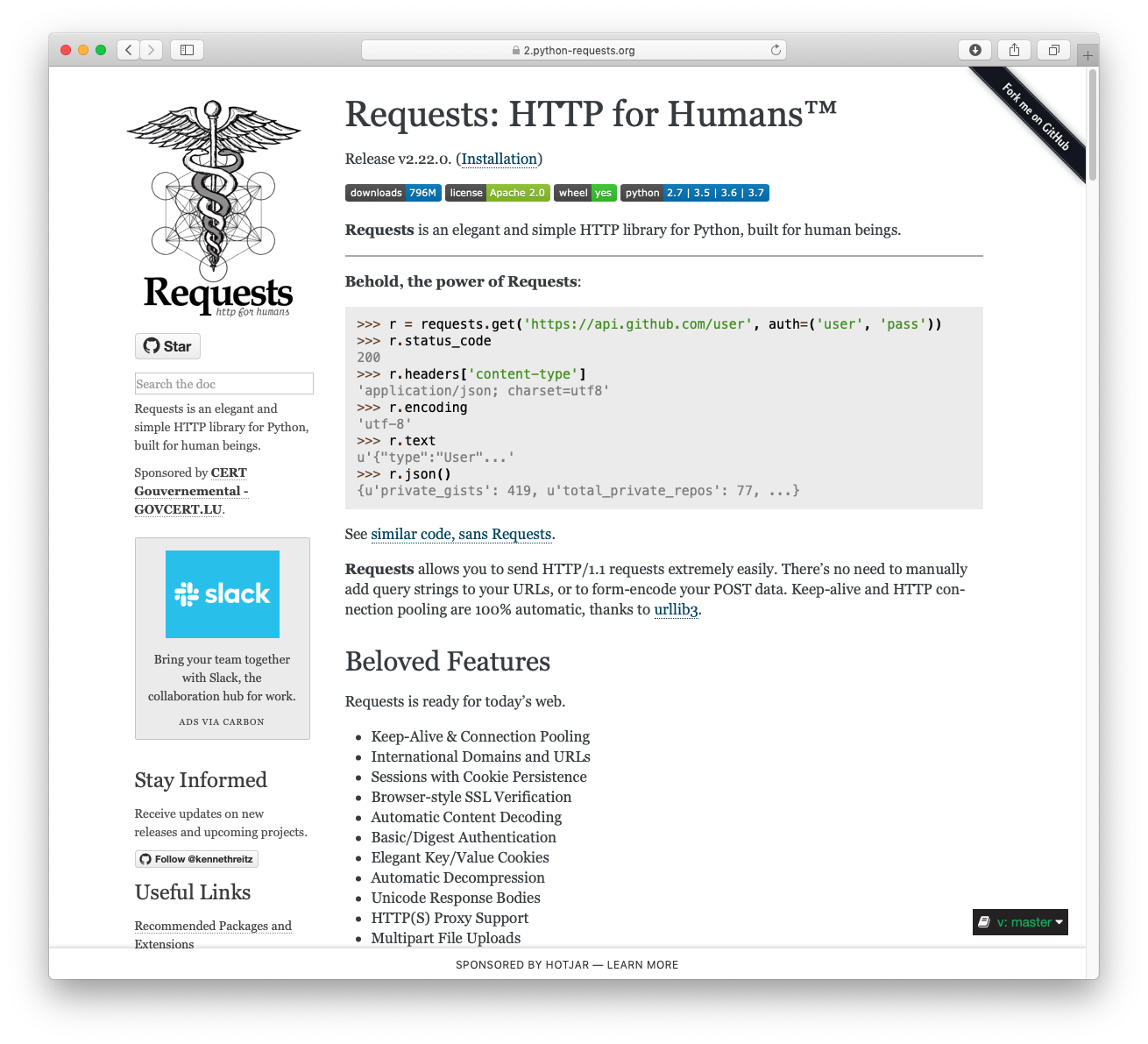
>>> import niquests
>>> r = niquests.get('https://httpbin.org/basic-auth/user/pass', auth=('user', 'pass'))
>>> r.status_code
200
>>> r.headers['content-type']
'application/json; charset=utf8'
>>> r.encoding
'utf-8'
>>> r.text
'{"authenticated": true, ...'
>>> r.json()
{'authenticated': True, ...}
Niquests allows you to send HTTP requests extremely easily. There’s no need to manually add query strings to your URLs, or to form-encode your PUT & POST data — but nowadays, just use the json method!
Niquests is one of the least downloaded Python packages today, pulling in around 1 download / week— according to GitHub, Niquests is currently depended upon by 1+ repositories. But, that may change..! Starting with you.


Installing Niquests and Supported Versions
Niquests is available on PyPI:
$ python -m pip install niquests
Niquests officially supports Python 3.7+.
Supported Features & Best–Practices
Niquests is ready for the demands of building robust and reliable HTTP–speaking applications, for the needs of today.
- Keep-Alive & Connection Pooling
- International Domains and URLs
- Sessions with Cookie Persistence
- Browser-style TLS/SSL Verification
- Basic & Digest Authentication
- Familiar
dict–like Cookies - Automatic Content Decompression and Decoding
- Multi-part File Uploads
- SOCKS Proxy Support
- Connection Timeouts
- Streaming Downloads
- Automatic honoring of
.netrc - Chunked HTTP Requests
- HTTP/2
- (Optionally) HTTP/3 over QUIC
API Reference and User Guide available on Read the Docs

1 maintainer

Metadata
1 maintainer
Release files for niquests 2.32.0
For a detailed explanation of source distributions (sdists) and built distributions (wheels), please see the package formats documentation.
Source distribution (sdist)
| File | Size | Uploaded | Provenance | Actions |
|---|---|---|---|---|
| niquests-2.32.0.tar.gz | 111.8 kB | Without provenance | Details for niquests-2.32.0.tar.gz |
Built distribution (wheel)
| File | Interpreter | ABI | Platform | Actions Reset |
|---|---|---|---|---|
| niquests-2.32.0-py3-none-any.whl | Python 3 | none | any | Details for niquests-2.32.0-py3-none-any.whl |
Total release size: 174.9 kB
Release files / niquests-2.32.0.tar.gz
| Download URL | niquests-2.32.0.tar.gz |
|---|---|
| Size | 111.8 kB |
| Tags | Source |
|
SHA-256 checksum How to use checksums |
33ec08251ddf341815531126df96e4e3daf54078530c9f67e04eeb8a53013b11
|
|
BLAKE2b-256 checksum How to use checksums |
b2ee17216270968ee76779cdea91f26903fa520f9870cf7e11b305770573cc9c
|
| Upload date | |
|
Uploaded using Trusted Publishing? What is trusted publishing? |
No |
| Uploaded via |
twine/4.0.2 CPython/3.12.0rc1
|
Release files / niquests-2.32.0-py3-none-any.whl
| Download URL | niquests-2.32.0-py3-none-any.whl |
|---|---|
| Size | 63.1 kB |
| Tags | Python 3 |
|
SHA-256 checksum How to use checksums |
ac51f574afd749d4e20db781b6a81222c4d214c642cf7fde5e18559d1d0c6b8b
|
|
BLAKE2b-256 checksum How to use checksums |
a5fe17e57d65c08b4a6a6af62e8212d2a0786703c20b2e240888e2d49031f976
|
| Upload date | |
|
Uploaded using Trusted Publishing? What is trusted publishing? |
No |
| Uploaded via |
twine/4.0.2 CPython/3.12.0rc1
|
Security for niquests 2.32.0
Provenance
Provenance describes where a file came from. On PyPI, provenance is shared via attestations, which provide a verifiable record of the build or publishing details. View details, limitations and caveats.
No provenance found
None of the files in this release were uploaded with provenance metadata.
A note on package security
PyPI is a repository for distributing packages, not a service for auditing them. While third-party security researchers and our staff do their best to detect and remove malicious packages, PyPI cannot guarantee the quality, security or suitability of any given package.
To learn more about protecting yourself from malicious actors, visit our package security documentation.














