
NODE GAM: Differentiable Generalized Additive Model for Interpretable Deep Learning:
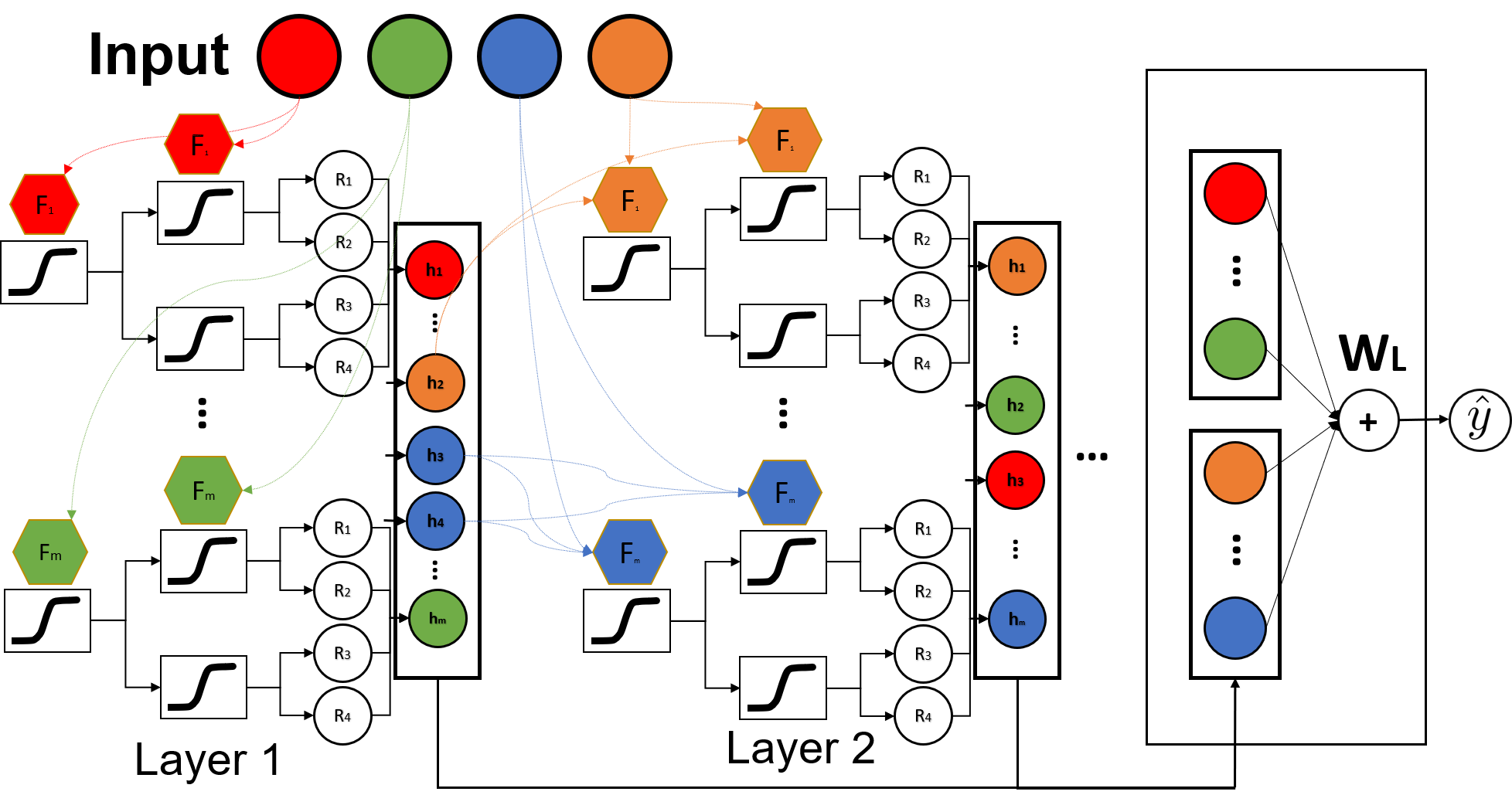
NodeGAM is an interpretable deep learning GAM model proposed in our ICLR 2022 paper: NODE GAM: Differentiable Generalized Additive Model for Interpretable Deep Learning. In short, it trains a GAM model by multi-layer differentiable trees to be accurate, interpretable, and differentiable. See this blog post for an intro, and our documentation website!
Installation
pip install nodegam
The performance and the runtime of the NodeGAM package
We compare NodeGAM with other GAMs (EBM, XGB-GAM), and XGB in 6 datasets. All models use default parameters, so the performance of NodeGAM here is lower than what paper reported. We find NodeGAM often performs better in larger datasets.
3 classification datasets:
| Dataset/AUROC | Domain | N | P | NodeGAM | EBM | XGB-GAM | XGB |
|---|---|---|---|---|---|---|---|
| MIMIC-II | Medicine | 25K | 17 | 0.844 ± 0.018 | 0.842 ± 0.019 | 0.833 ± 0.02 | 0.845 ± 0.019 |
| Adult | Finance | 33K | 14 | 0.916 ± 0.002 | 0.927 ± 0.003 | 0.925 ± 0.002 | 0.927 ± 0.002 |
| Credit | Finance | 285K | 30 | 0.989 ± 0.008 | 0.984 ± 0.007 | 0.985 ± 0.008 | 0.984 ± 0.01 |
3 regression datasets:
| Dataset/RMSE | Domain | N | P | NodeGAM | EBM | XGB-GAM | XGB |
|---|---|---|---|---|---|---|---|
| Wine | Nature | 5K | 12 | 0.705 ± 0.012 | 0.69 ± 0.011 | 0.713 ± 0.006 | 0.682 ± 0.023 |
| Bikeshare | Retail | 17K | 16 | 57.438 ± 3.899 | 55.676 ± 0.327 | 101.093 ± 0.946 | 45.212 ± 1.254 |
| Year | Music | 515K | 90 | 9.013 ± 0.004 | 9.204 ± 0.0 | 9.257 ± 0.0 | 9.049 ± 0.0 |
We also find the run time of our model increases mildly with growing data size due to mini-batch training, while our baselines increase training time much more.
3 classification datasets:
| Dataset/Seconds | Domain | N | P | NodeGAM | EBM | XGB-GAM | XGB |
|---|---|---|---|---|---|---|---|
| MIMIC-II | Medicine | 25K | 17 | 105.0 ± 14.0 | 6.0 ± 2.0 | 0.0 ± 1.0 | 1.0 ± 1.0 |
| Adult | Finance | 33K | 14 | 196.0 ± 56.0 | 15.0 ± 8.0 | 6.0 ± 0.0 | 1.0 ± 0.0 |
| Credit | Finance | 285K | 30 | 113.0 ± 36.0 | 37.0 ± 2.0 | 26.0 ± 7.0 | 16.0 ± 2.0 |
3 regression datasets:
| Dataset/Seconds | Domain | N | P | NodeGAM | EBM | XGB-GAM | XGB |
|---|---|---|---|---|---|---|---|
| Wine | Nature | 5K | 12 | 157.0 ± 86.0 | 4.0 ± 2.0 | 0.0 ± 0.0 | 0.0 ± 0.0 |
| Bikeshare | Retail | 17K | 16 | 223.0 ± 23.0 | 15.0 ± 3.0 | 1.0 ± 1.0 | 2.0 ± 1.0 |
| Year | Music | 515K | 90 | 318.0 ± 20.0 | 501.0 ± 8.0 | 376.0 ± 1.0 | 537.0 ± 1.0 |
Reproducing notebook is here.
See the Table 1 and 2 of our paper for more comparisons.
NodeGAM Training
Sklearn interface
To simply use it on your dataset, just run:
from nodegam.sklearn import NodeGAMClassifier, NodeGAMRegressor

model = NodeGAMClassifier()
model.fit(X, y)
Understand the model:
model.visualize()
or
from nodegam.vis_utils import vis_GAM_effects

vis_GAM_effects({
    'nodegam': model.get_GAM_df(),
})

See the notebooks/toy dataset with nodegam sklearn.ipynb here.
Notebook training
It is useful if you want to customize the NodeGAM training to your PyTorch pipeline. You can find details of the training in this notebook: https://colab.research.google.com/drive/1C_gBoSc1AlQ7VvCXVWiU-7X3YjQZTiZI?usp=sharing
And see more examples under notebooks/
Python file
You can also train a NodeGAM using our main file. To reproduce our results, e.g. NODE-GA2M trained in fold 0 (total 5 folds) of bikeshare, you can run
hparams="resources/best_hparams/node_ga2m/0519_f0_best_bikeshare_GAM_ga2m_s83_nl4_nt125_td1_d6_od0.0_ld0.3_cs0.5_lr0.01_lo0_la0.0_pt0_pr0_mn0_ol0_ll1"
python main.py \
--name 0603_best_bikeshare_f0 \
--load_from_hparams ${hparams}
--fold 0
The models will be stored in logs/0603_best_bikeshare_f0/. And the results including test/val error are stored in results/bikeshare_GAM.csv
We provide the best hyperparmeters we found in best_hparams/.
Baseline GAMs
We also provide code to train other GAMs for comparisons such as:
- Spline: we use the pygam package.
- EBM: Explainable Boosting Machine.
- XGB-GAM: Limit the XGB to have tree depth 1 that removes all interaction effects in the model. It's proposed in our KDD paper.
Sklearn interface
To train baselines on your dataset, just run:
from nodegam.gams.MySpline import MySplineLogisticGAM, MySplineGAM
from nodegam.gams.MyEBM import MyExplainableBoostingClassifier, MyExplainableBoostingRegressor
from nodegam.gams.MyXGB import MyXGBOnehotClassifier, MyXGBOnehotRegressor
from nodegam.gams.MyBagging import MyBaggingClassifier, MyBaggingRegressor


ebm = MyExplainableBoostingClassifier()
ebm.fit(X, y)

spline = MySplineLogisticGAM()
bagged_spline = MyBaggingClassifier(base_estimator=spline, n_estimators=3)
bagged_spline.fit(X, y)

xgb_gam = MyXGBOnehotClassifier()
bagged_xgb = MyBaggingClassifier(base_estimator=xgb_gam, n_estimators=3)
bagged_xgb.fit(X, y)
Understand the models:
from nodegam.vis_utils import vis_GAM_effects

fig, ax = vis_GAM_effects(
    all_dfs={
        'EBM': ebm.get_GAM_df(),
        'Spline': bagged_spline.get_GAM_df(),
        'XGB-GAM': bagged_xgb.get_GAM_df(),
    },
)
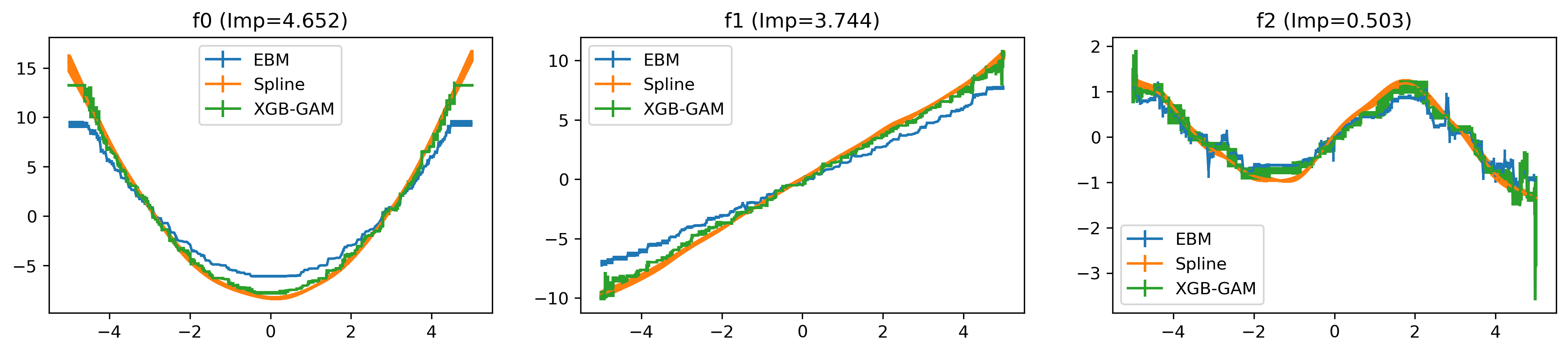
See the notebooks/toy dataset with nodegam sklearn.ipynb here for an example.
Python file
You can train Spline, EBM, and XGB-GAM by the following commands.
python baselines.py --name 0603_bikeshare_spline_f0 --fold 0 --model_name spline --dataset bikeshare
python baselines.py --name 0603_bikeshare_ebm_f0 --fold 0 --model_name ebm-o100-i100 --dataset bikeshare
python baselines.py --name 0603_bikeshare_xgb-o5_f0 --fold 0 --model_name xgb-o5 --dataset bikeshare
The result is shown in results/baselines_bikeshare.csv and the model is stored in logs/{name}/.
Visualization of the trained models stored under logs/
To visualize and compare multiple trained GAM models stored under logs/, run this in a notebook:
from nodegam.vis_utils import vis_GAM_effects
from nodegam.utils import average_GAMs

df_dict = {
    'node_ga2m': average_GAMs([
        '0603_best_bikeshare_f0',
        '0603_best_bikeshare_f1',
    ], max_n_bins=256),
    'ebm': average_GAMs([
        '0603_bikeshare_ebm_f0',
        '0603_bikeshare_ebm_f1',
    ], max_n_bins=256),
}

fig, ax = vis_GAM_effects(df_dict)
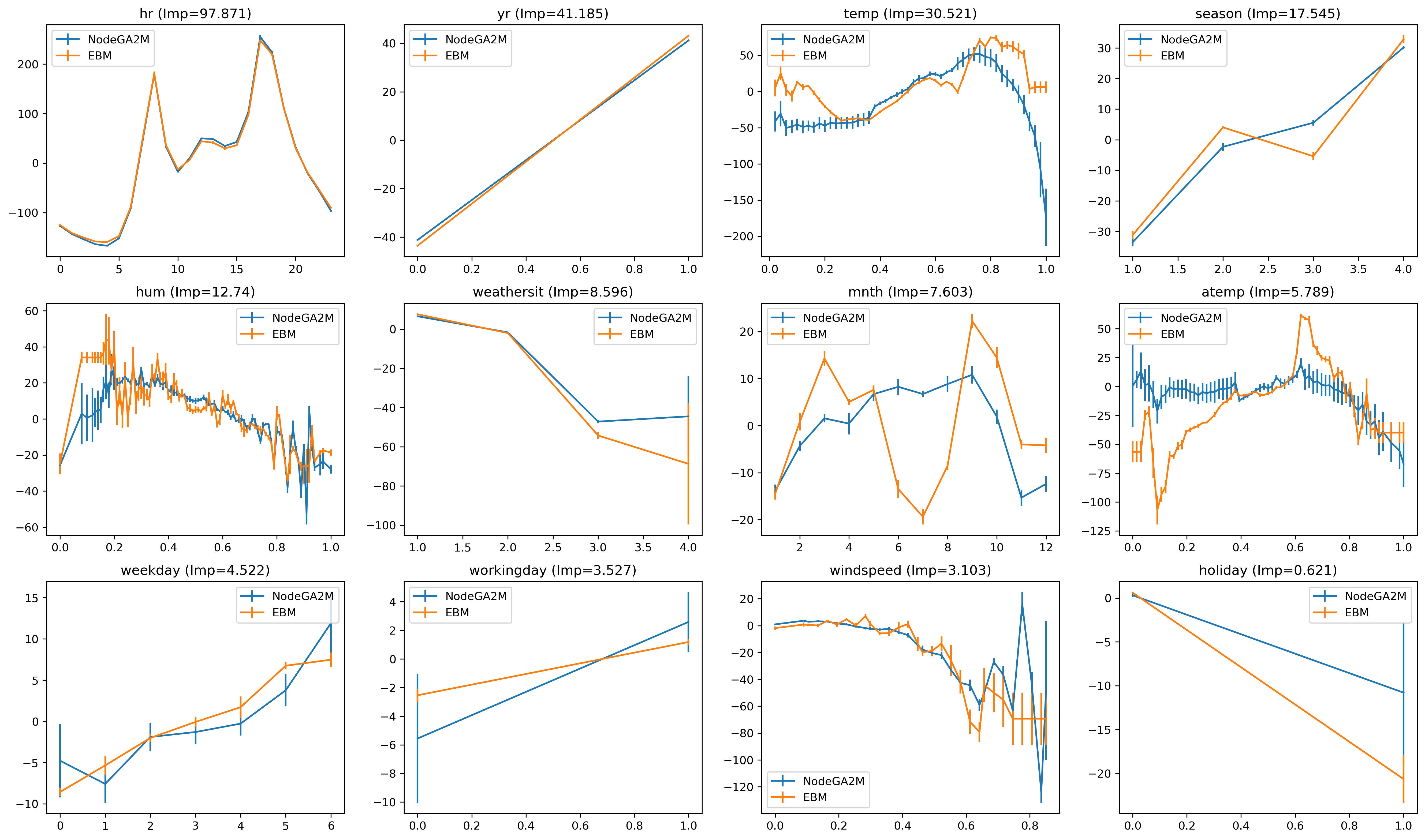
To avoid long computations, when visualizing we specify max_n_bins to do quantile binning of each
feature to have at most 256 bins (default). The average_GAMs take average of multiple runs of GAMs to produce mean and stdev on the GAM
graphs.
See notebooks/bikeshare visualization.ipynb here which we show bikeshare graphs for all GAMs
(NODE-GA2M, NODE-GAM, EBM and Spline) in our paper.
Citations
If you find the code useful, please cite:
@inproceedings{chang2021node,
  title={NODE-GAM: Neural Generalized Additive Model for Interpretable Deep Learning},
  author={Chang, Chun-Hao and Caruana, Rich and Goldenberg, Anna},
  booktitle={International Conference on Learning Representations},
  year={2022}
}

@inproceedings{chang2021interpretable,
  title={How interpretable and trustworthy are gams?},
  author={Chang, Chun-Hao and Tan, Sarah and Lengerich, Ben and Goldenberg, Anna and Caruana, Rich},
  booktitle={Proceedings of the 27th ACM SIGKDD Conference on Knowledge Discovery \& Data Mining},
  pages={95--105},
  year={2021}
}
Contributing
All content in this repository is licensed under the MIT license.
1 maintainer

Metadata
1 maintainer
Release files for nodegam 0.3.0
For a detailed explanation of source distributions (sdists) and built distributions (wheels), please see the package formats documentation.
Source distribution (sdist)
| File | Size | Uploaded | Provenance | Actions |
|---|---|---|---|---|
| nodegam-0.3.0.tar.gz | 67.6 kB | Without provenance | Details for nodegam-0.3.0.tar.gz |
Built distribution (wheel)
| File | Interpreter | ABI | Platform | Actions Reset |
|---|---|---|---|---|
| nodegam-0.3.0-py3-none-any.whl | Python 3 | none | any | Details for nodegam-0.3.0-py3-none-any.whl |
Total release size: 144.7 kB
Release files / nodegam-0.3.0.tar.gz
| Download URL | nodegam-0.3.0.tar.gz |
|---|---|
| Size | 67.6 kB |
| Tags | Source |
|
SHA-256 checksum How to use checksums |
7753dfc2457ec3c8f345898764678f85264d7f49c9c2afea2d019e22dc286921
|
|
BLAKE2b-256 checksum How to use checksums |
759f4470a096773f9729e2fa3388c53253bacc0d620133a412b3ab1f90850e0d
|
| Upload date | |
|
Uploaded using Trusted Publishing? What is trusted publishing? |
No |
| Uploaded via |
twine/3.8.0 pkginfo/1.8.3 readme-renderer/34.0 requests/2.27.1 requests-toolbelt/0.9.1 urllib3/1.26.9 tqdm/4.43.0 importlib-metadata/4.8.1 keyring/23.4.1 rfc3986/1.5.0 colorama/0.4.5 CPython/3.6.10
|
Release files / nodegam-0.3.0-py3-none-any.whl
| Download URL | nodegam-0.3.0-py3-none-any.whl |
|---|---|
| Size | 77.1 kB |
| Tags | Python 3 |
|
SHA-256 checksum How to use checksums |
f95e04869b69183ccdc6689d142973cc690f5fb712add0b9a5ffb55506df8358
|
|
BLAKE2b-256 checksum How to use checksums |
43b8d1c12b8d0e8ef891707447dd7b2f234543f7f36be6e0c031c1a4c11dc445
|
| Upload date | |
|
Uploaded using Trusted Publishing? What is trusted publishing? |
No |
| Uploaded via |
twine/3.8.0 pkginfo/1.8.3 readme-renderer/34.0 requests/2.27.1 requests-toolbelt/0.9.1 urllib3/1.26.9 tqdm/4.43.0 importlib-metadata/4.8.1 keyring/23.4.1 rfc3986/1.5.0 colorama/0.4.5 CPython/3.6.10
|
Security for nodegam 0.3.0
Provenance
Provenance describes where a file came from. On PyPI, provenance is shared via attestations, which provide a verifiable record of the build or publishing details. View details, limitations and caveats.
No provenance found
None of the files in this release were uploaded with provenance metadata.
A note on package security
PyPI is a repository for distributing packages, not a service for auditing them. While third-party security researchers and our staff do their best to detect and remove malicious packages, PyPI cannot guarantee the quality, security or suitability of any given package.
To learn more about protecting yourself from malicious actors, visit our package security documentation.














