


openapi-cli-tool
OpenAPI (Swagger 3.x) CLI Tool.
- Supports multiple file extensions (json|yaml|yml).
- Can list up defined API paths.
- Display an API specification which is resolved (
$ref). - Bundle multi-file into one (output to json|yaml|html).
- OAS interactive scaffolding.
Requirements
Python 2.7, 3.4 <=.
Installation
With pip:
$ pip install openapi-cli-tool
Manually:
Clone the repository and execute the Python installation command on your machine.
$ pip -r requirements.txt install
$ python setup.py install
Then openapi-cli-tool command is installed.
Usage
$ openapi-cli-tool --help
Usage: openapi-cli-tool [OPTIONS] COMMAND [ARGS]...

Options:
  --help  Show this message and exit.

Commands:
  bundle    Bundle multiple files into one.
  list      List up API paths in a file or directory.
  resolve   Display `$ref` resolved API specification.
  scaffold  Interactively create a simple OpenAPI Specification.
Bundle
Bundle multi-file specifications into one, regardless of file extension (json|yaml|yml).
$ openapi-cli-tool bundle --help
Usage: openapi-cli-tool bundle [OPTIONS] FILE_PATHS

  Bundle multiple files into one.

Options:
  -f, --file TEXT  Load common objects such as info and servers from a
                   specific file. Default is a file which is the top of list
                   command result.
  -t, --type TEXT  Export data type. {json|yaml|html}  [default: json]
  --help           Show this message and exit.
example:
$ openapi-cli-tool bundle -t html file1.json file2.yaml` > ./specification.html
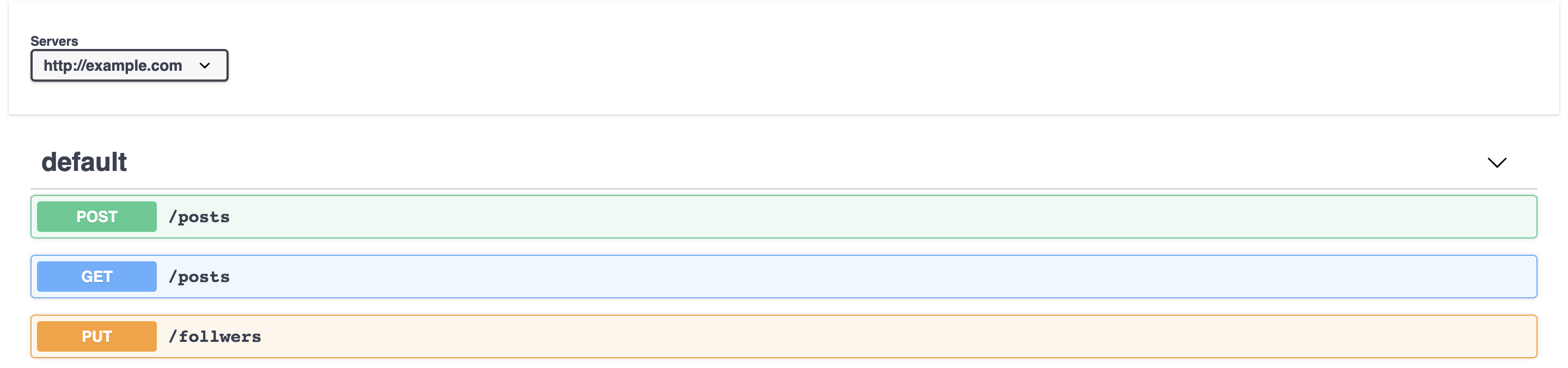
In the html file, an unpkg version of swagger-ui is embedded. Rendered screenshot below:
List
List up API paths from a file/directory regardless of the file extension (json|yaml|yml).
$ openapi-cli-tool list `find ./spec`

Method    Path       File
--------  ---------  ------------------------------------------
PUT       /avatar    ./tests/resources/spec/sample.yml
GET       /follwers  ./tests/resources/spec/folder1/sample2.yaml
POST      /follwers  ./tests/resources/spec/folder1/sample2.yaml
PUT       /follwers  ./tests/resources/spec/folder1/sample2.yaml
POST      /pets      ./tests/resources/spec/sample.yml
GET       /posts     ./tests/resources/spec/folder1/sample.json
POST      /posts     ./tests/resources/spec/folder1/sample.json
GET       /users     ./tests/resources/spec/folder1/sample.json
POST      /users     ./tests/resources/spec/folder1/sample.json
Resolve
Display an API specification which is resolved from a multi-file API specification via $ref pointers.
Usage: openapi-cli-tool resolve [OPTIONS] METHOD PATH FILE_PATHS

  Display `$ref` resolved API specification.

Options:
  -t, --type TEXT  Export data type. {json|yaml}  [default: json]
  --help           Show this message and exit.
example:
$ openapi-cli-tool resolve post /cats `find ./tests/resources/spec`
Scaffold
Interactively input information of your API.
A simple OpenAPI Specification is generated from your prompt.
$ openapi-cli-tool scaffold

Please enter title [""]: sample
Please enter version [v1.0]:
Please enter license [Apache 2.0]:
Please enter server url [http://example.com]:
Please enter path [/]: /example
Please enter method for /example [get|post|put|delete|head|option|trace]: get
Please enter description for get /example [""]: sample get endpoint
Please enter response code for get /example [200]:
1 maintainer

Metadata
1 maintainer
Release files for openapi-cli-tool 0.3.0
For a detailed explanation of source distributions (sdists) and built distributions (wheels), please see the package formats documentation.
Source distribution (sdist)
| File | Size | Uploaded | Provenance | Actions |
|---|---|---|---|---|
| openapi-cli-tool-0.3.0.tar.gz | 7.7 kB | Without provenance | Details for openapi-cli-tool-0.3.0.tar.gz |
Built distributions (wheels)
| File | Interpreter | ABI | Platform | Actions Reset |
|---|---|---|---|---|
| openapi_cli_tool-0.3.0-py3-none-any.whl | Python 3 | none | any | Details for openapi_cli_tool-0.3.0-py3-none-any.whl |
| openapi_cli_tool-0.3.0-py2-none-any.whl | Python 2 | none | any | Details for openapi_cli_tool-0.3.0-py2-none-any.whl |
Total release size: 29.9 kB
Release files / openapi-cli-tool-0.3.0.tar.gz
| Download URL | openapi-cli-tool-0.3.0.tar.gz |
|---|---|
| Size | 7.7 kB |
| Tags | Source |
|
SHA-256 checksum How to use checksums |
4f9bd88cc0737ee395b25bf5821e3f85236871da9c1a696bd36a3afdd6ff882a
|
|
BLAKE2b-256 checksum How to use checksums |
531753bd32842cac710fa1a7956044eec745251fa9f81e99bddfa99b9e6e1ac3
|
| Upload date | |
|
Uploaded using Trusted Publishing? What is trusted publishing? |
No |
| Uploaded via |
twine/1.15.0 pkginfo/1.5.0.1 requests/2.22.0 setuptools/42.0.2 requests-toolbelt/0.9.1 tqdm/4.40.2 CPython/2.7.15
|
Release files / openapi_cli_tool-0.3.0-py3-none-any.whl
| Download URL | openapi_cli_tool-0.3.0-py3-none-any.whl |
|---|---|
| Size | 11.1 kB |
| Tags | Python 3 |
|
SHA-256 checksum How to use checksums |
612ad09dad429fea783fd636453ed0d2ac1abb589d74efef1df2ad78de5b9f30
|
|
BLAKE2b-256 checksum How to use checksums |
463160bc7f835ef5231baac94b5ac90fd61956d60e92a696a82122567cd38910
|
| Upload date | |
|
Uploaded using Trusted Publishing? What is trusted publishing? |
No |
| Uploaded via |
twine/1.15.0 pkginfo/1.5.0.1 requests/2.22.0 setuptools/42.0.2 requests-toolbelt/0.9.1 tqdm/4.40.2 CPython/3.5.6
|
Release files / openapi_cli_tool-0.3.0-py2-none-any.whl
| Download URL | openapi_cli_tool-0.3.0-py2-none-any.whl |
|---|---|
| Size | 11.1 kB |
| Tags | Python 2 |
|
SHA-256 checksum How to use checksums |
895f43bf06a707cdd1e4ebef1f380c7c0c235cfedad93239d9e0bd29768c868d
|
|
BLAKE2b-256 checksum How to use checksums |
86a7c0969568612c4f838838d0a73fb4ae9c8e626945a76bad504ad0df157c26
|
| Upload date | |
|
Uploaded using Trusted Publishing? What is trusted publishing? |
No |
| Uploaded via |
twine/1.15.0 pkginfo/1.5.0.1 requests/2.22.0 setuptools/42.0.2 requests-toolbelt/0.9.1 tqdm/4.40.2 CPython/2.7.15
|
Security for openapi-cli-tool 0.3.0
Provenance
Provenance describes where a file came from. On PyPI, provenance is shared via attestations, which provide a verifiable record of the build or publishing details. View details, limitations and caveats.
No provenance found
None of the files in this release were uploaded with provenance metadata.
A note on package security
PyPI is a repository for distributing packages, not a service for auditing them. While third-party security researchers and our staff do their best to detect and remove malicious packages, PyPI cannot guarantee the quality, security or suitability of any given package.
To learn more about protecting yourself from malicious actors, visit our package security documentation.














