

An Open-source Factuality Evaluation Demo for LLMs


Overview • Installation • Usage • HuggingFace Demo • Documentation
Overview
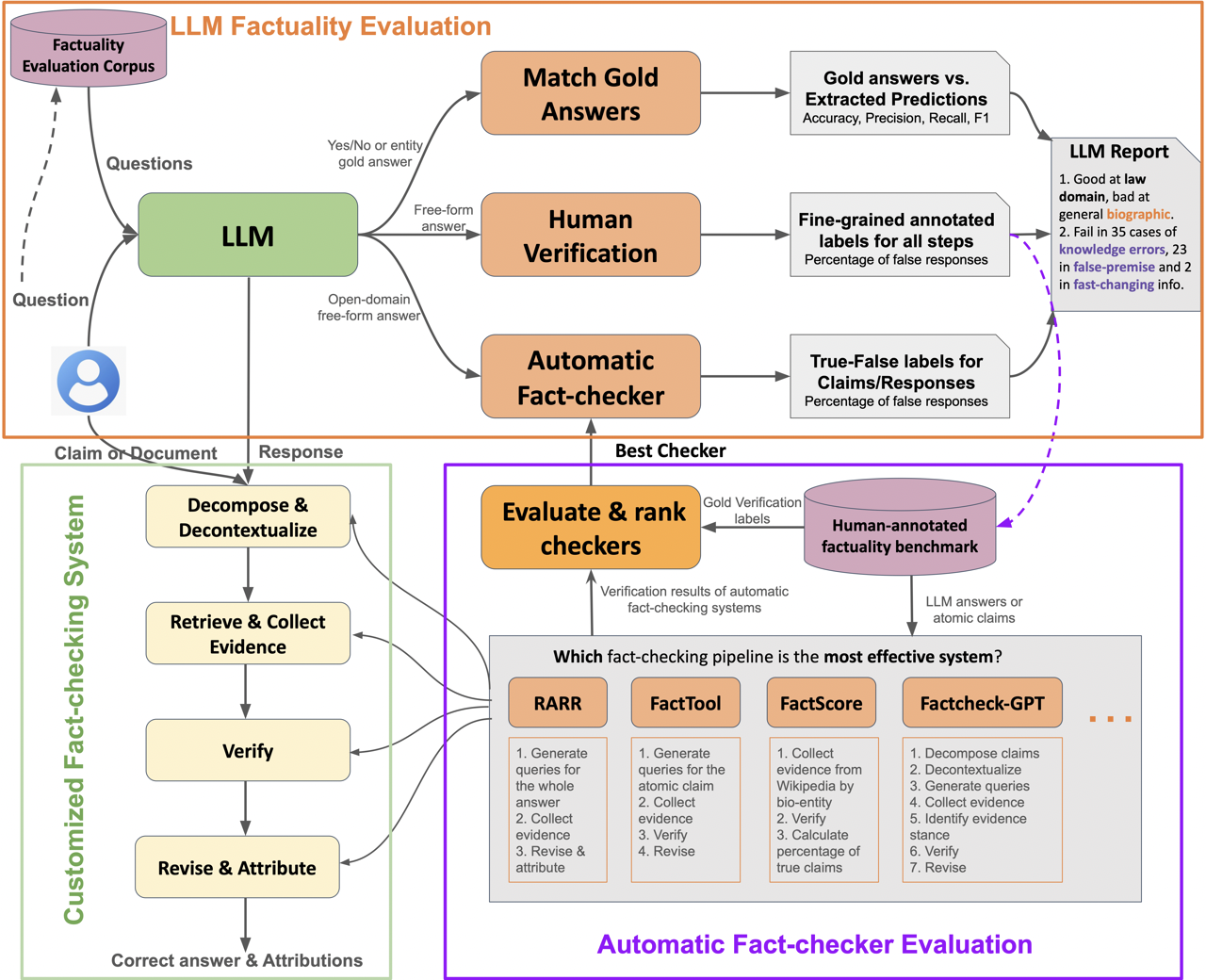
OpenFactCheck is an open-source repository designed to facilitate the evaluation and enhancement of factuality in responses generated by large language models (LLMs). This project aims to integrate various fact-checking tools into a unified framework and provide comprehensive evaluation pipelines, with built-in solvers for English and five additional languages (Arabic, Bulgarian, Chinese, Italian, and Urdu).
Supported Solvers
OpenFactCheck ships with several fact-checking pipelines you can use out of the box:
English
- factool — pipeline from FacTool
- factcheckgpt — pipeline from FactCheck-GPT
- rarr — Retrieval-Augmented Research and Revision
Multilingual (Arabic, Bulgarian, Chinese, and Italian are new in v1.1.0)
- arabicfactcheck — Arabic claim verification
- bulgarianfactcheck — Bulgarian claim verification
- chinesefactcheck — Chinese claim verification
- italianfactcheck — Italian claim verification
- urdufactcheck — Urdu claim verification
Each multilingual solver follows the same five-stage pattern: cp (claim processing) → rtv / rtv_tr / rtv_thtr (retrieval variants) → vfr (verification).
Utility
- dummy — passthrough/no-op (testing)
- tutorial — minimal example for building your own solver
- webservice — wrap any HTTP API as a solver
Installation
You can install the package from PyPI using pip:
pip install openfactcheck
Usage
First, you need to initialize the OpenFactCheckConfig object and then the OpenFactCheck object.
from openfactcheck import OpenFactCheck, OpenFactCheckConfig

# Initialize the OpenFactCheck object
config = OpenFactCheckConfig()
ofc = OpenFactCheck(config)
Response Evaluation
You can evaluate a response using the ResponseEvaluator class.
# Evaluate a response
result = ofc.ResponseEvaluator.evaluate(response: str)
LLM Evaluation
We provide FactQA, a dataset of 6480 questions for evaluating LLMs. Onc you have the responses from the LLM, you can evaluate them using the LLMEvaluator class.
# Evaluate an LLM
result = ofc.LLMEvaluator.evaluate(model_name: str,
                                   input_path: str)
Checker Evaluation
We provide FactBench, a dataset of 4507 claims for evaluating fact-checkers. Once you have the responses from the fact-checker, you can evaluate them using the CheckerEvaluator class.
# Evaluate a fact-checker
result = ofc.CheckerEvaluator.evaluate(checker_name: str,
                                       input_path: str)
Cite
If you use OpenFactCheck in your research, please cite the following:
@article{wang2024openfactcheck,
  title        = {OpenFactCheck: A Unified Framework for Factuality Evaluation of LLMs},
  author       = {Wang, Yuxia and Wang, Minghan and Iqbal, Hasan and Georgiev, Georgi and Geng, Jiahui and Nakov, Preslav},
  journal      = {arXiv preprint arXiv:2405.05583},
  year         = {2024}
}

@article{iqbal2024openfactcheck,
  title        = {OpenFactCheck: A Unified Framework for Factuality Evaluation of LLMs},
  author       = {Iqbal, Hasan and Wang, Yuxia and Wang, Minghan and Georgiev, Georgi and Geng, Jiahui and Gurevych, Iryna and Nakov, Preslav},
  journal      = {arXiv preprint arXiv:2408.11832},
  year         = {2024}
}

@software{hasan_iqbal_2024_13358665,
  author       = {Hasan Iqbal},
  title        = {hasaniqbal777/OpenFactCheck: v1.1.0},
  month        = {aug},
  year         = {2024},
  publisher    = {Zenodo},
  version      = {v1.1.0},
  doi          = {10.5281/zenodo.13358665},
  url          = {https://doi.org/10.5281/zenodo.13358665}
}
1 maintainer

Metadata
1 maintainer
Release files for openfactcheck 1.1.2
For a detailed explanation of source distributions (sdists) and built distributions (wheels), please see the package formats documentation.
Source distribution (sdist)
| File | Size | Uploaded | Provenance | Actions |
|---|---|---|---|---|
| openfactcheck-1.1.2.tar.gz | 6.1 MB | Without provenance | Details for openfactcheck-1.1.2.tar.gz |
Built distribution (wheel)
| File | Interpreter | ABI | Platform | Actions Reset |
|---|---|---|---|---|
| openfactcheck-1.1.2-py3-none-any.whl | Python 3 | none | any | Details for openfactcheck-1.1.2-py3-none-any.whl |
Total release size: 12.3 MB
Release files / openfactcheck-1.1.2.tar.gz
| Download URL | openfactcheck-1.1.2.tar.gz |
|---|---|
| Size | 6.1 MB |
| Tags | Source |
|
SHA-256 checksum How to use checksums |
e17a73b6a233648ad39310aa8a464e419cdef9d174fa56def9c795090d4e6c92
|
|
BLAKE2b-256 checksum How to use checksums |
f373abb04f77963e0198ebd04b9924020b354e65a2b410f58004f9f09e4e3e33
|
| Upload date | |
|
Uploaded using Trusted Publishing? What is trusted publishing? |
No |
| Uploaded via |
twine/6.2.0 CPython/3.11.15
|
Release files / openfactcheck-1.1.2-py3-none-any.whl
| Download URL | openfactcheck-1.1.2-py3-none-any.whl |
|---|---|
| Size | 6.2 MB |
| Tags | Python 3 |
|
SHA-256 checksum How to use checksums |
2b00259e9bcf4db02a05542e68da7e70e450fdd7862ce0f032395f72dfd942e5
|
|
BLAKE2b-256 checksum How to use checksums |
bd426cee61f0bd6dd7ca74cad4e9584026693eb77eddf55926f1db5629e88931
|
| Upload date | |
|
Uploaded using Trusted Publishing? What is trusted publishing? |
No |
| Uploaded via |
twine/6.2.0 CPython/3.11.15
|
Security for openfactcheck 1.1.2
Provenance
Provenance describes where a file came from. On PyPI, provenance is shared via attestations, which provide a verifiable record of the build or publishing details. View details, limitations and caveats.
No provenance found
None of the files in this release were uploaded with provenance metadata.
A note on package security
PyPI is a repository for distributing packages, not a service for auditing them. While third-party security researchers and our staff do their best to detect and remove malicious packages, PyPI cannot guarantee the quality, security or suitability of any given package.
To learn more about protecting yourself from malicious actors, visit our package security documentation.














