
[](http://pypi.python.org/pypi/opyum)
[](http://pypi.python.org/pypi/opyum)
[](http://pypi.python.org/pypi/opyum)
[](http://pypi.python.org/pypi/opyum)
[](http://pypi.python.org/pypi/opyum)
## Description
**Optimizing Python applications without mutilation code.**
Use the automatic modification of AST for code optimization, which is transparent to the user and requires the addition of only a few lines.
## Usage
**Decorator**:
```python
from opyum import optimize
@optimize
def function_for_optimize():
...
```
**Import-hook**:
```python
import opyum
opyum.activate()
# other imports
```
**"With" syntax:**
```python
import opyum
with opyum.activate:
# other imports
```
**Command-line mode:**
Show optimized source:
$ opyum show myfile.py
Diff between original source and optimized source:
$ opyum diff myfile.py
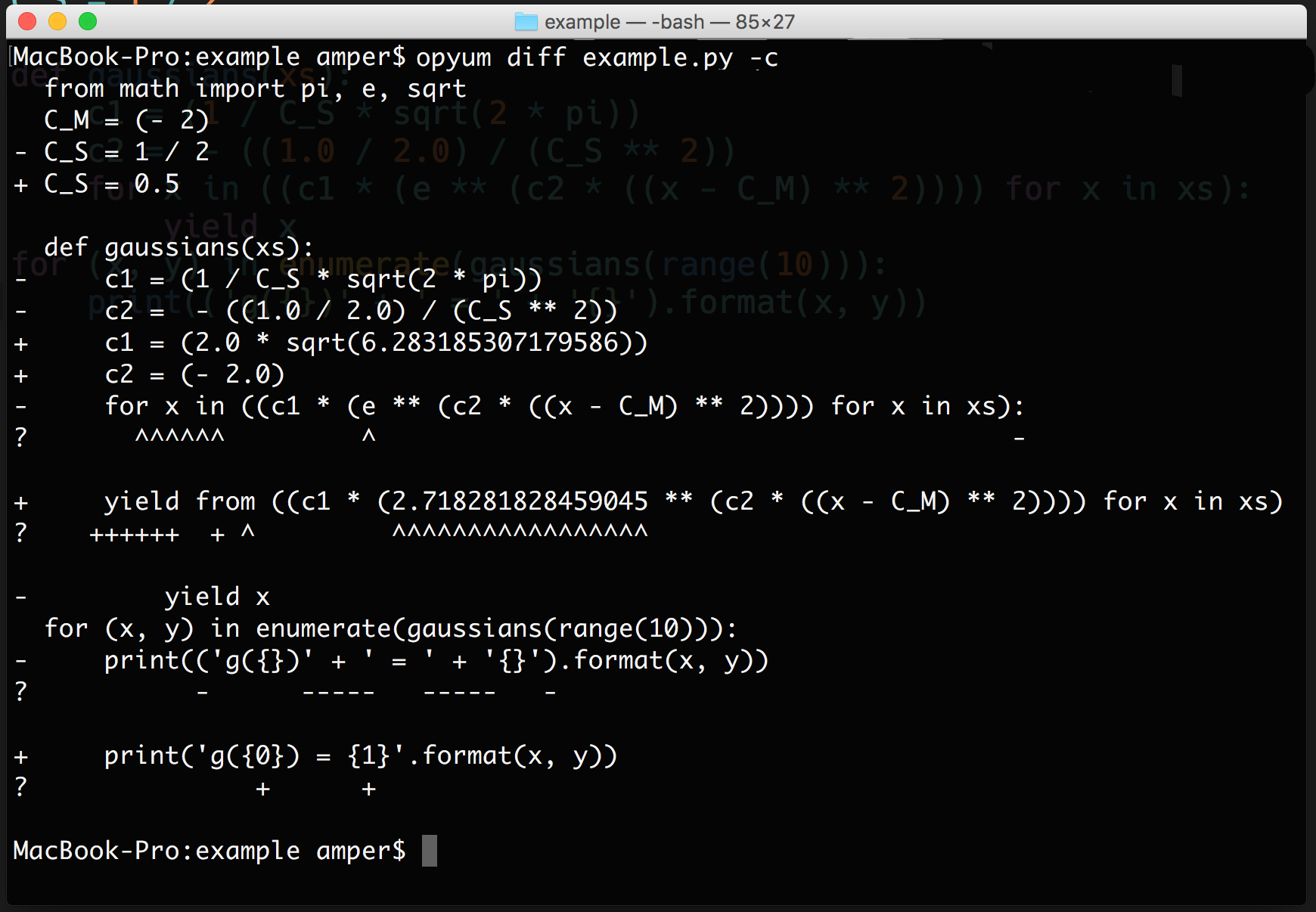
Console diff (with "-c" or "--console" option):
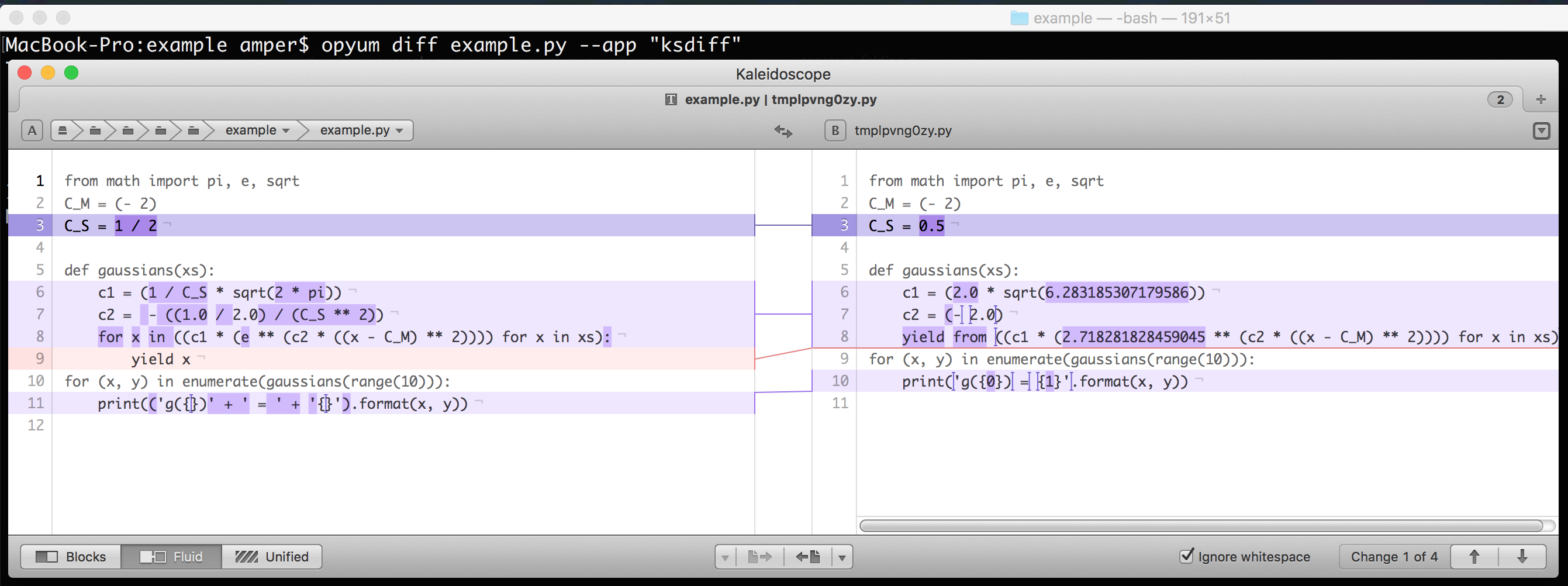
Custom app diff (with "--app" option):
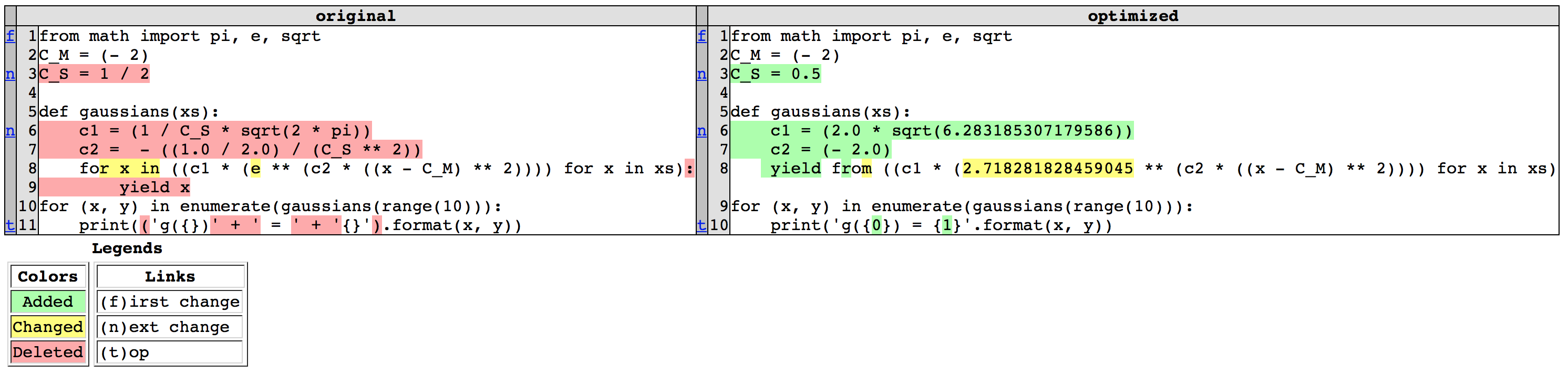
By default, html diff (without options):
## List of optimizations
####Constant folding
Before:
```python
x = 7 * 24 * 60 * 60
y = [i ** 2 for i in range(10) if i % 2 == 0]
z = sum(range(1000))
```
After:
```python
x = 604800
y = [0, 4, 16, 36, 64]
z = 499500
```
####"'Power' to 'multiplication'" optimization
Before:
```python
x1 = a ** (-2)
x2 = a ** (-1)
x3 = a ** ( 0)
x4 = a ** ( 1)
x5 = a ** ( 2)
```
After:
```python
x1 = 1 / (a * a)
x2 = 1 / a
x3 = 1
x4 = a
x5 = a * a
```
####"'Yield' to 'yield from'" optimization
Before:
```python
for x in some_expression:
yield x
```
After
```python
yield from some_expression
```
####Builtin constant propagation
Before:
```python
from math import pi
def circumference(r):
return 2 * pi * r
```
After:
```python
from math import pi
def circumference(r):
return 2 * 3.141592653589793 * r
```
####Custom constant propagation
Before:
```python
C_PI = 3.141592653589793
def circumference(r):
return 2 * C_PI * r
```
After:
```python
C_PI = 3.141592653589793
def circumference(r):
return 2 * 3.141592653589793 * r
```
####Dead code elimination
Before:
```python
def do_something():
return 1
print('returning 1')
if condition1:
pass
elif condition2:
do_something()
else:
pass
```
After:
```python
def do_something():
return 1
if not condition1 and condition2:
do_something()
```
## Installation
Installation is simple with pip:
$ pip install opyum
or with setuptools:
$ easy_install opyum
## Documentation
[opyum.readthedocs.org](http://opyum.readthedocs.org/)
[opyum.rtfd.org](http://opyum.rtfd.org/)
1 maintainer

Metadata
1 maintainer
Release files for opyum 0.2
For a detailed explanation of source distributions (sdists) and built distributions (wheels), please see the package formats documentation.
Source distribution (sdist)
| File | Size | Uploaded | Provenance | Actions |
|---|---|---|---|---|
| opyum-0.2.tar.gz | 20.5 kB | Without provenance | Details for opyum-0.2.tar.gz |
Release files / opyum-0.2.tar.gz
| Download URL | opyum-0.2.tar.gz |
|---|---|
| Size | 20.5 kB |
| Tags | Source |
|
SHA-256 checksum How to use checksums |
706b3c38f68a6ff275e76f76c1fb7c2c25c132766c49d8216880b6261ed95a0d
|
|
BLAKE2b-256 checksum How to use checksums |
76a1e3efd5bb4d3cc7c0eaff309c62b8a5dc88de68b1fb5de37f305c02a04892
|
| Upload date | |
|
Uploaded using Trusted Publishing? What is trusted publishing? |
No |
Security for opyum 0.2
Provenance
Provenance describes where a file came from. On PyPI, provenance is shared via attestations, which provide a verifiable record of the build or publishing details. View details, limitations and caveats.
No provenance found
None of the files in this release were uploaded with provenance metadata.
A note on package security
PyPI is a repository for distributing packages, not a service for auditing them. While third-party security researchers and our staff do their best to detect and remove malicious packages, PyPI cannot guarantee the quality, security or suitability of any given package.
To learn more about protecting yourself from malicious actors, visit our package security documentation.














