
pandamesh



This package translates geospatial vector data (points, lines, or polygons) to unstructured meshes.
import pandamesh as pm

# Get some sample data in geopandas form.
south_america = pm.data.south_america()

# Explode any multi-polygon, and project it to UTM20.
south_america = south_america.explode(index_parts=True).reset_index().to_crs(epsg=32620)

# Set a maximum cell size of 500 km and generate a mesh.
south_america["cellsize"] = 500_000.0
mesher = pm.TriangleMesher(south_america)
vertices, faces = mesher.generate()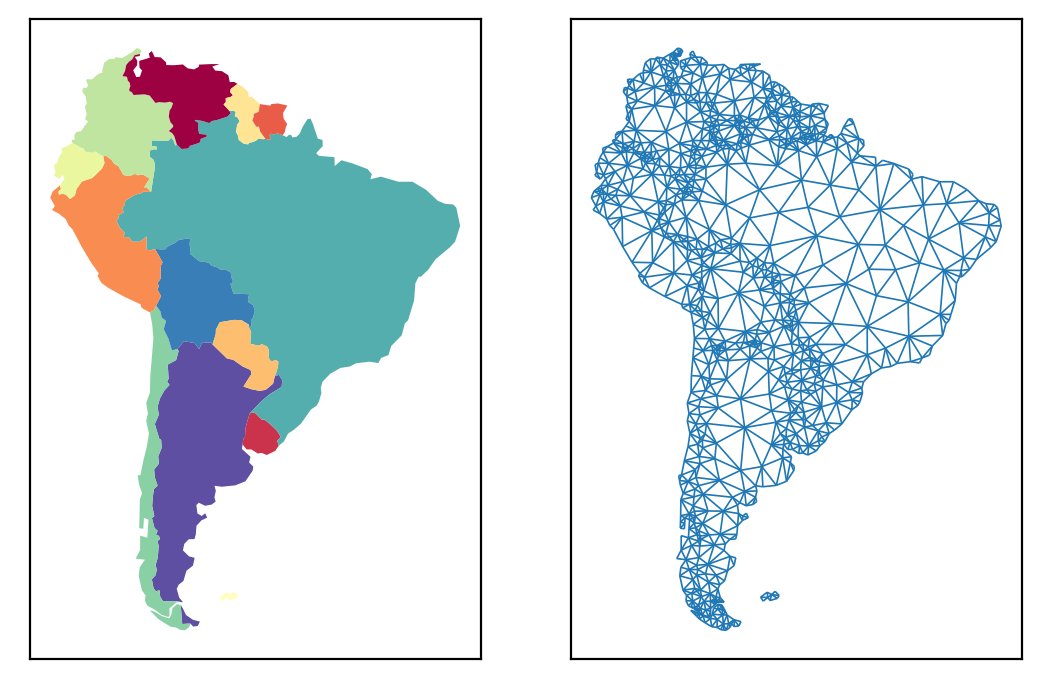
The package converts geospatial data, presented as geopandas GeoDataFrames, to unstructured meshes using the open source high quality mesh generators:
utilizing the respective Python API’s, available at:
For completeness, the source code of both projects can be found at:
https://gitlab.onelab.info/gmsh/gmsh, under api/gmsh.py
These APIs are wrapped in two lightweight classes: pandamesh.TriangleMesher and pandamesh.GmshMesher. Both are initialized with a GeoDataFrame defining the geometry features of the mesh. During initialization, geometries are checked for overlaps and intersections, as the mesh generators cannot deal with these. Generated meshes are returned as two numpy arrays: the coordinates of the vertices, and the connectivity of the mesh faces to these vertices (as is usual for many unstructured grid representations).
GeoPandas is not suited for geometries that “wrap around” the world. Consequently, this package cannot generate meshes for e.g. a sphere.
Installation
pip install pandameshDocumentation
The documentation can be found here.
Other projects
Pandamesh has been developed because none of the existing packages provide a straightforward scripting based approach to converting 2D vector geometries to 2D unstructured grids.
Examples of other packages which work with unstructured meshes are listed below.
See also this list for many other mesh generation tools.
pygmsh
The pygmsh Python package provides useful abstractions from Gmsh’s own Python interface so you can create complex geometries more easily. It also provides tools for 3D operations (e.g. extrusions).
qgis-gsmh
qgis-gmsh generates geometry input files for the GMSH mesh generator and converts the Gmsh mesh files to shapefiles that can be imported into QGIS.
Lambrechts, J., Comblen, R., Legat, V., Geuzaine, C., & Remacle, J. F. (2008). Multiscale mesh generation on the sphere. Ocean Dynamics, 58(5-6), 461-473.
Remacle, J. F., & Lambrechts, J. (2018). Fast and robust mesh generation on the sphere—Application to coastal domains. Computer-Aided Design, 103, 14-23. https://doi.org/10.1016/j.cad.2018.03.002
Shingle
Shingle provides generalised self-consistent and automated domain discretisation for multi-scale geophysical models.
Candy, A. S., & Pietrzak, J. D. (2018). Shingle 2.0: generalising self-consistent and automated domain discretisation for multi-scale geophysical models. Geoscientific Model Development, 11(1), 213-234. https://doi.org/10.5194/gmd-11-213-2018
3 maintainers


Metadata
3 maintainers
Release files for pandamesh 0.2.3
For a detailed explanation of source distributions (sdists) and built distributions (wheels), please see the package formats documentation.
Source distribution (sdist)
| File | Size | Uploaded | Provenance | Actions |
|---|---|---|---|---|
| pandamesh-0.2.3.tar.gz | 46.7 kB | Without provenance | Details for pandamesh-0.2.3.tar.gz |
Built distribution (wheel)
| File | Interpreter | ABI | Platform | Actions Reset |
|---|---|---|---|---|
| pandamesh-0.2.3-py3-none-any.whl | Python 3 | none | any | Details for pandamesh-0.2.3-py3-none-any.whl |
Total release size: 86.9 kB
Release files / pandamesh-0.2.3.tar.gz
| Download URL | pandamesh-0.2.3.tar.gz |
|---|---|
| Size | 46.7 kB |
| Tags | Source |
|
SHA-256 checksum How to use checksums |
67272322b65a71c929f2c53c2019540d946bc8b0aeb311444457e115c0ffc616
|
|
BLAKE2b-256 checksum How to use checksums |
2f4286a22290a9916354b74d5b4b32af754b72fa07a3e5974b2c0f9883e68737
|
| Upload date | |
|
Uploaded using Trusted Publishing? What is trusted publishing? |
No |
| Uploaded via |
twine/6.1.0 CPython/3.12.8
|
Release files / pandamesh-0.2.3-py3-none-any.whl
| Download URL | pandamesh-0.2.3-py3-none-any.whl |
|---|---|
| Size | 40.1 kB |
| Tags | Python 3 |
|
SHA-256 checksum How to use checksums |
fc1f5b3c976acaa49634c6e694e966fb94ae7ea6e26757dc16e4fad011e5858d
|
|
BLAKE2b-256 checksum How to use checksums |
4489e652fe65c440582111afb542d4ac6fa6ef80126476abdbbb5d4620bae70f
|
| Upload date | |
|
Uploaded using Trusted Publishing? What is trusted publishing? |
No |
| Uploaded via |
twine/6.1.0 CPython/3.12.8
|
Security for pandamesh 0.2.3
Provenance
Provenance describes where a file came from. On PyPI, provenance is shared via attestations, which provide a verifiable record of the build or publishing details. View details, limitations and caveats.
No provenance found
None of the files in this release were uploaded with provenance metadata.
A note on package security
PyPI is a repository for distributing packages, not a service for auditing them. While third-party security researchers and our staff do their best to detect and remove malicious packages, PyPI cannot guarantee the quality, security or suitability of any given package.
To learn more about protecting yourself from malicious actors, visit our package security documentation.














