
patray



Patray stands for PulseAudioTray. It is "yet another pulseaudio frontend".
Default view
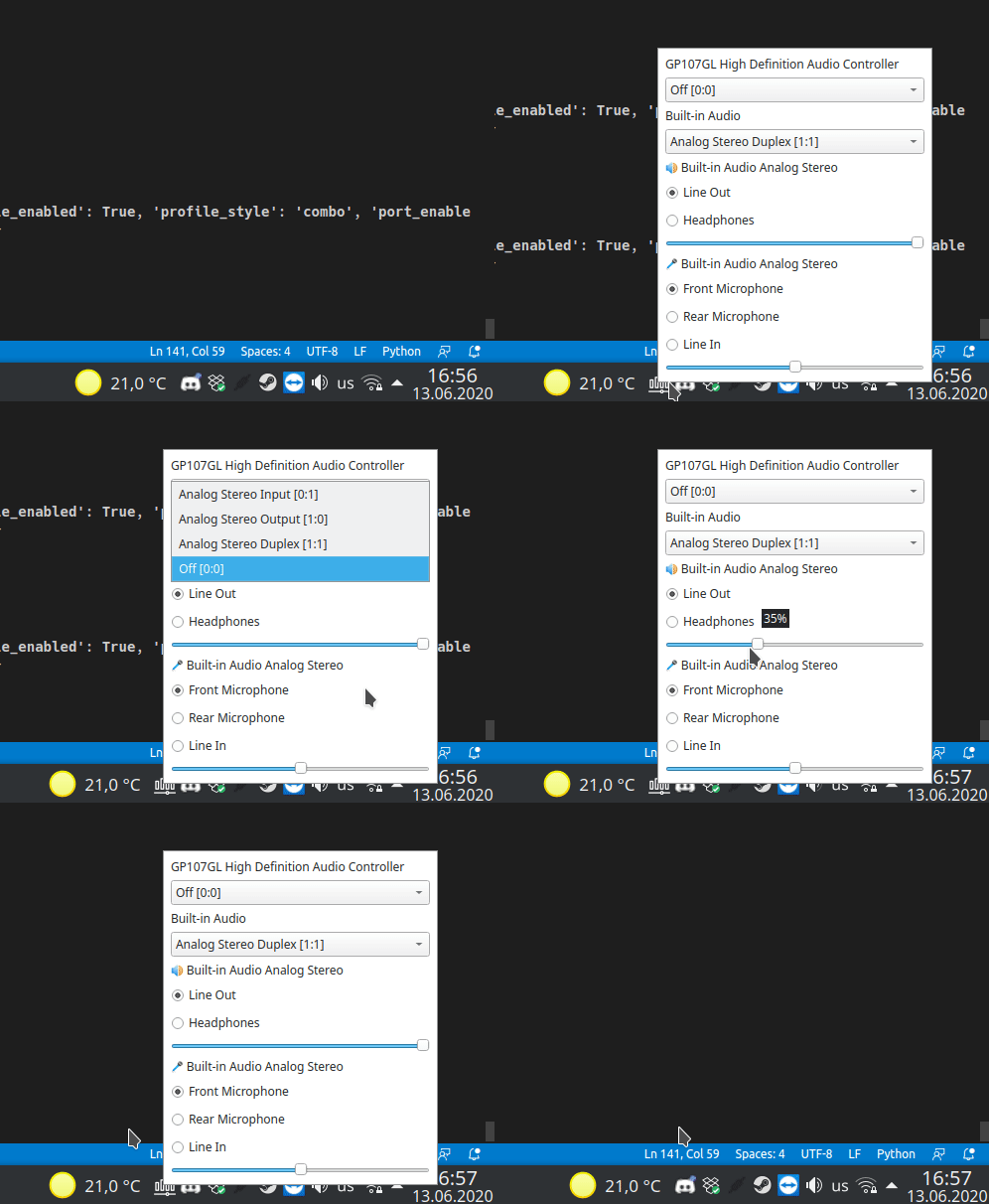
Configuring
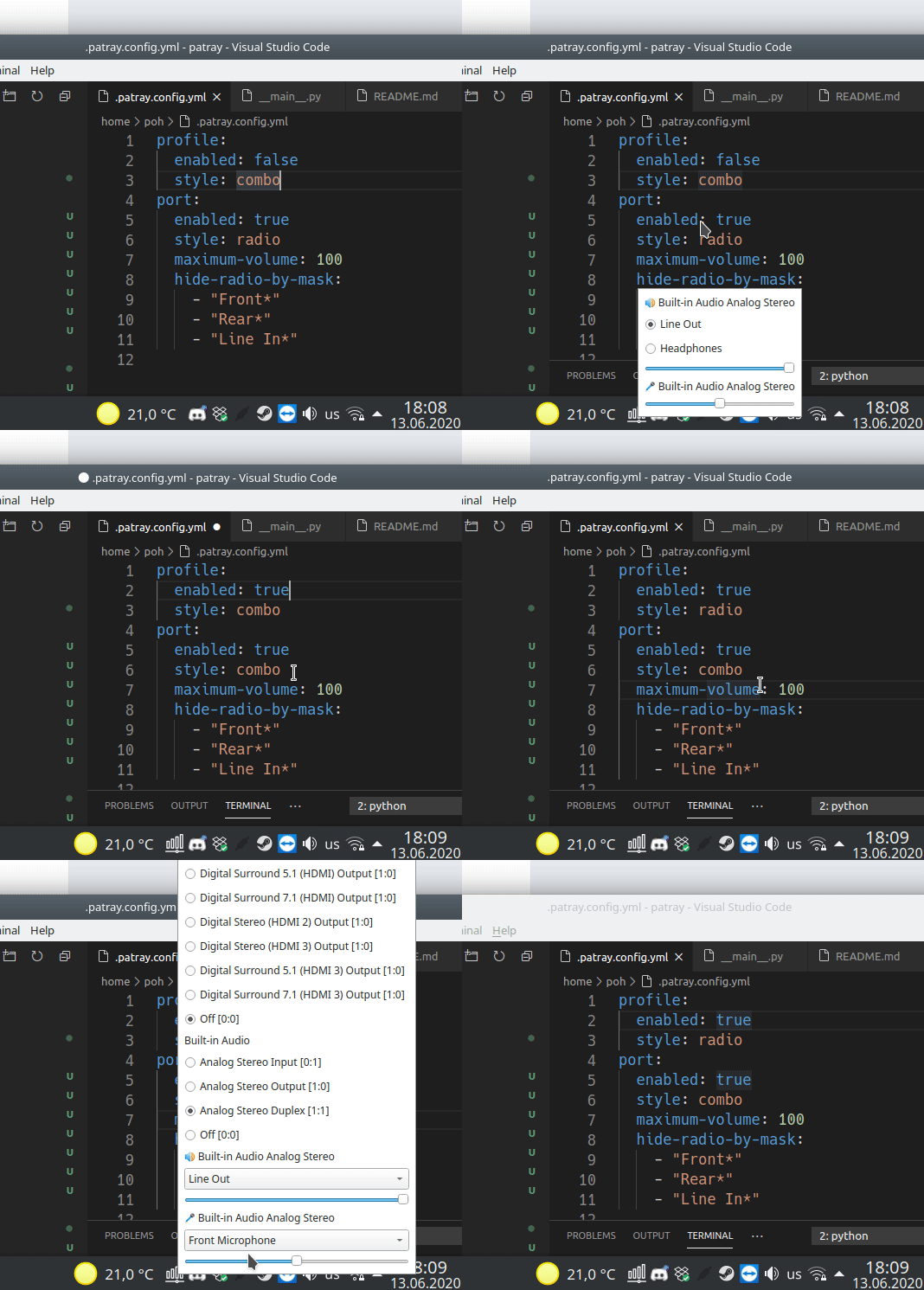
Reasons
- Brilliant yktoo sound switcher lacks of volume control
- pasystray have too much options and heavy interface
- No simple tray for all in one menu:
- port switching with radio buttons
- volume control scroll bar
Features
- Card profile switches
- Profile port switches
- Profile volume slider
- Port filters by mask
- Configurable UI view: combo or radio
License
patray is offered under MIT license.
Requirements
- python 3.7+
Installation
$ python -m pip install patray
Usage
Common usecase is:
$ python -m patray ~/.patray.config.yml
Configuration options are built on cock logic, so you need to run
$ python -m patray --help
to see all available options. But you can pass all options via command line interface, or even via environemnt vairables.
Example
For version 0.1.2 help output looks like this:
$ python -m patray --help
Usage: patray [OPTIONS] [CONFIGURATION_FILE]

Options:
  --profile-enabled BOOLEAN      [default: True]
  --profile-style [combo|radio]  [default: combo]
  --profile-weight FLOAT         [default: 1.0]
  --port-enabled BOOLEAN         [default: True]
  --port-style [combo|radio]     [default: radio]
  --port-maximum-volume INTEGER  [default: 100]
  --port-hide-by-mask TEXT
  --port-weight FLOAT            [default: 1.0]
  --log-level TEXT               [default: INFO]
  --icon-path FILE
  --icon-color TEXT              Use `random` value for random color on each
                                 click  [default: #fff]

  --version                      Show the version and exit.  [default: False]
  --help                         Show this message and exit.  [default: False]
You can see all defaults and all «flat» keys. Your configuration file can look like this:
icon-color: random
profile:
  enabled: true
  style: combo
port:
  enabled: true
  style: radio
  weight: 0.95
  maximum-volume: 100
  hide-by-mask:
    - "Front*"
    - "Rear*"
    - "Line In*"
You can see, that each - in flat cli argument name can be cutted off to create tree-like config.
1 maintainer

Metadata
1 maintainer
Release files for patray 0.1.2
For a detailed explanation of source distributions (sdists) and built distributions (wheels), please see the package formats documentation.
Source distribution (sdist)
| File | Size | Uploaded | Provenance | |
|---|---|---|---|---|
| patray-0.1.2.tar.gz | 8.8 kB | Without provenance | Details |
Built distribution (wheel)
| File | Interpreter | ABI | Platform | Reset |
|---|---|---|---|---|
| patray-0.1.2-py3-none-any.whl | Python 3 | none | any | Details |
Total release size: 17.7 kB
Release files / patray-0.1.2.tar.gz
| Download URL | patray-0.1.2.tar.gz |
|---|---|
| Size | 8.8 kB |
| Tags | Source |
|
SHA-256 checksum How to use checksums |
3bc08151ec4bd95d6a23b6c1fcb9ecdf28d4bc53a90bab2977fe9ab176b9fa9c
|
|
BLAKE2b-256 checksum How to use checksums |
a58de349af3f6492e9eccf8607ee5bb70cda9d6f0101dffc4e381201020f4b4c
|
| Upload date | |
|
Uploaded using Trusted Publishing? What is trusted publishing? |
No |
| Uploaded via |
twine/3.4.2 importlib_metadata/4.8.1 pkginfo/1.7.1 requests/2.26.0 requests-toolbelt/0.9.1 tqdm/4.62.3 CPython/3.7.1
|
Release files / patray-0.1.2-py3-none-any.whl
| Download URL | patray-0.1.2-py3-none-any.whl |
|---|---|
| Size | 8.8 kB |
| Tags | Python 3 |
|
SHA-256 checksum How to use checksums |
40952b863764dc7a56c737e1226b64adc36b848d5cc9c88019bd4672a183acb3
|
|
BLAKE2b-256 checksum How to use checksums |
1070b7a1a8e4bf661b1f411f2e4d2d31ed9a91458a2b9d2ccaf29a82f9982bf6
|
| Upload date | |
|
Uploaded using Trusted Publishing? What is trusted publishing? |
No |
| Uploaded via |
twine/3.4.2 importlib_metadata/4.8.1 pkginfo/1.7.1 requests/2.26.0 requests-toolbelt/0.9.1 tqdm/4.62.3 CPython/3.7.1
|
Security for patray 0.1.2
Provenance
Provenance describes where a file came from. On PyPI, provenance is shared via attestations, which provide a verifiable record of the build or publishing details. View details, limitations and caveats.
No provenance found
None of the files in this release were uploaded with provenance metadata.
A note on package security
PyPI is a repository for distributing packages, not a service for auditing them. While third-party security researchers and our staff do their best to detect and remove malicious packages, PyPI cannot guarantee the quality, security or suitability of any given package.














