
This release is a pre-release and may not be stable for production use.


pbi-load-test
Python package and CLI application to measure Power BI reports loading capacity, using different filters and parameters.
It simulates a realistic set of user actions such as changing slicers, filters (soon), bookmarks (soon)
[Prerequisites](#prerequisites) | [Installation](#installation) | [Configuration](#configuration) | [Example](#example)
Prerequisites
- It requires and Azure AD login method. Ensure you have Azure CLI installed locally and authentificate (
az login) in order to generate a token easily. Soon:
- This package is based on Selenium python package. It will open a Chromium window to launch the test. In any case, it may require the Chromium driver locally. The latest versions for each OS can be found here.
Installation
With pip
$ pip install pbi-load-test
And to test the installation
$ pbi-load-test --version
0.1.1a1
with poetry
$ poetry add pbi-load-test
And to test the installation
$ poetry run pbi-load-test --version
0.1.1a1
Configuration
The load test is configurated through a config.yaml file which should be located in the current working directory.
# authentification: oauth
workspace: ... # PBI Workspace Name
report: ... # Report name
page: ... # Page name

slicers:
  - table: ... # Table name from dataset which contains the column to filter on
    column: ... # The column name containing the values to filter on
    values:
      - ... # The value to filter on
      - ...
Example
It ensures that a config.yaml file exists in the current working directory
❯ poetry run pbi-load-test run

CORE - MARKETING [DEV]
SFE Country Dashboard TMDL
Activity Field Days
Workspace ID: 310d9fbb-1474-4939-bcb8-669a536ec959
Report ID: c89485c6-e0c3-4715-a710-ddd450491a9a
groups/310d9fbb-1474-4939-bcb8-669a536ec959/reports/c89485c6-e0c3-4715-a710-ddd450491a9a/pages
Page ID: ReportSectioncbd8077dfb6a167ccb5e
Duration: 30.085
Press Enter to continue...
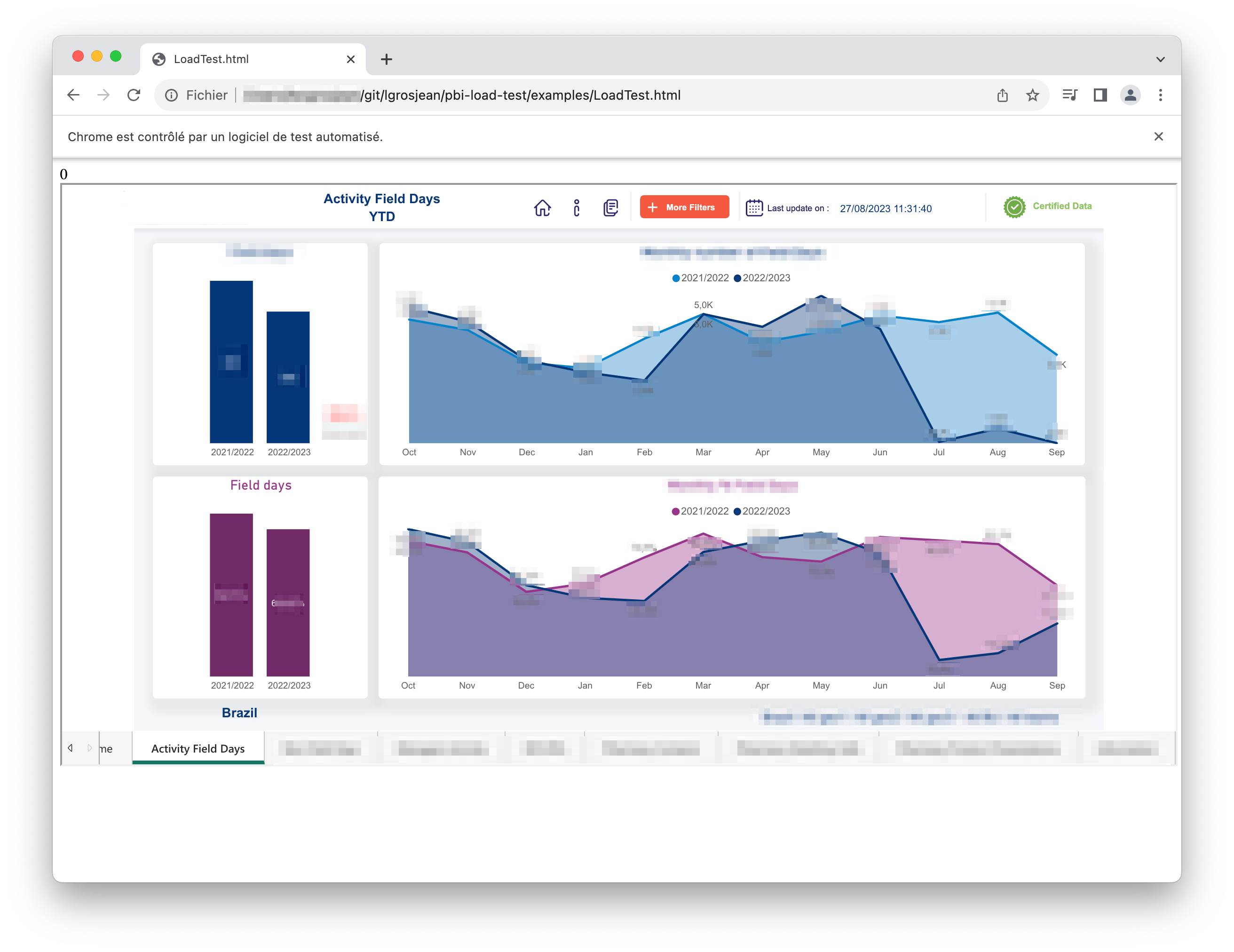
After the test, all created files will be removed.
1 maintainer

Metadata
1 maintainer
Release files for pbi-load-test 0.1.1a1
For a detailed explanation of source distributions (sdists) and built distributions (wheels), please see the package formats documentation.
Source distribution (sdist)
| File | Size | Uploaded | Provenance | Actions |
|---|---|---|---|---|
| pbi_load_test-0.1.1a1.tar.gz | 10.2 kB | Without provenance | Details for pbi_load_test-0.1.1a1.tar.gz |
Built distribution (wheel)
| File | Interpreter | ABI | Platform | Actions Reset |
|---|---|---|---|---|
| pbi_load_test-0.1.1a1-py3-none-any.whl | Python 3 | none | any | Details for pbi_load_test-0.1.1a1-py3-none-any.whl |
Total release size: 22.5 kB
Release files / pbi_load_test-0.1.1a1.tar.gz
| Download URL | pbi_load_test-0.1.1a1.tar.gz |
|---|---|
| Size | 10.2 kB |
| Tags | Source |
|
SHA-256 checksum How to use checksums |
b7cbfab7465ec83dd31cc74f80f9724da366bb7256662de5aef13ada2d8480b6
|
|
BLAKE2b-256 checksum How to use checksums |
9c453d7342b15f68770e06575001177e4c085d77e0506372750b474a1b0314c6
|
| Upload date | |
|
Uploaded using Trusted Publishing? What is trusted publishing? |
No |
| Uploaded via |
poetry/1.4.2 CPython/3.9.14 Darwin/22.5.0
|
Release files / pbi_load_test-0.1.1a1-py3-none-any.whl
| Download URL | pbi_load_test-0.1.1a1-py3-none-any.whl |
|---|---|
| Size | 12.3 kB |
| Tags | Python 3 |
|
SHA-256 checksum How to use checksums |
70e33f7a013d411d9d1b4c7784d85b7b585c37c7fda5d7aac54d76906ec2030e
|
|
BLAKE2b-256 checksum How to use checksums |
128390fd27a21f7ad1b65e013fb06bd5901117b9b6d05ad777b1ade5c41eb019
|
| Upload date | |
|
Uploaded using Trusted Publishing? What is trusted publishing? |
No |
| Uploaded via |
poetry/1.4.2 CPython/3.9.14 Darwin/22.5.0
|
Security for pbi-load-test 0.1.1a1
Provenance
Provenance describes where a file came from. On PyPI, provenance is shared via attestations, which provide a verifiable record of the build or publishing details. View details, limitations and caveats.
No provenance found
None of the files in this release were uploaded with provenance metadata.
A note on package security
PyPI is a repository for distributing packages, not a service for auditing them. While third-party security researchers and our staff do their best to detect and remove malicious packages, PyPI cannot guarantee the quality, security or suitability of any given package.
To learn more about protecting yourself from malicious actors, visit our package security documentation.














